
Overview
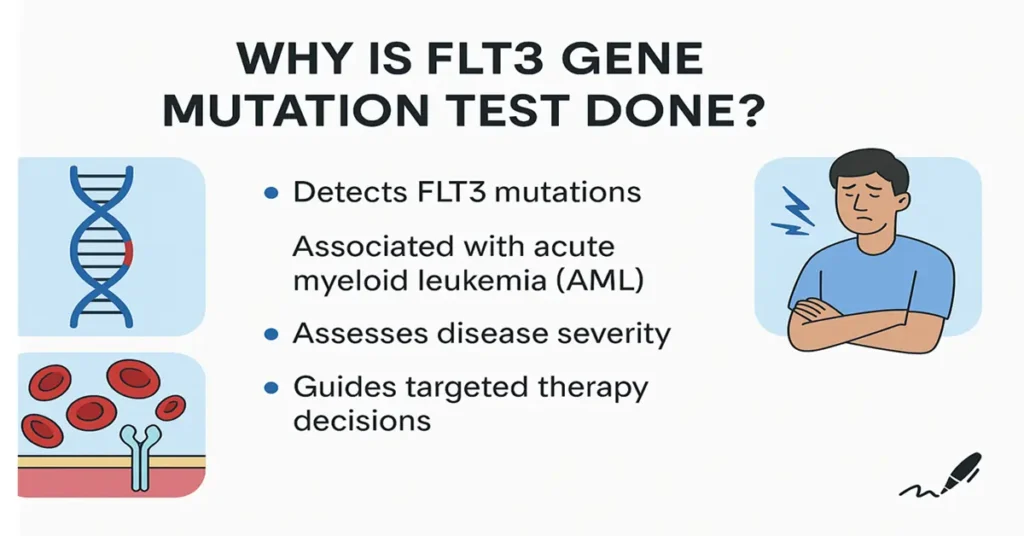
The FLT3 Gene Mutation Test is a specialized genetic investigation used to identify changes in the FLT3 (FMS-like Tyrosine Kinase 3) gene. This gene plays a key role in the normal growth and development of blood-forming cells, particularly early precursor cells in the bone marrow. Certain mutations in the FLT3 gene are strongly associated with acute myeloid leukemia (AML), a rapidly progressing blood cancer.
In clinical practice, this test helps doctors assess how aggressive the leukemia may be and how it is likely to behave. FLT3 mutation status is routinely used to support risk assessment and guide treatment planning, including decisions around targeted therapies. Because FLT3-related changes can drive faster disease progression, identifying these mutations early has important clinical value.
Where Is the FLT3 Gene Found in the Body?
The FLT3 gene is located on chromosome 13q12. It is mainly active in hematopoietic stem cells within the bone marrow. These stem cells are responsible for producing all major blood components, including red blood cells, white blood cells, and platelets.
The FLT3 gene codes for a receptor tyrosine kinase protein found on the surface of immature blood cells. This receptor sends growth and survival signals that regulate how these cells divide and mature. When mutations occur in the FLT3 gene, these signaling pathways become abnormal, leading to uncontrolled growth of immature blood cells.
Main Functions and Importance of the FLT3 Gene
The FLT3 gene and its associated protein have several essential roles in normal blood cell development.
1. Controls Growth of Early Blood Cells
FLT3 signaling helps regulate the multiplication of early blood-forming cells, ensuring that cell growth remains balanced and orderly.
2. Supports Normal Hematopoiesis
Hematopoiesis refers to the continuous process of blood cell formation. FLT3 contributes to maintaining stability in this process, particularly at early stages.
3. Prevents Abnormal Cell Proliferation
Under normal conditions, FLT3 signaling is tightly regulated. When mutations disrupt this control, immature cells may begin to multiply excessively, contributing to leukemia development.
4. Acts as an Important Biomarker
FLT3 mutation status is widely used in AML to help estimate disease severity, understand prognosis, and support treatment decisions. For this reason, FLT3 testing has become a standard component of AML diagnostic and risk-stratification workflows.
What Does a Low/Negative FLT3 Result Mean?
A low or negative FLT3 result indicates that no FLT3 mutation has been detected. This finding is generally considered a standard-risk feature in the context of AML.
Causes of Low/Negative FLT3 Levels
A negative result typically means that the FLT3 gene is functioning without detectable mutation. Neither internal tandem duplication (ITD) nor tyrosine kinase domain (TKD) mutations are present. In patients with AML, this suggests that the disease is not being driven by FLT3-related genetic changes.
Symptoms of Low/Negative Levels
A negative FLT3 result does not cause symptoms on its own. If AML is present, symptoms arise from the leukemia itself—such as reduced normal blood cell production—rather than from FLT3 gene status.
Common AML-related symptoms, which are not specific to FLT3, may include fatigue, fever, infections, weight loss, or bleeding tendencies.
What Does a High/Positive FLT3 Result Mean?
A positive FLT3 result means that a mutation has been detected in the gene. In AML, this finding is associated with a more aggressive disease pattern and a higher risk category.
Causes of High/Positive FLT3 Levels
Two main types of FLT3 mutations are identified in clinical testing.
1. FLT3-ITD (Internal Tandem Duplication)
This is the most common FLT3 mutation. It involves duplication of a segment of DNA within the gene, leading to continuous activation of the FLT3 receptor. This mutation is commonly associated with more aggressive disease behavior.
2. FLT3-TKD (Tyrosine Kinase Domain Mutation)
This mutation affects a specific region of the FLT3 protein involved in signal transmission. It alters how the receptor functions and may influence disease behavior and treatment response.
Both mutation types result in excessive signaling that promotes rapid growth of leukemia cells.
Symptoms of High/Positive FLT3 Levels
A positive FLT3 mutation does not produce unique symptoms by itself. Instead, it is associated with more severe or rapidly progressing AML.
Patients may experience pronounced fatigue, frequent infections, easy bruising or bleeding, bone pain, fever, and faster clinical deterioration. These features reflect the underlying leukemia rather than the genetic test result alone.
Reference Ranges
FLT3 testing is reported qualitatively rather than as a numeric range. Results are typically classified as negative, indicating no mutation detected, or positive, indicating the presence of an FLT3 mutation. In clinical interpretation, a negative result is associated with standard-risk AML, while a positive result supports a higher-risk classification and may influence treatment planning.
Sample Required for the FLT3 Gene Mutation Test
FLT3 mutation testing can be performed on two main types of samples.
1. Blood Sample (EDTA Tube)
Peripheral blood may be used, particularly when circulating leukemia cells are present. This approach is less invasive and often used during initial evaluation.
2. Bone Marrow Aspirate
Bone marrow samples provide more detailed and reliable genetic information and are commonly preferred at diagnosis and during follow-up assessments.
Test Preparation
Most patients do not require special preparation for FLT3 testing. It is important to inform the doctor about any medications being taken. When a bone marrow sample is planned, local anesthesia or sedation may be used. Any additional instructions, such as fasting for combined tests, should be followed as advised.
When to Consult a Doctor
Medical evaluation is recommended if symptoms such as persistent fatigue, frequent infections, unexplained bruising or bleeding, fever without a clear cause, bone pain, or unintentional weight loss are present.
Patients should also consult their doctor if an FLT3 test result is positive, if further clarification about AML risk is needed, or if guidance is required regarding treatment planning and available therapeutic options.
Important Word Explanations
- AML: Acute Myeloid Leukemia, a rapidly progressing blood cancer
- Hematopoiesis: The process of forming new blood cells
- Receptor Tyrosine Kinase: A signaling protein that controls cell growth and division
- Mutation: A change in the DNA sequence
- ITD: Internal Tandem Duplication, a type of FLT3 mutation
- TKD: Tyrosine Kinase Domain mutation
- Prognosis: An estimate of disease behavior and outcome
~END~
Related Posts
None found