
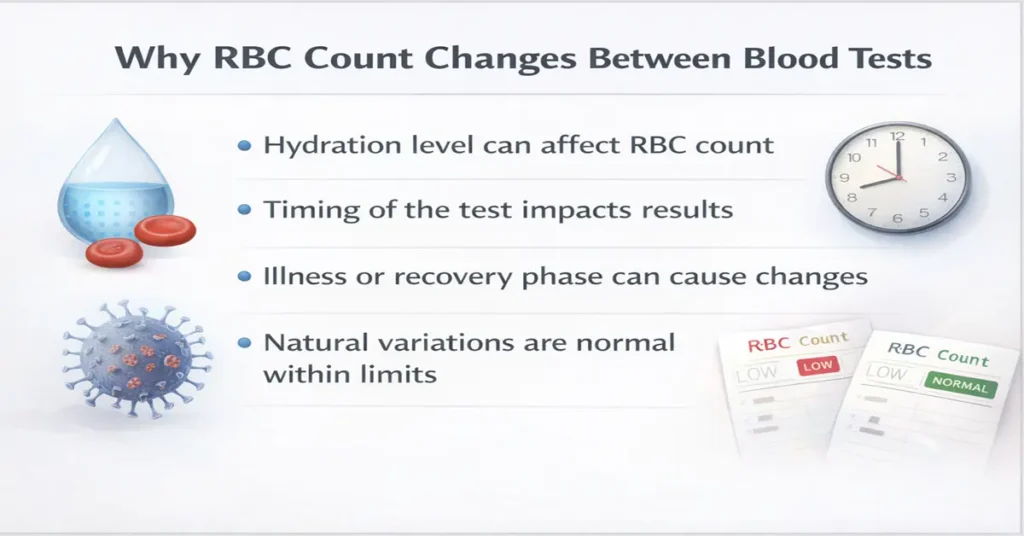
Why RBC Count Changes Between Blood Tests
A confusion I hear almost every day in OPD
Many patients come back with two blood reports in hand and say something like:
“Last time my RBC count was normal. This time it’s low… or high. Same lab, same test. Why is it changing?”
This confusion is very common. From more than 10 years of hospital and diagnostic lab experience, I can confidently say this:
a change in RBC count between blood tests is very often normal and expected, especially when the change is mild.
This article focuses only on why RBC count varies from one test to another, not on diseases, not on symptoms, and not on treatment. The aim is to help you understand how doctors and lab professionals interpret these changes in real life.
First, an important thing many people don’t realize
RBC count is not a fixed number like date of birth or blood group.
It is a dynamic value, which means it can change depending on:
- Body hydration
- Recent illness
- Physical activity
- Sample timing
- Lab-related factors
That is why two reports done days or weeks apart can look slightly different — even in healthy people.
The most common reason: hydration status
From daily lab experience, hydration is the biggest reason RBC count changes.
- When you are slightly dehydrated, blood becomes more concentrated
→ RBC count appears higher - When you are well hydrated, blood is more diluted
→ RBC count may appear lower
Many patients say:
“Test ke din pani kam piya tha.”
That alone can explain a noticeable difference between two reports.
This is also why doctors rarely panic over a small RBC fluctuation.
Timing of the blood test matters more than people think
RBC count can vary depending on when the sample is taken.
For example:
- Early morning, fasting, slightly dehydrated → RBC may look higher
- Afternoon, after meals and fluids → RBC may look lower
From lab practice, we often see:
Same person, same lab, different timing → different RBC number
This variation is physiological, not pathological.
Recent illness or recovery phase
Another very common reason for changing RBC values is recent illness, even mild ones.
After:
- Viral fever
- Cold or flu
- Minor infection
- Recovery from illness
The bone marrow may temporarily slow down or adjust RBC production.
During this phase:
- RBC count may drop slightly
- Then return to baseline in a few weeks
Clinically, doctors call this a transient change, and it usually corrects itself.
Physical activity before the test
Many people don’t realize this, but physical exertion before blood collection can affect RBC count.
- Heavy exercise
- Long walking
- Climbing stairs just before the test
These can temporarily shift fluid balance in the blood, leading to small RBC changes.
That is why labs advise:
“Test se pehle thoda rest kar lo.”
Lab analyzer and sample handling factors
From inside-the-lab experience, this is something patients rarely know.
RBC count depends on:
- Type of hematology analyzer
- Calibration timing
- Sample mixing quality
- Time gap between collection and testing
Even with good-quality labs, minor variations are normal and accepted clinically.
Doctors are trained to look at trends, not single numbers.
Borderline values often move in and out of range
If your RBC count is close to the lower or upper reference limit, it may:
- Appear “normal” in one report
- Appear “low” or “high” in another
This does not mean something new has gone wrong.
It simply means the value is hovering near the cutoff.
From OPD experience, this is one of the most common reasons patients worry unnecessarily.
Natural biological variation (often ignored)
Every human body has day-to-day biological variation.
Just like:
- Blood pressure varies
- Sugar levels fluctuate
RBC count also changes slightly from day to day.
This is normal physiology, not disease.
Clinically significant changes are usually:
- Large
- Persistent
- Associated with symptoms
Not small ups and downs.
How doctors actually interpret changing RBC counts
In real OPD practice, doctors do not compare reports line by line the way patients do.
They look at:
- Overall trend
- Hemoglobin stability
- Other CBC parameters
- Patient symptoms
If:
- Hemoglobin is stable
- No new symptoms
- Change is mild
Doctors often document:
“No clinically significant variation.”
This is why many reports are not even discussed in detail during follow-up visits.
When RBC variation is usually harmless
From long clinical experience, RBC changes are usually harmless when:
- The change is mild
- Hemoglobin remains stable
- Platelets and WBC are normal
- Patient feels well
In such cases, reassurance is the correct medical approach.
When doctors take RBC changes more seriously
Doctors pay closer attention when:
- RBC keeps changing progressively over multiple reports
- Hemoglobin also starts changing
- There are symptoms like fatigue or breathlessness
- Other blood parameters change together
Even then, the concern is based on the pattern, not a single report.
Should you repeat the test because RBC changed?
Repeat testing is usually advised when:
- The test was done during illness
- Hydration was poor
- Doctor wants to confirm a trend
Repeat testing is usually not needed when:
- Change is small
- Hemoglobin is stable
- You feel fine
From lab experience, unnecessary repeat tests often add more confusion than clarity.
A common patient mistake
Many patients:
- Compare two reports side by side
- Focus only on the highlighted RBC value
- Ignore context and clinical condition
As lab professionals, we often reassure patients by saying:
“Body ek machine nahi hai, numbers thode upar-neeche hote rehte hain.”
What changing RBC count does NOT automatically mean
A changing RBC count does not automatically indicate:
- Serious blood disease
- Bone marrow failure
- Cancer
- Internal bleeding
Those conditions show persistent, progressive changes with symptoms, not mild fluctuations.
Test Preparation
To reduce unnecessary variation in future tests:
- Drink adequate water before the test
- Avoid heavy exercise just before blood collection
- Try to give samples at a similar time each visit
- Inform the lab about recent illness or recovery
Consistent preparation gives more comparable results.
When to Consult a Doctor
Consult your doctor if:
- RBC changes are large and persistent
- You have symptoms like fatigue or breathlessness
- Hemoglobin also starts changing
- Doctor advises follow-up based on your history
Otherwise, mild RBC variation alone is usually not a cause for concern.
Important Word Explanations
RBC (Red Blood Cell): Cells that carry oxygen in blood.
CBC: Complete Blood Count test.
Hydration: Body water balance.
Analyzer: Machine that measures blood parameters.
Transient: Temporary change that resolves on its own.
People Also Ask
Is it normal for RBC count to change between tests?
Yes. Mild changes are very common and often normal.
Can dehydration change RBC count?
Yes. It is one of the most common reasons.
Should I worry if my RBC changed but I feel fine?
Usually no, especially if hemoglobin is stable.
How much change in RBC is acceptable?
Small variations around the normal range are usually acceptable clinically.
~END~