
What Is Alcohol Test
Why This Test Is Done
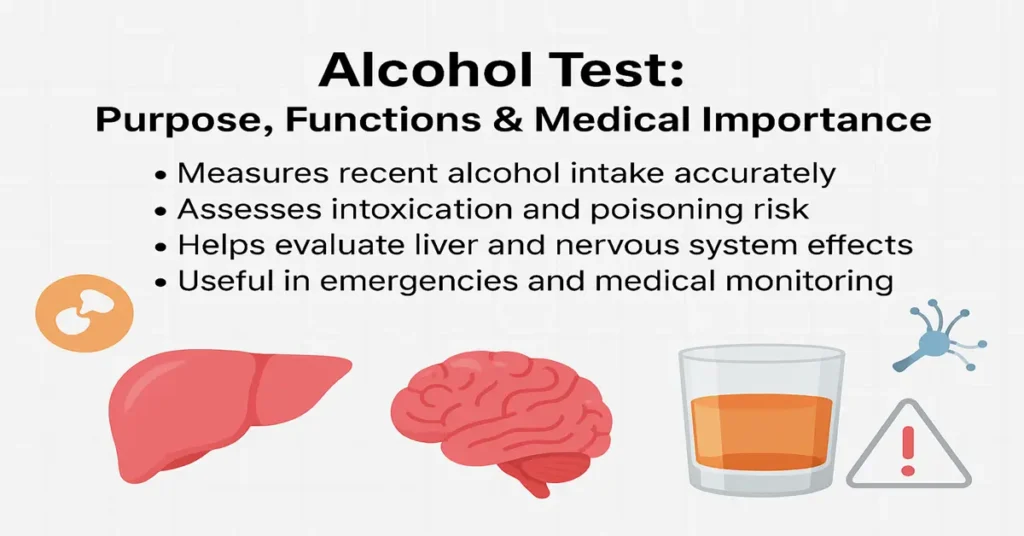
An alcohol test is used to measure the amount of alcohol present in the body at a specific point in time. In day-to-day clinical practice, doctors order this test to understand whether recent alcohol intake could be contributing to a patient’s symptoms or clinical condition.
In emergency rooms, the test is commonly used when someone presents with confusion, drowsiness, poor coordination, vomiting, altered behavior, or loss of consciousness. Clinically, this is where doctors pause and ask a simple but important question: are these symptoms due to alcohol, or is something else happening underneath, such as head injury, low blood sugar, stroke, or infection?
Alcohol testing is also used in trauma cases, before certain surgical procedures, during workplace or legal evaluations, and when monitoring individuals with known alcohol use problems. In patients with liver disease or unexplained metabolic disturbances, the test helps clarify whether alcohol exposure is playing a role.
Biological Role and Effects of Alcohol in the Body
Alcohol does not have a useful biological role in the body. Once consumed, it acts primarily as a central nervous system depressant. It is absorbed quickly from the stomach and small intestine into the bloodstream and then distributed to nearly all organs.
The liver is responsible for breaking down most of the alcohol through enzymes such as alcohol dehydrogenase and aldehyde dehydrogenase. This process happens at a relatively fixed speed. In routine lab practice, this is why drinking more or faster than the liver can handle leads to rising blood alcohol levels.
Alcohol affects brain chemicals that control judgment, coordination, mood, and alertness. It can also influence blood sugar levels, fluid balance, and heart rhythm. Because alcohol crosses the blood–brain barrier easily, even modest increases in blood levels can produce noticeable physical and behavioral changes.
Medical Importance of Measuring This Parameter
Measuring alcohol levels is medically important because alcohol can closely mimic or hide serious medical conditions. Slurred speech, poor balance, or altered consciousness may look like alcohol intoxication, but they can also be signs of stroke, head injury, or severe metabolic problems.
In emergency situations, knowing the alcohol level helps guide immediate care, such as airway protection, fluid management, and monitoring. Very high levels can suppress breathing and protective reflexes, making early recognition critical.
In people who drink regularly, alcohol testing also helps assess ongoing exposure and risk to organs such as the liver, brain, and heart. Over time, these results support counseling, treatment planning, and long-term follow-up.
Conditions Assessed Using This Test
The alcohol test itself does not diagnose a disease, but it plays a key role in identifying and managing several alcohol-related conditions. The most direct situation is acute alcohol intoxication, which can range from mild impairment to severe alcohol poisoning.
It supports evaluation of alcohol use disorder when combined with medical history, behavior patterns, and other laboratory findings. Repeatedly elevated levels in clinical settings often raise concern for harmful drinking habits.
Alcohol testing is also helpful when assessing complications linked to alcohol, such as low blood sugar, worsening liver disease, medication interactions, or unexplained neurological symptoms. In some clinical situations, it is used during pregnancy-related assessments, though routine testing is not standard.
Limitations of the Test
The alcohol test has important limitations that doctors keep in mind. It reflects only recent alcohol intake and does not show long-term drinking patterns by itself. A normal result does not rule out chronic alcohol use if the person has not consumed alcohol recently.
Results are influenced by timing, body weight, liver function, food intake, and individual metabolism. Two people can drink the same amount and show very different blood levels.
Breath and urine tests are useful for screening, but they are more prone to variation. Blood testing remains the most accurate method in medical settings. It is also important to remember that alcohol level does not always equal impairment, as tolerance varies widely.
Additional Information
Alcohol levels are usually reported as Blood Alcohol Concentration (BAC), expressed as a percentage or in milligrams per deciliter. Legal driving limits differ by region, but medical interpretation focuses on health impact rather than legality.
Alcohol interacts with many medications, including sedatives, painkillers, antidepressants, and diabetes drugs. In routine practice, even moderate alcohol levels can become risky when combined with these medicines.
For accurate interpretation, alcohol test results are always reviewed alongside symptoms, physical examination, and other laboratory findings.
Test Preparation
For planned testing, patients are usually advised to avoid alcohol for at least 24 hours unless the goal is to detect recent intake. It is important to inform the healthcare provider about all medications, supplements, and existing medical conditions, especially liver disease or diabetes.
No special fasting is required for an alcohol test unless it is combined with other blood investigations. In emergency situations, testing is done immediately without preparation.
When to See a Doctor
Medical attention is needed if there is confusion, repeated vomiting, severe drowsiness, breathing difficulty, seizures, or unresponsiveness after alcohol intake. These signs may indicate alcohol poisoning or another serious condition.
People who struggle to control drinking, experience withdrawal symptoms, or develop ongoing health problems related to alcohol should consult a doctor. Early medical support can prevent long-term damage.
Sample Type
Alcohol levels are most accurately measured using a blood sample taken from a vein. Breath analyzers and urine tests may be used in screening or legal contexts, but blood testing is considered the gold standard for clinical evaluation.
Important Word Explanations
Blood Alcohol Concentration (BAC): The amount of alcohol present in the blood at a given time.
Alcohol Dehydrogenase: A liver enzyme that helps break down alcohol.
Central Nervous System Depressant: A substance that slows brain and nerve activity.
Alcohol Intoxication: Impairment of physical and mental function due to alcohol intake.
Tolerance: Reduced response to alcohol after repeated exposure.
People Also Ask
Is a positive alcohol test always serious?
Not always. Mild elevations may cause temporary effects, but higher levels can be dangerous and need medical attention.
Can alcohol levels be temporary?
Yes. Alcohol levels rise and fall based on recent intake and usually decrease as the liver processes alcohol.
Does a normal result rule out alcohol problems?
No. A normal test only shows there was no recent alcohol intake, not long-term drinking habits.
When do doctors usually worry about alcohol levels?
When there are neurological symptoms, breathing problems, or signs of organ stress.
Is repeat testing common?
Yes. In hospitals, repeat tests are often done to monitor clearance and patient safety.
Do coffee or cold showers lower alcohol levels?
No. They may increase alertness but do not reduce alcohol in the blood.
~END~