
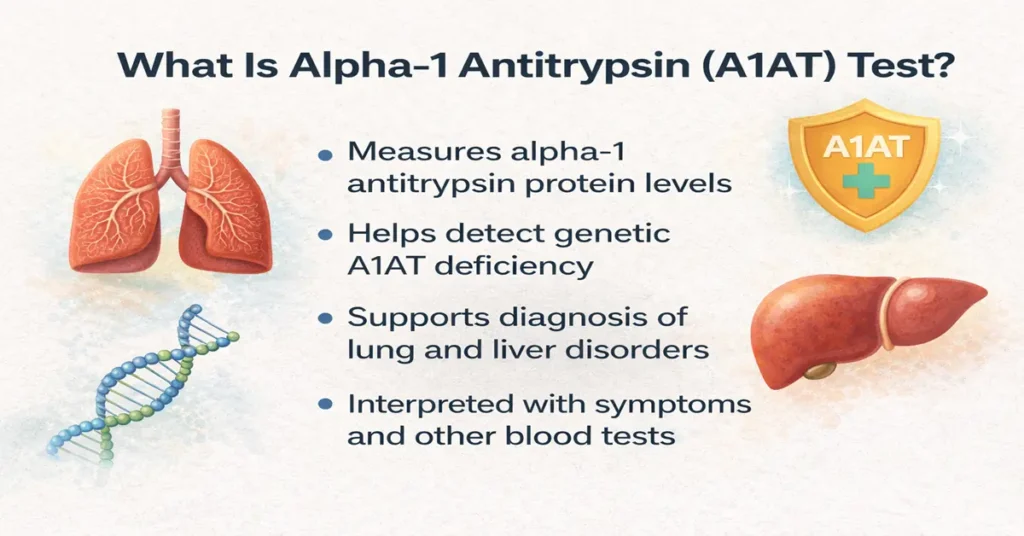
What Is Alpha-1 Antitrypsin (A1AT) Test
The Alpha-1 Antitrypsin (A1AT) test is a blood test used to measure the level of alpha-1 antitrypsin, a protective protein made mainly by the liver. In everyday clinical terms, this protein acts like a safety shield, especially for the lungs, protecting delicate tissues from damage caused by inflammatory enzymes released by white blood cells.
The A1AT test is important because abnormal levels—either low or high—can point toward underlying genetic conditions, liver-related problems, lung disease, or ongoing inflammation. In routine lab practice, this test is often requested when doctors feel that common explanations do not fully explain a patient’s symptoms or lab abnormalities.
Why This Test Is Done
Doctors usually order the A1AT test when lung or liver problems appear earlier than expected or do not follow the usual pattern. For example, when a relatively young person develops chronic breathing issues without a strong smoking history, this test often comes into consideration.
It is also used when liver function tests are abnormal and no clear cause is found. Because alpha-1 antitrypsin is produced in the liver, problems with its production or release can lead to liver injury, sometimes starting as early as infancy.
In some situations, the test helps interpret inflammatory states. Since A1AT behaves as an acute-phase protein, its level can rise during infections or inflammation. Clinically, this helps doctors decide whether inflammation is influencing other test results.
Family history matters as well. If close relatives have alpha-1 antitrypsin deficiency, unexplained lung disease, or chronic liver disease, testing helps identify individuals who may be affected or at risk, even before symptoms become obvious.
Biological Role and Functions of Alpha-1 Antitrypsin
Alpha-1 antitrypsin belongs to a group of proteins known as protease inhibitors. Its main job is to control enzymes like neutrophil elastase. These enzymes are useful for fighting infections, but if left unchecked, they can damage healthy tissues.
In the lungs, A1AT protects the elastic structure of air sacs. Without enough protection, lung tissue becomes vulnerable and can gradually lose its ability to stretch and recoil properly, leading to conditions such as emphysema.
In the liver, A1AT is produced and then released into the bloodstream. In certain genetic conditions, the protein is formed incorrectly and gets trapped inside liver cells. Over time, this buildup can injure the liver.
Beyond lungs and liver, A1AT also plays a general role in controlling inflammation. During infections or stress, its levels naturally rise as part of the body’s defense system.
Medical Importance of Measuring This Parameter
Measuring alpha-1 antitrypsin levels is clinically important for both diagnosis and long-term management. One of the main reasons for testing is to identify alpha-1 antitrypsin deficiency, a genetic condition that can affect both the lungs and the liver.
From a practical point of view, early detection allows doctors to monitor patients more closely, guide lifestyle decisions, and plan appropriate follow-up. In lung disease, knowing the A1AT status helps explain why symptoms may be severe or appear early.
The test also helps distinguish between genetic deficiency and changes caused by inflammation or liver disease. For example, a high A1AT level often signals inflammation rather than a primary protein disorder.
Overall, the test supports accurate diagnosis and helps doctors decide what further investigations, if any, are needed.
Conditions Diagnosed Using This Test
The A1AT test is most commonly linked with diagnosing alpha-1 antitrypsin deficiency. This condition can lead to chronic obstructive pulmonary disease, emphysema, bronchiectasis, and various forms of liver disease.
In infants and children, low A1AT levels may explain prolonged jaundice, hepatitis, or unexplained liver dysfunction. In adults, it may be associated with chronic liver disease, cirrhosis, or, in rare cases, liver cancer.
The test is also useful when evaluating chronic lung conditions that progress faster than expected or start at an unusually young age.
High A1AT levels, on the other hand, usually point toward infection, inflammation, tissue injury, or autoimmune activity. In such cases, the test supports broader clinical assessment rather than serving as a diagnosis on its own.
Limitations of the Test
Like many laboratory tests, the A1AT test has limitations. Because alpha-1 antitrypsin is an acute-phase reactant, its level can rise during infections or inflammatory states. This can temporarily mask an underlying deficiency.
A normal or even high level does not always rule out a genetic problem. Some people have normal quantities of A1AT, but the protein does not function properly. In such cases, additional tests like phenotype or genotype analysis are needed.
The test also does not measure disease severity. Doctors usually combine it with imaging, lung function tests, liver studies, and clinical findings to form a complete picture.
Additional Information
In routine practice, the A1AT test is rarely used alone. It is often ordered alongside liver function tests, inflammatory markers, and respiratory evaluations.
If deficiency is confirmed, family screening may be recommended. Repeat testing is sometimes done when initial results are influenced by acute illness.
Understanding results early helps patients avoid lung irritants, stay alert to liver health, and follow appropriate medical advice over time.
Test Preparation
The alpha-1 antitrypsin test usually does not require special preparation. Fasting is not necessary unless other blood tests are being done at the same time.
Patients should inform their doctor about ongoing infections, inflammation, or recent illness, as these can affect interpretation of results.
Following laboratory instructions ensures reliable and meaningful results.
When to See a Doctor
Medical evaluation is advised if there is unexplained shortness of breath, chronic cough, wheezing, recurrent chest infections, or abnormal liver tests without a clear cause.
Infants with persistent jaundice or poor growth should be evaluated promptly. Adults with early-onset lung disease or a family history of A1AT-related conditions should also seek medical advice.
Sample Type
The A1AT test is performed on a blood sample, usually drawn from a vein in the arm. The sample is then analyzed in the laboratory to measure alpha-1 antitrypsin concentration. Additional samples may be taken if genetic or confirmatory testing is required.
Important Word Explanations
Alpha-1 Antitrypsin (A1AT): A protective protein that helps prevent tissue damage during inflammation
Protease inhibitor: A substance that blocks enzymes capable of breaking down proteins
Emphysema: A lung condition where air sacs are damaged, leading to breathing difficulty
Acute-phase reactant: A protein whose level changes during inflammation or infection
Genetic disorder: A condition caused by changes in genes passed from parents to children
People Also Ask
Is the A1AT test serious?
The test itself is simple. Its importance depends on the result and the symptoms being investigated.
Can A1AT levels change temporarily?
Yes. Levels can rise during infections or inflammation and may return to baseline afterward.
Does an abnormal A1AT level always mean disease?
Not always. Sometimes it reflects temporary inflammation rather than a long-term condition.
When do doctors usually recommend this test?
When lung or liver problems appear early, progress unusually fast, or have no clear cause.
Is repeat testing common for A1AT?
Yes. Repeat testing is often done if results may have been affected by illness.
Can someone have symptoms with normal A1AT levels?
Yes. In some cases, the protein level is normal but its function is abnormal, requiring further tests.
~END~