
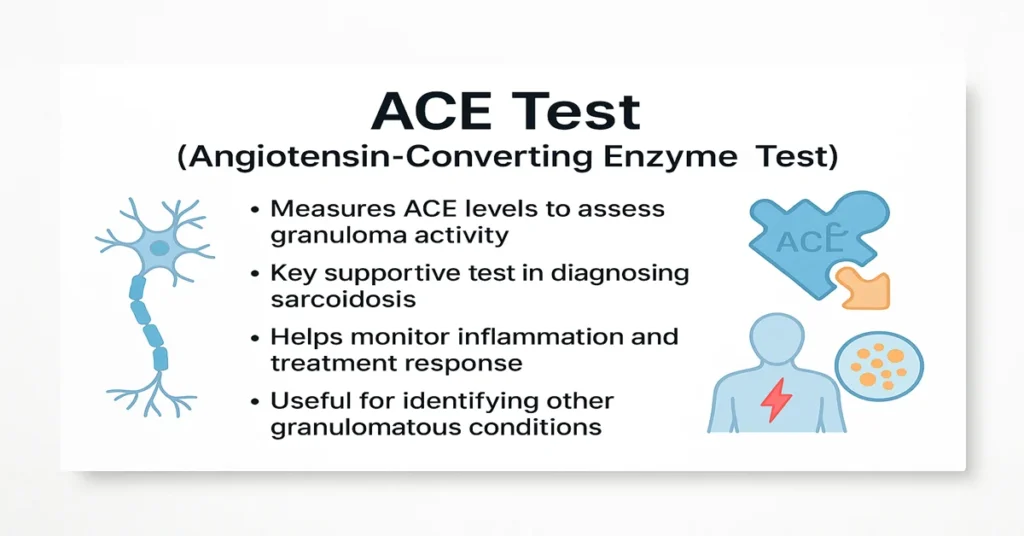
What Is ACE Test
Why This Test Is Done
The Angiotensin-Converting Enzyme (ACE) test is a blood test mainly used to support the evaluation of diseases in which granulomas form, most commonly sarcoidosis. ACE is produced in several tissues of the body, particularly in the lungs and in the lining of blood vessels. When granulomas develop during certain inflammatory or immune-related conditions, the cells within these granulomas release higher amounts of ACE into the blood.
In real clinical practice, this test is not used as a general screening test. Doctors usually request it when a patient has symptoms or imaging findings that suggest granulomatous disease, such as unexplained lung changes, enlarged lymph nodes, persistent cough, or multi-system inflammation. Because ACE levels can vary from person to person, the result is always interpreted alongside clinical findings, imaging studies, and other laboratory tests. On its own, ACE does not confirm a diagnosis, but it can add useful context.
Biological Role and Functions of ACE
ACE is part of the renin–angiotensin system, which helps regulate blood pressure, fluid balance, and vascular tone. Its primary biological function is converting angiotensin I into angiotensin II, a molecule that narrows blood vessels and raises blood pressure. ACE also plays a role in inflammation and immune regulation.
Under normal conditions, ACE is present in organs such as the lungs, kidneys, adrenal glands, and blood vessels. However, when granulomas form, additional ACE is produced by activated immune cells. This explains why ACE levels may rise in granulomatous diseases. Clinically, the test reflects immune activity rather than blood pressure control, which is an important distinction when explaining results to patients.
Medical Importance of Measuring This Parameter
The main value of ACE testing lies in its supportive role, particularly in sarcoidosis. Sarcoidosis can affect multiple organs, including the lungs, lymph nodes, skin, eyes, and liver. Active granulomas in these organs may release ACE, leading to elevated blood levels.
Doctors use the ACE test in several practical situations:
Supporting diagnosis
When symptoms, imaging, and clinical findings suggest sarcoidosis, an elevated ACE level can strengthen suspicion, though it is never used alone to confirm the disease.
Monitoring disease activity
Once sarcoidosis or another granulomatous condition is diagnosed, ACE levels may be followed over time. Rising values may suggest increasing inflammatory activity, while falling values may indicate improvement.
Assessing response to treatment
In patients receiving treatment, especially steroids or other anti-inflammatory therapies, decreasing ACE levels often reflect reduced granuloma activity. Clinically, this helps doctors judge whether treatment is effective.
Evaluating other inflammatory conditions
ACE may also be elevated in other granulomatous or inflammatory diseases. While it is not a primary diagnostic tool for these conditions, an abnormal value may prompt further evaluation.
Conditions Diagnosed Using This Test
The ACE test does not diagnose disease on its own. Instead, it supports clinical decision-making when combined with other findings.
Sarcoidosis
This is the condition most strongly associated with elevated ACE. Many patients with active disease show increased levels, but not all. Normal ACE does not exclude sarcoidosis.
Tuberculosis and other chronic infections
Some chronic infections that form granulomas may raise ACE levels, though results are variable.
Fungal or granulomatous infections
Certain fungal infections can also increase ACE due to immune activation.
Autoimmune or inflammatory disorders
Chronic inflammation in some autoimmune conditions may mildly raise ACE levels.
Liver disease
Because the liver helps clear ACE from the blood, certain liver disorders may cause modest elevations.
Genetic variation
Some individuals naturally have higher ACE levels without any disease. Stable values over time and lack of symptoms help differentiate this from pathological elevation.
Limitations of the Test
Understanding the limitations of ACE testing is essential to avoid over-interpretation.
ACE is not specific to sarcoidosis. Many conditions can raise ACE levels, and the test cannot confirm a diagnosis by itself.
A normal ACE level does not rule out sarcoidosis or other granulomatous disease. Some patients have normal values even with active disease.
Age and genetics influence ACE levels. Children and adolescents often have higher values than adults, and some adults naturally have higher baseline levels.
Medications can affect results. Corticosteroids may lower ACE levels, sometimes masking disease activity. This is why trends over time matter more than a single value.
Laboratory methods vary. Different labs may report slightly different ranges, so comparison should ideally be done using the same laboratory.
Additional Information
In routine practice, doctors often rely on serial ACE measurements rather than a single test. Watching how levels change over weeks or months gives more meaningful information about disease activity. ACE testing is often combined with imaging, calcium levels, liver tests, and other markers depending on the suspected condition.
ACE should always be viewed as a supportive marker that adds to the overall clinical picture, not as a standalone answer.
Test Preparation
No special preparation is usually required for an ACE test. Patients can eat and drink normally unless other tests are being done at the same time. It is important to inform the doctor about ongoing medications, especially steroids. Adequate hydration is helpful but does not directly change ACE levels.
When to See a Doctor
Medical review is advised if ACE levels are abnormal and symptoms are present, such as persistent cough, breathlessness, unexplained fatigue, skin changes, eye symptoms, or swollen lymph nodes. Patients already diagnosed with sarcoidosis or similar conditions should follow their doctor’s advice regarding repeat testing and follow-up.
Urgent evaluation is needed if breathing difficulty, vision changes, or neurological symptoms develop.
Sample Type
The ACE test is performed on a blood sample drawn from a vein in the arm. The result is interpreted using the reference range provided by the laboratory that performed the test.
Important Word Explanations
ACE (Angiotensin-Converting Enzyme): An enzyme involved in blood pressure regulation and immune activity.
Granuloma: A cluster of immune cells formed during chronic inflammation.
Sarcoidosis: A multi-system inflammatory disease characterized by granuloma formation.
ACE activity: The measurable level of ACE enzyme in the blood.
Autoimmune disease: A condition in which the immune system reacts against the body’s own tissues.
People Also Ask
Is a high ACE level always serious?
Not necessarily. It depends on symptoms, clinical findings, and whether the elevation persists.
Can ACE levels be temporarily high?
Yes. Infections, inflammation, or temporary immune activation can cause short-term increases.
Does a normal ACE level rule out sarcoidosis?
No. Some patients with sarcoidosis have normal ACE levels.
When do doctors usually worry about ACE results?
When levels remain consistently high and match clinical or imaging findings.
Is repeat ACE testing common?
Yes. Doctors often repeat the test to monitor trends rather than relying on a single result.
~END~