
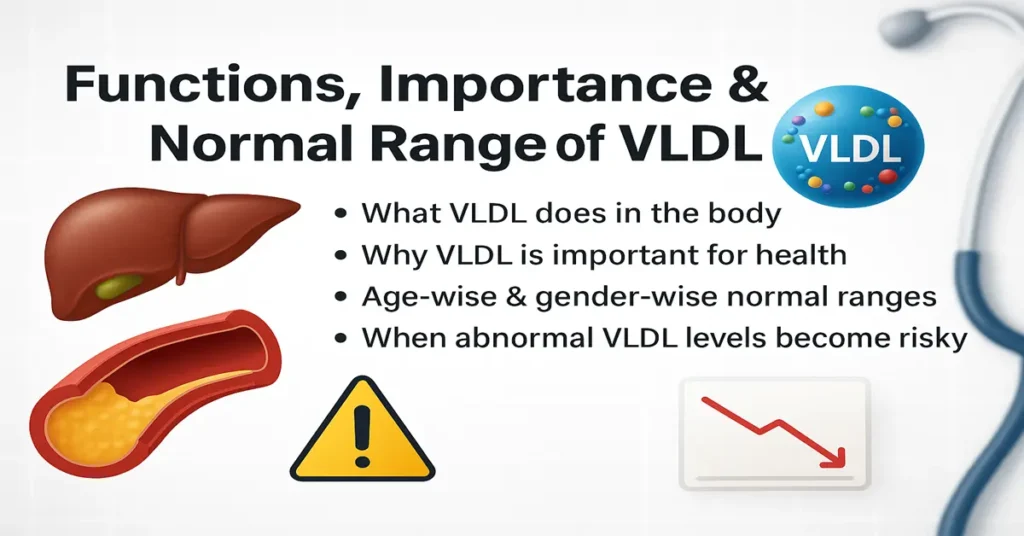
Functions, Importance & Normal Range of VLDL (Very Low-Density Lipoprotein)
VLDL (Very Low-Density Lipoprotein) is a lipoprotein produced by the liver. Its primary role is to transport triglycerides—a major form of fat—from the liver into the bloodstream, where they are delivered to muscles for energy use and to fat tissue for storage. Although LDL and HDL are discussed more often, VLDL plays a central role in lipid balance and metabolic health and is closely linked with triglyceride levels.
In routine lab practice, VLDL is rarely looked at in isolation. It is usually interpreted alongside triglycerides, LDL, HDL, and the patient’s metabolic profile. Balanced VLDL levels are important. High levels signal excess triglyceride circulation and higher cardiovascular risk, while very low levels may point toward nutritional issues, absorption problems, or reduced liver production. This article explains what VLDL does, why it matters, and how its normal range is interpreted across different groups.
What VLDL Does in the Body
VLDL is synthesized in the liver and released into the bloodstream as a triglyceride-rich particle.
Transport of triglycerides
VLDL’s main function is to carry triglycerides to tissues. Muscles use these fats as a steady energy source, while fat cells store them for later needs. This system helps maintain energy availability between meals and during prolonged activity.
Conversion into other lipoproteins
As VLDL releases triglycerides, it gradually becomes IDL (Intermediate-Density Lipoprotein) and then LDL. Clinically, this is why high VLDL often goes hand in hand with rising LDL over time.
Support for energy metabolism
Triglycerides delivered by VLDL provide long-lasting energy, especially during fasting, exercise, or periods of increased demand.
Prevention of liver fat overload
By exporting triglycerides from the liver, VLDL helps prevent excess fat accumulation within liver cells. When this process is disturbed, fatty liver can develop.
Why VLDL Is Important
VLDL is often labeled negatively because of its link with triglycerides, but the body does require it in normal amounts.
Energy delivery to tissues
VLDL ensures that fats produced or packaged in the liver reach tissues that need them, keeping overall energy balance stable.
Hormone-related support
Fat transport is essential for hormone synthesis. Triglycerides and cholesterol handled through VLDL pathways support normal hormonal function.
Cell structure and metabolism
Lipid transport systems, including VLDL, help maintain healthy cell membranes and metabolic processes.
Influence on future cholesterol levels
Because VLDL eventually becomes LDL, its level influences long-term cholesterol patterns and cardiovascular risk.
Role of VLDL in the Body
VLDL participates in several interconnected metabolic pathways.
Fat transport and storage
VLDL moves triglycerides from the liver to storage and usage sites, helping stabilize blood energy supply.
Liver lipid regulation
Adequate VLDL production allows the liver to offload excess triglycerides. Very low VLDL may sometimes reflect reduced liver output or inadequate fat availability.
Formation of LDL
VLDL is the precursor to LDL. This conversion explains why elevated triglycerides often lead to higher LDL over time.
Cardiovascular interaction
Triglyceride-rich VLDL particles can irritate vessel walls when present in excess, contributing to plaque development.
Interaction with HDL
HDL helps remove excess lipids from circulating particles like VLDL. A healthy balance between HDL and VLDL supports vascular protection.
Normal VLDL Levels (General Range)
VLDL is usually calculated from triglyceride values rather than measured directly.
General reference range
Normal: 5–30 mg/dL
Borderline high: 30–40 mg/dL
High: > 40 mg/dL
Very high: > 50 mg/dL
Very low VLDL (< 5 mg/dL) is uncommon and may need clinical correlation.
Age-Wise Normal VLDL Levels
VLDL values do not change sharply with age, but metabolism influences average levels.
Children (2–10 years): 5–20 mg/dL
Adolescents (11–18 years): 5–25 mg/dL
Adults (19–50 years): 5–30 mg/dL
Older adults (50+ years): 5–35 mg/dL
Slight increases in later life are commonly seen due to slower fat metabolism.
Gender-Wise Normal VLDL Levels
Hormonal differences influence triglyceride handling and VLDL levels.
Men: 5–30 mg/dL, with a higher tendency for elevation due to central fat distribution
Women: 5–25 mg/dL before menopause; values may rise after menopause and approach male ranges
VLDL Levels During Pregnancy
Pregnancy brings physiological changes in lipid metabolism to support fetal growth.
First trimester: 5–25 mg/dL
Second trimester: often rises to 20–40 mg/dL
Third trimester: may reach 30–50 mg/dL
These changes are expected and usually normalize after delivery.
When Abnormal VLDL Levels Become Risky
High VLDL (> 40 mg/dL)
Typically reflects high triglycerides and is associated with increased risk of heart disease, stroke, fatty liver, insulin resistance, and metabolic syndrome.
Very high VLDL (> 50 mg/dL)
Significantly raises the risk of pancreatitis and advanced fatty liver disease.
Very low VLDL (< 5 mg/dL)
May be seen with malnutrition, malabsorption, liver disorders, overactive thyroid, or chronic illness and should be evaluated in context.
What the VLDL Test Helps Detect
VLDL values help clinicians assess triglyceride-related cardiovascular risk, metabolic health, insulin resistance, liver fat handling, and response to lifestyle or medication changes. It is usually interpreted as part of a complete lipid profile.
Test Preparation
For accurate results, fasting for 9–12 hours is often advised when triglycerides and VLDL are assessed. Adequate hydration is important. Alcohol should be avoided for 24–48 hours, and heavy exercise should be skipped on the testing day. Regular diet should be maintained for a few days before testing unless advised otherwise.
When to Consult a Doctor
Medical advice is recommended if VLDL remains consistently above 40 mg/dL, triglycerides are elevated, or if there are symptoms such as chest discomfort, breathlessness, abdominal pain, or signs of fatty liver. People with diabetes, thyroid disorders, or liver disease benefit from early evaluation.
Important Word Explanations
Triglycerides: Fats used as a major energy source
Lipoprotein: A particle that transports fats through the blood
Pancreatitis: Inflammation of the pancreas due to very high triglycerides
Insulin resistance: Reduced response of cells to insulin
Fatty liver: Excess fat accumulation in the liver
People Also Ask
Is high VLDL dangerous?
High VLDL reflects high triglycerides. Persistent elevation increases cardiovascular and metabolic risk.
Can VLDL levels change temporarily?
Yes. Recent meals, alcohol intake, illness, or dehydration can temporarily alter VLDL values.
Does abnormal VLDL always mean heart disease?
No. It often indicates metabolic imbalance, but long-term elevation increases heart risk.
When do doctors worry about VLDL levels?
Concern rises when VLDL stays high on repeat tests or is associated with high triglycerides.
Is repeat testing common for VLDL?
Yes. Repeat testing helps confirm whether changes are temporary or persistent.
Can VLDL return to normal naturally?
In many cases, yes. Improving metabolic balance often normalizes VLDL levels over time.
~END~