
Overview
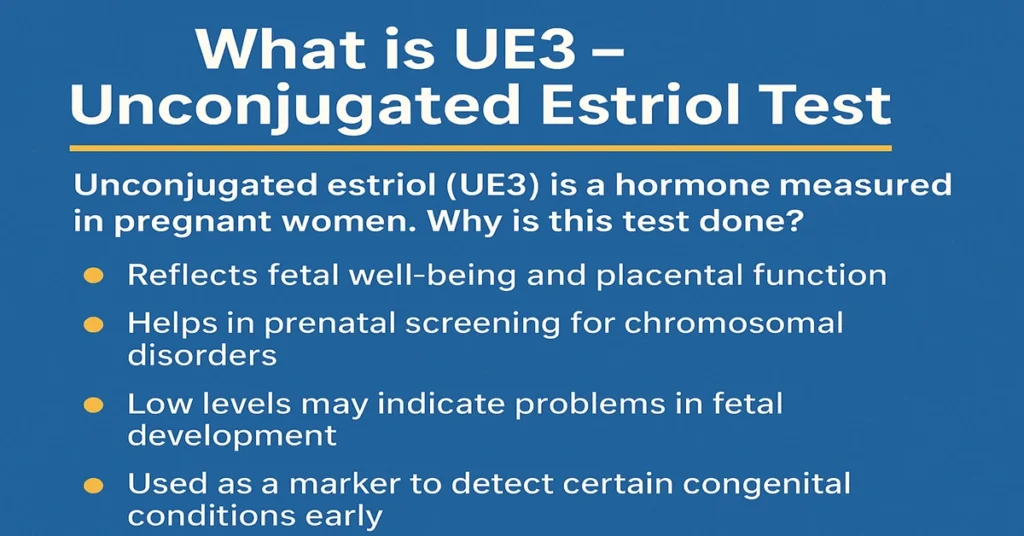
The UE3 (Unconjugated Estriol) Test measures the level of unconjugated estriol, a naturally occurring estrogen that becomes especially important during pregnancy. Estriol is one of the three main estrogen hormones, but unlike the others, its production during pregnancy depends on close cooperation between the fetus and the placenta. Because of this, UE3 serves as a useful indicator of how well this fetal–placental unit is functioning.
In routine practice, the UE3 test is most often included in the Triple Test (AFP, hCG, uE3) or the Quadruple Test (AFP, hCG, uE3, inhibin A) performed during the second trimester, usually between 15 and 20 weeks of gestation. The result helps assess the statistical risk of certain chromosomal conditions, such as Down syndrome (trisomy 21) and Edwards syndrome (trisomy 18), and also provides indirect information about fetal growth and placental health.
What is the UE3 – Unconjugated Estriol Test?
Unconjugated estriol refers to the free, biologically active form of estriol circulating in the mother’s blood during pregnancy. Its level reflects a combination of fetal hormone production, fetal liver processing, and placental conversion.
Because estriol synthesis relies on these multiple steps, UE3 acts as a sensitive marker of overall fetal development and placental function. Clinicians use it as part of prenatal screening rather than as a standalone diagnostic test. An abnormal value does not confirm a condition by itself, but it helps identify pregnancies that may benefit from closer monitoring or further evaluation.
Where is UE3 Produced in the Body?
Estriol production during pregnancy is a coordinated process involving several organs.
First, the fetal adrenal glands produce hormone precursors, mainly DHEA-S. These precursors are then processed by the fetal liver into intermediate forms. Finally, the placenta converts these substances into estriol, which enters the mother’s circulation and can be measured in her blood.
Outside pregnancy, only very small amounts of estriol are produced by the ovaries and adrenal glands. These levels are low and do not carry the same clinical significance as they do during pregnancy.
Main Functions and Importance of UE3
Unconjugated estriol is valued mainly as a reflection of fetal–placental well-being. Because its production depends on several fetal organs, reduced levels can signal that one or more of these steps is not functioning optimally.
As part of second-trimester screening, UE3 contributes to calculating the estimated risk of chromosomal abnormalities such as trisomy 21 and trisomy 18. When combined with other markers, it improves the overall accuracy of prenatal risk assessment.
UE3 levels also provide indirect insight into placental performance. Persistently low values may suggest reduced hormone conversion or placental stress, prompting clinicians to look more closely at fetal growth and pregnancy progress.
Causes of Low UE3 Levels
Lower-than-expected UE3 levels usually reflect reduced estriol production somewhere along the fetal–placental pathway. This pattern is commonly seen in certain chromosomal conditions, including Down syndrome and Edwards syndrome, where low estriol is a recognized screening marker.
Reduced levels may also be associated with impaired placental function, disturbances in fetal hormone metabolism, or, in more severe situations, loss of fetal viability. Rare inherited metabolic conditions affecting steroid synthesis can also lead to markedly low UE3 values.
Symptoms of Low UE3 Levels
Low UE3 levels do not cause symptoms in the mother. Instead, they act as a laboratory signal that may be linked with pregnancy-related concerns. These may include reduced fetal growth, decreased fetal movements, or abnormal findings on ultrasound. Any such result is interpreted carefully alongside gestational age, ultrasound findings, and other screening markers.
Causes of High UE3 Levels
Higher UE3 levels are usually less concerning. They are commonly seen in multiple pregnancies, where more than one fetus and placenta contribute to hormone production. Larger fetuses and advancing gestational age are also associated with naturally higher estriol levels.
In most cases, elevated UE3 reflects a normally progressing pregnancy rather than a pathological condition.
Symptoms of High UE3 Levels
High UE3 levels themselves do not produce symptoms. They are typically viewed as a normal variation related to gestational age, fetal size, or multiple gestation and rarely require further investigation on their own.
Reference Ranges
Maternal serum UE3 levels rise steadily throughout pregnancy. Approximate values may include:
- Around 15 weeks: about 0.3–0.6 ng/mL
- Around 20 weeks: about 1.0–3.5 ng/mL
- Around 30 weeks: about 10–15 ng/mL
- Near term: about 25–28 ng/mL
These ranges vary with gestational age, laboratory methods, and individual pregnancy factors. For this reason, results are always interpreted in relation to accurate dating and other screening parameters.
Sample Type
The UE3 test is most commonly performed on a maternal blood sample, using serum. Although estriol can also be measured in urine, blood testing is preferred for prenatal screening programs.
Test Preparation
No fasting is required before the test. Accurate information about gestational age is essential, as interpretation depends heavily on the week of pregnancy. It is also important to inform the doctor about multiple pregnancies, diabetes, or the use of hormonal medications, as these factors can influence result interpretation.
When to Consult a Doctor
Medical advice is recommended if UE3 levels are significantly lower than expected or if combined screening results indicate increased risk. Consultation is also important when ultrasound findings are abnormal or when fetal movements decrease.
Urgent medical attention is required if there is severe abdominal pain, vaginal bleeding, leakage of fluid, or a sudden absence of fetal movement, regardless of UE3 results.
Important Word Explanations
- UE3: Unconjugated estriol, an estrogen measured during pregnancy.
- Triple Test: Prenatal screening using AFP, hCG, and uE3.
- Quad Test: Screening using AFP, hCG, uE3, and inhibin A.
- Chromosomal abnormalities: Conditions caused by changes in chromosome number or structure.
- Placental insufficiency: Reduced ability of the placenta to support the fetus.
- Neural tube defects: Developmental defects of the brain or spinal cord.
~END~
Related Posts
None found