
TSH (Thyroid Stimulating Hormone) Test – Complete, Easy-to-Understand Guide
Introduction
The TSH (Thyroid Stimulating Hormone) test is one of the most commonly used and clinically important blood tests for assessing thyroid function. Although the thyroid gland itself is small and located at the front of the neck, it influences nearly every major system in the body. Metabolism, energy levels, heart rate, body temperature, digestion, and even emotional balance are all closely tied to thyroid activity.
Because thyroid imbalance is both common and often subtle in its early stages, the TSH test is usually the first investigation doctors rely on when thyroid disease is suspected. It is simple to perform, widely available, and provides a reliable overview of how the thyroid system is responding to the body’s needs.
What is TSH?
TSH stands for Thyroid Stimulating Hormone. It is produced by the pituitary gland, a small but vital gland located at the base of the brain. TSH does not act directly on body tissues. Instead, it serves as a control signal that tells the thyroid gland how much hormone to produce.
The pituitary constantly monitors circulating levels of thyroid hormones — mainly T3 (Triiodothyronine) and T4 (Thyroxine). When these hormone levels fall, the pituitary increases TSH release to stimulate the thyroid. When thyroid hormone levels rise, TSH secretion is reduced. This continuous adjustment helps keep thyroid hormone levels stable.
The TSH test measures how strongly the pituitary is signaling the thyroid, which is why it is such a sensitive indicator of thyroid function.
Where is TSH Produced in the Body?
TSH is produced exclusively in the pituitary gland. Its release is governed by a tightly regulated feedback loop between the pituitary and the thyroid.
When blood levels of T3 and T4 decrease, the pituitary responds by releasing more TSH. When T3 and T4 levels increase, TSH production is suppressed. This feedback mechanism works much like a thermostat, automatically adjusting hormone output to maintain balance.
Because of this relationship, changes in TSH often appear before changes in thyroid hormone levels become obvious, making it a valuable early marker of thyroid dysfunction.
Functions and Importance of TSH
TSH acts as the central regulator of the thyroid system. Its role is indirect but essential, as it controls how much thyroid hormone is produced and released.
By stimulating the thyroid gland, TSH ensures adequate production of T3 and T4 to support normal metabolic activity. Through this control, TSH influences energy use, body temperature, heart rate, mental alertness, and overall metabolic stability.
TSH also plays a role in growth and development, particularly during childhood, by supporting appropriate thyroid hormone availability. In adults, balanced TSH activity helps maintain cardiovascular function, cognitive performance, and emotional well-being.
Clinically, TSH serves as the most reliable first-line marker for identifying both underactive and overactive thyroid states.
Causes of Low TSH Levels
Low TSH levels usually reflect a situation where circulating thyroid hormones are relatively high. In response, the pituitary reduces TSH output to limit further thyroid hormone production.
Common Causes
Low TSH is most often associated with hyperthyroid states, where the thyroid gland produces excess hormone. It may also be seen when thyroid hormone intake is higher than required, or when pituitary signaling is impaired. In early pregnancy, temporary suppression of TSH can occur as part of normal hormonal adaptation.
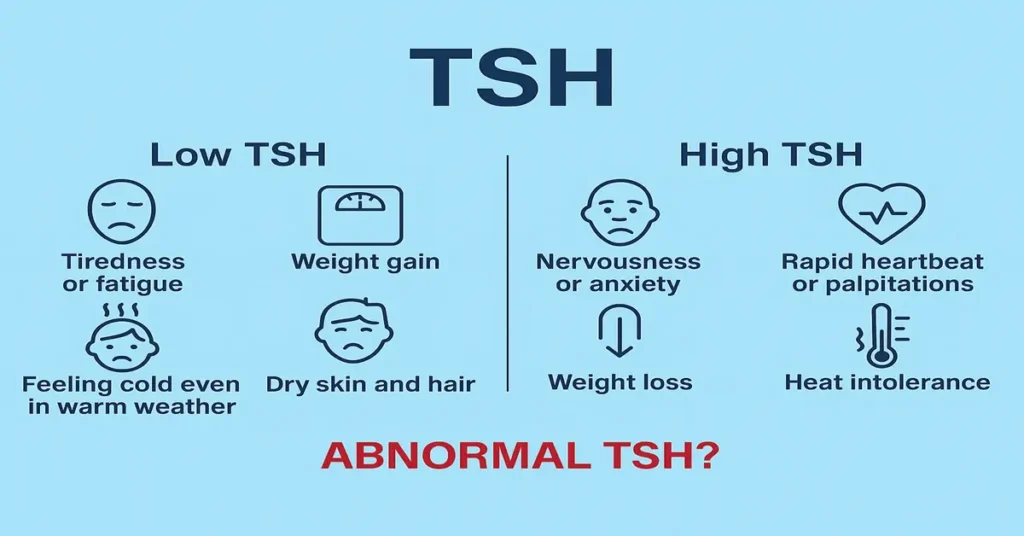
Symptoms of Low TSH (Usually Due to High Thyroid Hormones)
When TSH is suppressed and thyroid hormone levels are elevated, the body tends to operate at an accelerated pace.
Individuals may experience nervousness, restlessness, increased heart rate, heat intolerance, unintended weight loss, sleep disturbance, and increased bowel activity. Muscle weakness and a sense of internal agitation are also common. These symptoms reflect heightened metabolic activity rather than the low TSH itself.
Causes of High TSH Levels
High TSH levels usually indicate that the thyroid gland is not producing enough hormone to meet the body’s demands. The pituitary compensates by increasing TSH secretion in an attempt to stimulate the thyroid.
Common Causes
This pattern is most commonly seen in hypothyroidism, including autoimmune-related thyroid failure. It may also occur after thyroid surgery or radiation, or when thyroid hormone replacement is insufficient. Less commonly, pituitary-related causes can affect TSH regulation.
Symptoms of High TSH (Usually Due to Low Thyroid Hormones)
When TSH is elevated and thyroid hormone levels are low, metabolic activity slows.
People may notice persistent fatigue, gradual weight gain, cold intolerance, dry skin, hair thinning, constipation, slowed heart rate, and reduced mental sharpness. Mood changes and menstrual irregularities may also develop. These symptoms often progress slowly, which can delay recognition of thyroid dysfunction.
Reference (Normal) Ranges
Reference ranges can vary slightly between laboratories, but commonly accepted adult values include:
TSH (Adults): 0.4 – 4.0 mIU/L
Values above the upper range may suggest reduced thyroid activity, while values below the lower range may indicate increased thyroid activity. During thyroid treatment, target ranges may be narrower depending on clinical context.
TSH results are always interpreted alongside FT4 and, when appropriate, FT3 to ensure accurate assessment.
Sample Type and Collection
Sample Type: Serum (blood)
Tube Used: Red Top (Plain) or SST
Fasting: Not required unless combined with other tests
The test involves a routine blood draw from a vein and is usually completed within minutes. Results are typically available within a day.
Test Preparation
No special preparation is required for most individuals.
It is important to inform the clinician about current thyroid medications and supplements. Biotin supplements should be avoided for a few days before testing, as they can interfere with laboratory assays. The timing of thyroid medication on the day of testing should follow medical guidance.
When to Consult a Doctor
Medical evaluation is advised if symptoms such as unexplained weight change, persistent fatigue, heart rate abnormalities, temperature sensitivity, hair or skin changes, menstrual irregularities, or cognitive slowing are present.
Abnormal TSH results are best assessed in combination with FT4 and FT3 values, along with clinical findings, to determine whether further testing or follow-up is required.
Important Word Explanations
Thyroid Gland
A small gland in the neck that produces hormones regulating metabolism and energy use.
Pituitary Gland
A hormone-controlling gland at the base of the brain.
T3 (Triiodothyronine)
The active thyroid hormone that directly affects metabolism.
T4 (Thyroxine)
The main circulating thyroid hormone that serves as a reserve for T3.
Hypothyroidism
A condition in which thyroid hormone production is reduced.
Hyperthyroidism
A condition in which thyroid hormone production is excessive.
Graves’ Disease
An autoimmune condition causing thyroid overactivity.
Hashimoto’s Disease
An autoimmune condition leading to thyroid underactivity.
~END~
Related Posts
None found
Pingback: MCV Test (Mean Corpuscular Volume): Normal Range, Causes, Symptoms & Preparation