
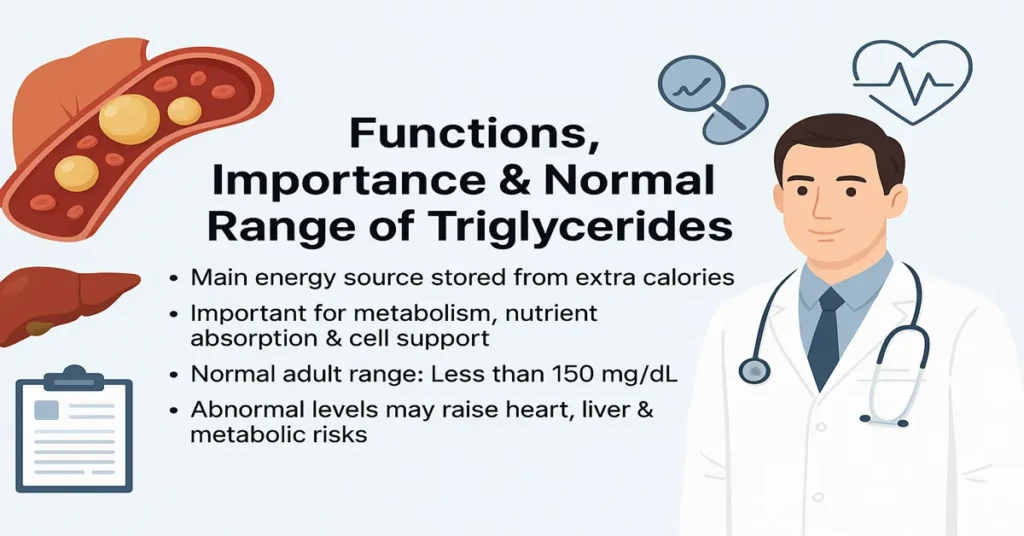
Functions, Importance & Normal Range of Triglycerides
Overview
Triglycerides are one of the most important forms of fat found in the blood and are routinely measured as part of a lipid profile. In day-to-day clinical practice, triglycerides are best understood as the body’s main energy storage system. After you eat, any extra calories—especially from carbohydrates and fats—are converted into triglycerides and stored in fat cells. When the body needs energy between meals, during physical activity, or while fasting, these triglycerides are broken down and used as fuel.
Having triglycerides is essential. The concern arises when levels are persistently too high or unusually low. High triglycerides increase the risk of heart disease, fatty liver, metabolic syndrome, and pancreatitis. Very low levels, although less common, can point toward poor nutrition, malabsorption, or certain metabolic conditions. Knowing what triglycerides do and how to interpret their normal range helps both patients and clinicians make informed decisions.
This article explains the functions of triglycerides, why they matter, normal reference ranges, and when abnormal values need attention.
What Do Triglycerides Do?
Triglycerides are made of three fatty acids attached to a glycerol backbone. Their role in the body is practical and continuous.
Energy storage
When calorie intake exceeds immediate energy needs, the body converts the excess into triglycerides and stores them in fat tissue. This provides a long-term energy reserve.
Fuel between meals
As blood sugar levels fall between meals, triglycerides are broken down to release fatty acids that keep energy levels steady.
Support metabolism
Triglycerides help regulate how the body balances energy intake, storage, and usage.
Insulation and protection
Stored fat helps maintain body temperature and cushions vital organs against physical stress.
Transport of dietary fats
Triglycerides carry fats from the intestine through the bloodstream to muscles and other tissues where they are needed.
Without triglycerides, the body would struggle to maintain energy balance, especially during fasting or illness.
Why Are Triglycerides Important?
Triglycerides are not just a number on a report; they reflect how the body handles energy and fats.
Indicator of metabolic health
In routine lab practice, high triglycerides are often seen alongside insulin resistance, obesity, or poorly controlled diabetes.
Relationship with cholesterol
Triglycerides interact closely with HDL and LDL cholesterol. High triglycerides combined with low HDL significantly increase cardiovascular risk.
Marker of liver stress
The liver plays a central role in triglyceride metabolism. Abnormal levels may suggest fatty liver or metabolic overload.
Cardiovascular risk assessment
Persistently elevated triglycerides contribute to plaque formation in arteries and increase the risk of heart attack and stroke.
Hormonal influence
Hormones such as insulin and thyroid hormones strongly affect triglyceride levels, so abnormalities may signal endocrine imbalance.
Triglycerides give a broader picture of metabolic and cardiovascular health, not just fat intake.
Role of Triglycerides in the Body
Triglycerides support several essential processes.
Maintaining energy balance
They act as a backup energy system when glucose is unavailable.
Supporting physical activity
During prolonged exercise, muscles rely on triglycerides for sustained energy.
Helping nutrient absorption
Triglycerides aid the absorption of fat-soluble vitamins like A, D, E, and K.
Supporting cell structure
Fatty acids derived from triglycerides contribute to normal cell function.
Protecting organs
Stored fat cushions organs and provides physical protection.
These roles explain why both deficiency and excess can cause problems.
Normal Triglyceride Levels (Age-Wise)
Reference ranges can vary slightly between laboratories, but commonly accepted values are:
Children (10–19 years)
75 – 135 mg/dL
Adults (20 years and above)
Less than 150 mg/dL is considered ideal
Older adults (50+ years)
100 – 170 mg/dL
A mild rise can occur with age due to slower metabolism and hormonal changes.
Values are always interpreted alongside other lipid parameters.
Normal Triglyceride Levels (Gender-Wise)
Gender differences are usually mild and influenced by hormones and body composition.
Men
Ideal: below 150 mg/dL
Men often show slightly higher levels due to differences in fat distribution and metabolism.
Women
Ideal: below 150 mg/dL
Before menopause, estrogen tends to keep triglycerides lower. After menopause, levels may gradually rise.
Gender alone rarely determines risk; overall metabolic health matters more.
Triglyceride Levels During Pregnancy
Pregnancy causes predictable changes in lipid metabolism.
First trimester
Approximately 100 – 150 mg/dL
Second trimester
Around 150 – 200 mg/dL
Third trimester
Often 200 – 300 mg/dL or slightly higher
These increases are normal and support fetal growth, hormone production, and energy needs. Levels usually return to baseline after delivery.
When Abnormal Triglyceride Levels Become Risky
Both extremes deserve attention.
High triglycerides (hypertriglyceridemia)
Risk increases when levels are persistently elevated, especially above 200 mg/dL. Very high levels (above 500 mg/dL) significantly raise the risk of pancreatitis. Long-term elevation contributes to heart disease, stroke, fatty liver, and insulin resistance.
Low triglycerides (hypotriglyceridemia)
Unusually low levels may reflect malnutrition, malabsorption, hyperthyroidism, chronic illness, or extreme dietary restriction. Very low levels can affect energy availability and nutrient absorption.
Clinically, doctors focus on patterns over time, not a single isolated value.
Test Preparation
For accurate triglyceride measurement:
Fast for 9–12 hours if advised
Drink water normally
Avoid alcohol for at least 24 hours
Avoid heavy, sugary, or fatty meals the night before
Do not perform intense exercise just before the test
Inform your doctor about medications or supplements
Proper preparation reduces false elevations.
When to Consult a Doctor
Medical advice is recommended if:
Triglycerides remain high on repeated testing
Levels exceed 200 mg/dL consistently
You have diabetes, obesity, or thyroid disease
There is chest discomfort or shortness of breath
There is sudden abdominal pain (possible pancreatitis)
You experience unexplained weight loss or weakness
There is a strong family history of heart disease
Early evaluation helps prevent long-term complications.
Important Word Explanations
Triglycerides: Fats stored in the body and used as energy
Hypertriglyceridemia: Abnormally high triglyceride levels
Hypotriglyceridemia: Abnormally low triglyceride levels
Atherosclerosis: Narrowing or hardening of arteries
Pancreatitis: Inflammation of the pancreas
Insulin resistance: Reduced response of cells to insulin
People Also Ask
Is a high triglyceride level serious?
Mild elevation is common, but very high or persistent levels increase heart and pancreas risk.
Can triglyceride levels be temporarily high?
Yes. Recent heavy meals, alcohol intake, illness, or poor blood sugar control can cause temporary rises.
Does high triglyceride always mean heart disease?
No. It is a risk marker, not a diagnosis. Doctors interpret it with cholesterol, sugar levels, and clinical history.
When do doctors usually worry about triglycerides?
When levels stay high over time or cross 500 mg/dL.
Is repeat testing common for triglycerides?
Yes. Repeat tests help confirm whether the abnormality is persistent or reversible.
Can triglycerides be low and still be a problem?
Yes. Very low levels may indicate nutritional or metabolic issues and should be evaluated.
~END~