
Testosterone Blood Test – Complete, Clear & Patient-Friendly Guide
Overview
The Testosterone Blood Test measures the amount of testosterone circulating in the bloodstream at the time of testing. Testosterone is a key hormone involved in physical development, reproductive health, energy regulation, muscle and bone strength, and overall hormonal balance. While it is often referred to as a male hormone, it is also present and necessary in women, though in much smaller amounts.
In clinical settings, this test is commonly requested when symptoms suggest a possible hormonal imbalance. These may include changes in sexual function, fertility concerns, menstrual irregularities, unexplained fatigue, or physical changes such as altered hair growth. Because testosterone production is closely connected to the testes, ovaries, adrenal glands, and pituitary gland, abnormal values can provide useful clues about where further evaluation may be needed.
What is Testosterone?
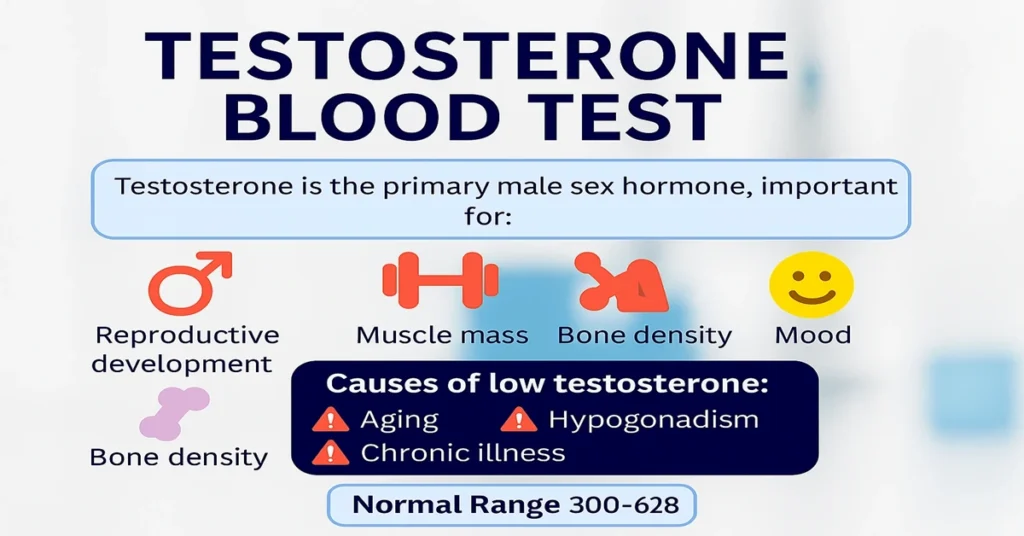
Testosterone is part of a group of hormones known as androgens. These hormones play a central role in sexual development and influence many metabolic and structural functions in the body. Testosterone contributes to reproductive organ development, pubertal changes, muscle and bone maintenance, and red blood cell production.
In men, testosterone supports sperm production, sexual desire, and physical strength. In women, smaller amounts help maintain bone density, support ovarian function, and contribute to sexual interest and overall vitality. Because testosterone interacts with multiple body systems, even modest changes in levels can sometimes be reflected in physical or emotional symptoms.
Where Testosterone Is Produced in the Body
Testosterone production varies by sex and involves coordination between multiple organs.
In Men
The majority of testosterone is produced in the testes, specifically by specialized cells that respond to signals from the pituitary gland. The pituitary releases luteinizing hormone (LH), which regulates how much testosterone the testes produce.
In Women
Women produce lower amounts of testosterone through the ovaries and adrenal glands. Additional small amounts are formed in fat tissue through conversion from other hormones.
Peripheral Conversion
Some testosterone originates from precursor hormones such as androstenedione. This conversion takes place in tissues like fat, skin, and the liver, helping maintain a steady hormonal balance across different life stages.
Main Functions and Importance of Testosterone
Testosterone affects many interconnected systems, which explains why its measurement is relevant in a wide range of clinical situations.
Reproductive and Sexual Health
Testosterone supports libido and sexual interest in both men and women. In men, it contributes to erectile function and sperm production. In women, it plays a supportive role in ovarian function and menstrual regularity.
Physical Strength and Bone Health
The hormone helps maintain muscle mass, muscle strength, and bone density. It also influences how fat is distributed throughout the body.
Metabolic and Blood Functions
Testosterone supports red blood cell production and plays a role in metabolism and energy regulation, which can influence stamina and physical endurance.
Mental and Emotional Well-Being
Balanced testosterone levels are associated with stable mood, motivation, focus, and emotional resilience. Changes in levels may sometimes coincide with shifts in mood or cognitive performance.
Causes of Low Testosterone Levels
Low testosterone, often referred to clinically as hypogonadism, can arise from several mechanisms involving hormone production or regulation.
Common Causes
A gradual decline with aging is expected, particularly after early adulthood. Other causes include conditions affecting the testes, disorders involving the pituitary or hypothalamus, and chronic medical illnesses. Body composition changes, long-term illness, and the effects of certain medications can also influence testosterone levels.
From a laboratory perspective, low values are usually interpreted alongside other hormone tests to determine whether the issue is primary or secondary in nature.
Symptoms of Low Testosterone
Reduced testosterone levels may affect both physical and emotional health.
In Men
Men may notice changes in sexual interest, physical strength, body composition, or energy levels. Mood changes, reduced bone density, and fertility concerns may also be reported in some cases.
In Women
Women may experience reduced libido, menstrual irregularities, low energy, or gradual changes in bone health.
These findings are not specific to testosterone alone and are evaluated carefully in combination with clinical history and other test results.
Causes of High Testosterone Levels
Elevated testosterone levels may be physiological or related to underlying medical conditions or external hormone exposure.
Common Causes
High values may be seen with the use of androgen-containing medications or supplements, certain endocrine disorders, or hormone-secreting tumors. In women, conditions associated with increased androgen production can lead to higher testosterone levels. Adrenal gland disorders may also contribute.
Laboratory interpretation focuses on identifying whether elevation is persistent and whether it aligns with symptoms or other hormonal findings.
Symptoms of High Testosterone Levels
Higher testosterone levels can influence physical appearance and emotional state.
In Men
Possible findings include skin changes, mood alterations, and shifts in muscle mass or reproductive function.
In Women
Women may experience changes such as increased facial or body hair, menstrual irregularities, or skin changes.
Persistent elevations are typically followed up with additional testing to clarify the underlying cause rather than being judged on a single result.
Reference Ranges
Testosterone reference ranges vary by age, sex, and laboratory method.
Total Testosterone
Adult men: 300 – 1,000 ng/dL
Adult women: 15 – 70 ng/dL
Free Testosterone
Men: 5 – 21 ng/dL
Women: 0.5 – 6 ng/dL
Because testosterone levels naturally peak in the early morning, samples are usually collected between 7 AM and 10 AM to improve consistency.
Sample Type
Sample Type: Serum (blood)
Tube Used: Red top (plain) or SST
Best Time: Morning, typically between 7 and 10 AM
Test Preparation
Preparation for this test is generally straightforward. Some patients may be advised to fast, depending on accompanying tests. Informing the doctor about hormone use or medications is important, as these can influence results. Stress and recent intense physical activity may also affect hormone levels temporarily.
Blood is drawn from a vein in the arm, and results are usually available within 24 hours.
When to Consult a Doctor
Medical consultation is appropriate when symptoms such as persistent fatigue, reduced sexual interest, menstrual irregularities, fertility concerns, or unexplained physical changes occur. Changes in mood, bone strength, or hair patterns may also prompt testing.
If testosterone levels are outside the expected range, doctors often recommend further evaluation with related hormone tests to understand the broader hormonal context.
Important Word Explanations
- Leydig Cells: Cells in the testes responsible for testosterone production.
- Hypogonadism: A condition marked by reduced production of sex hormones.
- Androgens: A group of hormones involved in male traits and reproductive function.
- PCOS: A hormonal condition associated with altered androgen levels in women.
- Adrenal Glands: Hormone-producing glands located above the kidneys.
- Congenital Adrenal Hyperplasia (CAH): A genetic disorder affecting adrenal hormone production.
~END~
Related Posts
None found