
T4 Test (Thyroxine): Meaning, Levels, Symptoms, Normal Range & Complete Guide
Overview
The T4 (Thyroxine) Test measures the amount of thyroxine circulating in the blood. T4 is one of the two main hormones produced by the thyroid gland, the other being T3 (Triiodothyronine). While T3 is the more active hormone at the tissue level, T4 serves as the body’s primary circulating and reserve thyroid hormone.
From a clinical point of view, T4 helps doctors assess how effectively the thyroid gland is producing hormone and whether the overall thyroid system is functioning in balance. This test is routinely used to evaluate unexplained metabolic symptoms and to monitor known thyroid conditions over time.
Doctors commonly request the T4 test when assessing:
- Underactive thyroid function
- Overactive thyroid function
- Thyroid inflammation
- Autoimmune thyroid disorders
- Response to thyroid-related treatment
Two measurements are typically reported:
Total T4, which includes both protein-bound and free hormone, and
Free T4, which reflects the fraction available for biological activity.
Together, these values help clarify hormone production and availability.
Where is T4 Produced in the Body?
T4 is produced exclusively by the thyroid gland, a small butterfly-shaped organ located at the front of the neck. The thyroid releases T4 in response to signals from the pituitary gland in the form of TSH (Thyroid-Stimulating Hormone).
Once released into the bloodstream, most T4 binds to transport proteins such as thyroxine-binding globulin (TBG). This bound hormone acts as a circulating reserve. Only a small percentage remains unbound as free T4, which reflects the hormone that can enter tissues and be converted into active T3.
In routine practice, this balance between bound and free hormone is essential for stable metabolic control.
Main Functions and Importance of T4
Although T4 itself is less active than T3, it plays a central supporting role in thyroid physiology.
Regulates Metabolism
T4 helps maintain baseline metabolic activity. When levels are low, metabolism slows. When levels are high, metabolic processes accelerate beyond normal needs.
Controls Heart Rate and Body Temperature
T4 influences cardiac activity and internal heat regulation. Subtle changes may affect pulse rate and temperature tolerance.
Supports Growth and Brain Development
Adequate T4 is especially important during fetal development, infancy, and childhood, where it supports brain maturation and skeletal growth.
Helps Digestion and Muscle Activity
Normal T4 levels support smooth digestive movement and coordinated muscle function.
Maintains Mental Health
Stable T4 supports attention, memory, and emotional balance. Disturbances may affect mood, clarity, and mental speed.
Acts as a Hormone Reservoir
T4 functions as a reserve hormone that can be converted into T3 in the liver, kidneys, and peripheral tissues whenever increased metabolic activity is required.
In clinical terms, T4 provides hormonal stability and adaptability across changing physiological demands.
Causes of Low T4 Levels
Low T4 levels usually indicate reduced thyroid hormone production or impaired regulation within the thyroid–pituitary system.
Common Causes
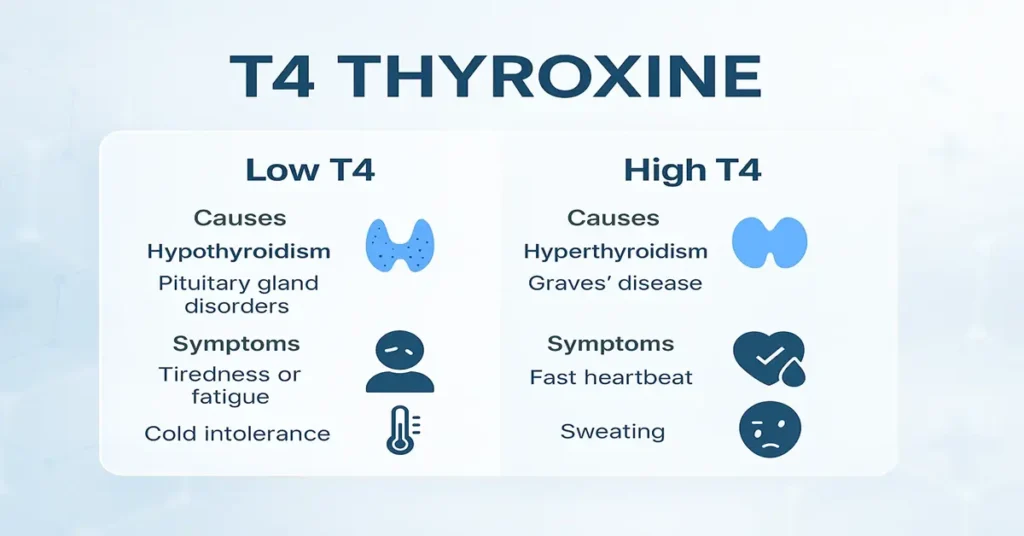
Low T4 may be seen in underactive thyroid states, autoimmune thyroid damage, pituitary-related hormone signaling issues, or during severe systemic illness. Certain medications and long-standing nutritional or metabolic stress can also influence T4 production.
Importantly, low T4 values may appear gradually and can precede obvious clinical symptoms.
Symptoms of Low T4 Levels
Reduced T4 slows metabolic processes throughout the body.
People may notice persistent tiredness, reduced tolerance to cold, dry skin, hair thinning, slowed heart rate, digestive sluggishness, and changes in mood or concentration. Swelling of the face or extremities and menstrual irregularities may also be seen over time.
Symptoms often develop slowly and are typically non-specific in early stages.
Causes of High T4 Levels
High T4 levels reflect increased thyroid hormone availability in the bloodstream.
Common Causes
Elevated T4 is commonly associated with overactive thyroid conditions, autoimmune stimulation of the thyroid, thyroid inflammation, or excess hormone exposure. Hormonal changes, such as those occurring during pregnancy, can also influence total T4 measurements due to altered binding proteins.
High T4 places increased demand on cardiovascular, nervous, and muscular systems.
Symptoms of High T4 Levels
Excess T4 accelerates metabolic activity beyond normal limits.
Patients may experience rapid heartbeat, heat intolerance, excessive sweating, nervousness, sleep disturbance, weight loss despite normal intake, tremors, muscle weakness, and changes in bowel habits. Fatigue is common despite increased metabolic drive.
More severe elevations can place significant strain on the heart and nervous system.
Reference Ranges
Reference ranges vary slightly between laboratories, but commonly used values include:
- Total T4: 5.0 – 12.0 µg/dL
- Free T4: 0.8 – 1.8 ng/dL
Low T4 values generally suggest reduced thyroid activity, while high values suggest increased activity. Final interpretation is always made in conjunction with TSH and T3 results.
Sample Type and Testing Information
Sample Type
Serum (blood sample)
Tube Used
Red Top (Plain)
Processing
A routine venous blood sample is collected and analyzed. Results are typically available within one to two working days.
Associated Tests
TSH, Total or Free T3, and thyroid antibody tests are often reviewed together to clarify the underlying thyroid condition.
Test Preparation
Most patients do not require fasting for a T4 test.
Thyroid medications should be taken only as advised on the day of testing. Biotin supplements should be stopped a few days beforehand, as they can interfere with thyroid hormone assays. Hormonal medications and iodine-containing drugs should be disclosed to the clinician.
Pregnancy should always be mentioned, as it naturally alters thyroid hormone binding and levels.
When to Consult a Doctor
Medical review is recommended if symptoms such as unexplained weight changes, persistent fatigue, palpitations, temperature intolerance, hair or skin changes, or menstrual irregularities are present.
Abnormal T4 results usually lead to further evaluation rather than immediate conclusions. Additional testing helps determine whether the issue involves thyroid hormone production, regulation, or conversion.
Important Word Explanations
Thyroxine (T4)
A major thyroid hormone that supports metabolism and serves as a reserve for active hormone.
Triiodothyronine (T3)
The active thyroid hormone formed from T4 in body tissues.
TSH (Thyroid-Stimulating Hormone)
A pituitary hormone that regulates thyroid hormone production.
Hyperthyroidism
A state of excessive thyroid hormone activity.
Hypothyroidism
A state of reduced thyroid hormone activity.
Graves’ Disease
An autoimmune condition that overstimulates the thyroid gland.
Hashimoto’s Disease
An autoimmune condition that gradually reduces thyroid hormone production.
~END~
Related Posts
None found