
T3 Test: Meaning, Levels, Symptoms, Normal Range & Complete Guide
Overview
The T3 Test measures the level of Triiodothyronine (T3), one of the main hormones produced by the thyroid gland. Among thyroid hormones, T3 is considered the biologically active form. It is the hormone that actually acts on tissues and organs to regulate metabolism, energy use, and temperature control.
While the thyroid gland produces both T3 and T4, most circulating T3 is formed outside the thyroid through conversion from T4. Because of this, the T3 test helps doctors understand not only thyroid gland activity but also how effectively the body is activating thyroid hormone at the tissue level.
The test is commonly used to evaluate suspected hyperthyroidism, monitor known thyroid disorders, or clarify symptoms when TSH or T4 results are not fully explanatory.
Two forms of the test are used:
Total T3, which measures both protein-bound and free hormone, and
Free T3, which reflects the hormone directly available to body tissues.
Where is T3 Produced in the Body?
T3 enters the bloodstream through two main pathways.
A smaller portion is produced directly by the thyroid gland itself. The gland releases T3 along with T4 into circulation.
The larger share of T3 is produced outside the thyroid. Organs such as the liver, kidneys, and muscles convert T4 into active T3 using specialized enzymes. This conversion allows the body to adjust thyroid activity locally based on tissue needs.
From a clinical perspective, this means a normal thyroid gland can still be associated with low T3 if conversion is impaired, especially during illness or physiological stress.
Main Functions and Importance of T3
Regulates Metabolism
T3 determines how quickly the body converts nutrients into energy. It influences oxygen use, calorie consumption, and heat production. Changes in T3 often explain symptoms related to unexplained weight changes or altered energy levels.
Supports Heart and Muscle Function
T3 affects heart rate, cardiac output, and muscle responsiveness. Subtle shifts in T3 can influence how fast or slow the heart works, even before structural heart disease is present.
Controls Body Temperature
By increasing cellular energy production, T3 plays a major role in maintaining normal body temperature. Sensitivity to cold or heat is often linked to altered T3 activity.
Supports Brain and Emotional Health
T3 influences mental alertness, concentration, and mood. In children, it is essential for brain development. In adults, imbalance may affect cognitive speed or emotional stability.
Helps Digestion and Hormonal Balance
Normal digestive movement and appetite depend partly on thyroid hormone activity. T3 also interacts with reproductive hormones, influencing menstrual regularity and fertility.
Enhances Energy Production
At the cellular level, T3 improves how efficiently cells generate ATP, the body’s usable energy source. This explains why abnormal T3 levels often feel physically exhausting or overstimulating.
Overall, T3 acts as a metabolic regulator that fine-tunes how actively the body functions.
Causes of Low T3 Levels
Low T3 levels can occur when thyroid hormone production is reduced or when conversion from T4 to T3 is impaired.
Common Causes
Low T3 may be seen in hypothyroidism, pituitary-related disorders affecting TSH, chronic systemic illnesses, or prolonged physical stress. It is also common during severe illness, where the body temporarily reduces T3 production as a protective response, often referred to as low T3 syndrome.
Certain medications and nutritional states can also influence conversion efficiency. Importantly, low T3 does not always indicate permanent thyroid disease and must be interpreted in clinical context.
Symptoms of Low T3 Levels
When T3 is reduced, metabolic processes slow down across multiple systems.
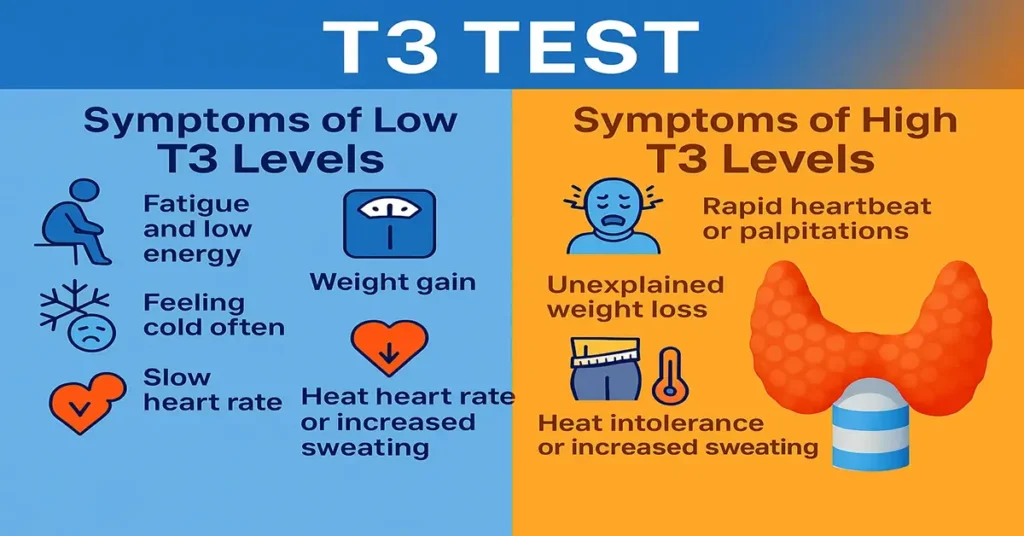
People may experience ongoing fatigue, reduced stamina, sensitivity to cold, slowed heart rate, digestive sluggishness, dry skin, hair thinning, and difficulty concentrating. Emotional changes such as low mood or mental slowing may also occur.
Symptoms usually develop gradually and reflect reduced cellular activity rather than sudden illness.
Causes of High T3 Levels
High T3 levels typically suggest increased thyroid activity or excess hormone availability.
Common Causes
Elevated T3 is commonly associated with hyperthyroidism, especially Graves’ disease. It may also be seen in nodular thyroid disease, thyroid inflammation, or excess thyroid hormone intake.
A specific pattern called T3-thyrotoxicosis occurs when T3 is high while T4 remains normal, making T3 testing particularly useful in certain patients.
Symptoms of High T3 Levels
High T3 accelerates metabolism beyond normal limits.
Patients may notice rapid heartbeat, palpitations, nervousness, tremors, heat intolerance, increased sweating, unintended weight loss, sleep disturbance, and frequent bowel movements. Despite increased energy turnover, fatigue is common due to constant over-stimulation.
Severe or rapidly rising T3 levels can place significant stress on the heart and nervous system.
Reference Ranges for T3
Reference ranges vary slightly between laboratories, but commonly used values include:
- Total T3: 80 – 200 ng/dL
- Free T3: 2.3 – 4.2 pg/mL
Results are never interpreted alone. Doctors always review T3 alongside TSH and T4 to understand whether changes reflect thyroid disease, conversion issues, or temporary physiological responses.
Sample Type and Testing Information
Sample Type
Serum (blood sample)
Tube Used
Red Top (Plain Tube)
Procedure
A routine blood sample is collected from a vein and analyzed for T3 concentration. The test is simple, safe, and widely available.
Related Tests
TSH, Free T4, Total T4, and thyroid antibody tests are often reviewed together for a complete thyroid assessment.
Test Preparation
Most patients do not require fasting for a T3 test.
Thyroid medications should be taken only as directed by the doctor on the day of testing. Biotin supplements should be avoided for a few days beforehand, as they can interfere with hormone assays. It is important to inform the clinician about all medications, especially steroids, heart medicines, or iodine-containing drugs.
Morning samples are commonly preferred to maintain consistency between tests.
When to Consult a Doctor
Medical advice should be sought if symptoms such as unexplained weight change, persistent fatigue, palpitations, temperature intolerance, mood changes, or menstrual irregularities occur.
Abnormal T3 results usually lead to further evaluation rather than immediate conclusions. Additional tests help determine whether the issue lies within the thyroid gland itself, the pituitary system, or hormone activation at the tissue level.
Important Word Explanations
Thyroid Gland
A butterfly-shaped gland in the neck that produces hormones regulating metabolism.
T3 (Triiodothyronine)
The active thyroid hormone that directly affects energy use and metabolic rate.
T4 (Thyroxine)
A precursor hormone that is converted into T3 in peripheral tissues.
TSH (Thyroid-Stimulating Hormone)
A pituitary hormone that controls thyroid hormone production.
Hyperthyroidism
A condition in which thyroid hormone levels are higher than normal.
Hypothyroidism
A condition in which thyroid hormone levels are lower than normal.
Graves’ Disease
An autoimmune disorder that causes excessive thyroid hormone production.
~END~
Related Posts
None found