
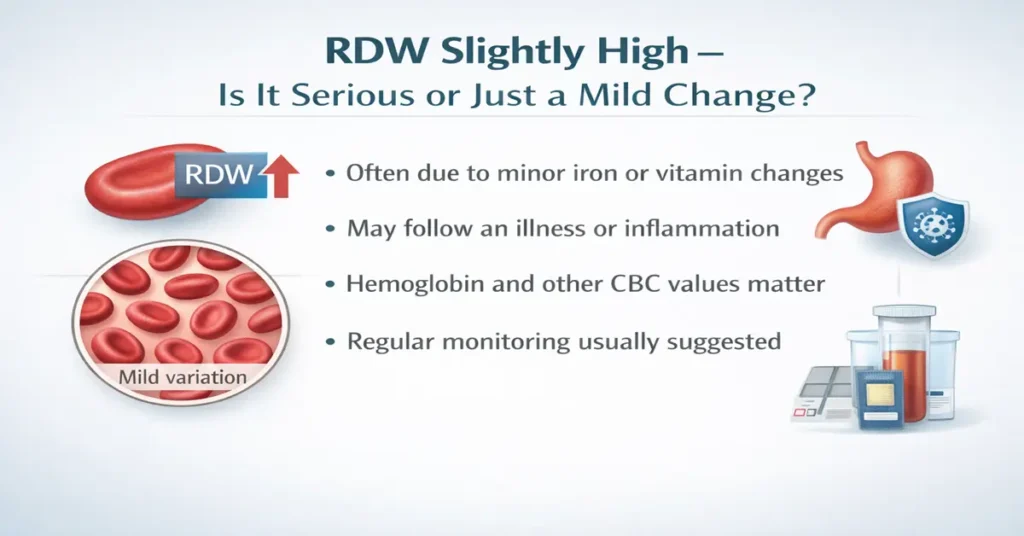
RDW Slightly High – Is It Serious?
This is one of the most common questions I hear at the lab counter.
A patient looks at the CBC report, notices that RDW is marked slightly high, and immediately worries that something serious is going on. Many people search online and end up reading extreme explanations that don’t really apply to their situation.
From real hospital and OPD experience, I want to reassure you first:
In most routine cases, a slightly high RDW is not serious.
What matters is how high it is, what other blood values look like, and how the patient feels clinically. RDW by itself rarely tells the full story.
Let me explain this clearly and practically, just like I explain it to patients every day.
Why a “Slightly High RDW” Creates Confusion
Most patients expect blood test values to be either:
- Normal
- Or clearly abnormal
But RDW often falls into a grey zone. It may be just a little above the reference limit, and that small rise creates unnecessary fear.
The confusion happens because:
- RDW reflects variation, not a disease
- A small variation is very common in real life
- Labs flag even minor changes to maintain safety
So when RDW is slightly high, it does not automatically mean anemia, serious illness, or blood disorder.
What “Slightly High” Usually Means in Lab Practice
From day-to-day reporting experience, a slightly high RDW usually means:
- Red blood cells are not exactly the same size
- There is minor variation, not drastic abnormality
- The bone marrow is responding or adjusting to something mild
This adjustment is often temporary and harmless.
In many OPD cases, patients with slightly high RDW:
- Feel completely fine
- Have no major symptoms
- Show stable hemoglobin and other CBC values
Common Real-World Reasons We See in OPD
1. Early or Recovering Phase of Nutritional Changes
This is one of the most common reasons.
When the body starts correcting a mild deficiency:
- New red blood cells may be slightly different in size
- Older cells remain as they are
- RDW increases a little
This can happen:
- After dietary improvement
- During recovery from mild anemia
- After starting supplements (even short-term)
Clinically, this is a positive adjustment phase, not a danger sign.
2. Minor Iron or Vitamin Fluctuations
Not all deficiencies cause dramatic blood changes.
In early or borderline cases:
- Hemoglobin may still be normal
- RDW may rise slightly
From lab experience, this pattern is common in:
- Young adults with irregular diet
- Women with menstrual blood loss
- People under stress or recent illness
Doctors usually observe rather than panic.
3. Recent Illness or Inflammation
After infections, fever, or inflammation:
- Bone marrow activity changes briefly
- Red cell production timing shifts
- RDW may rise slightly
We often see this in patients who:
- Recently recovered from viral illness
- Had minor surgery
- Were hospitalized briefly
In most cases, RDW normalizes on its own.
4. Lab Timing and Natural Biological Variation
This is something patients rarely realize.
RDW can change slightly due to:
- Hydration level
- Time gap between tests
- Normal biological variation
That’s why we never interpret RDW in isolation from the rest of the CBC.
When a Slightly High RDW Is Usually Harmless
From OPD and hospital experience, it is usually harmless when:
- The rise is minimal
- Hemoglobin is stable
- Other CBC values are normal
- The patient has no symptoms
- There is no rapid change compared to past reports
In such cases, doctors often reassure the patient and suggest routine follow-up only.
When RDW Needs More Attention
Although most cases are harmless, attention is needed if:
- RDW keeps rising on repeat tests
- It is accompanied by falling hemoglobin
- Other RBC indices are abnormal
- The patient has persistent weakness, breathlessness, or fatigue
Even then, RDW is treated as a clue, not a diagnosis.
How Doctors Clinically Interpret Slightly High RDW
In real clinical practice, doctors rarely react to RDW alone.
They look at:
- Previous CBC reports
- Patient symptoms
- Overall trend, not a single value
A slightly high RDW with stable values is usually interpreted as:
- A mild, early change
- Or a recovery pattern
- Or a non-significant variation
This is why many doctors do not even mention it unless the patient asks.
Should You Repeat the Test?
Repeat Testing Is Usually Advised When:
- RDW is rising progressively
- Symptoms are present
- Hemoglobin or other values change
Repeat Testing Is Often Not Needed When:
- RDW is only slightly high
- The patient feels well
- Other CBC values are stable
From lab experience, many repeat reports come back normal or unchanged.
A Practical Note From the Lab Counter
I often tell patients this:
“RDW is like a warning light that can blink for many small reasons. A slight blink doesn’t mean the engine has failed.”
It becomes meaningful only when seen with other changes or symptoms.
Test Preparation
- No fasting is required for RDW
- Avoid testing during acute illness if possible
- Inform the lab about recent infections, surgery, or blood loss
- Use the same lab for follow-up to compare trends accurately
When to Consult a Doctor
Consult a doctor if:
- RDW keeps increasing on repeat reports
- You have persistent fatigue or breathlessness
- Hemoglobin or RBC count starts falling
- You have long-term medical conditions
If RDW is slightly high and you feel fine, routine follow-up is usually enough.
Important Word Explanations
RDW (Red Cell Distribution Width)
A measure of how similar or different red blood cells are in size.
CBC (Complete Blood Count)
A blood test that evaluates different components of blood together.
Bone marrow
The tissue inside bones that produces blood cells.
Nutritional deficiency
Lack of essential nutrients needed for normal blood formation.
Inflammation
The body’s response to infection or injury, which can affect blood production temporarily.
People Also Ask
Is a slightly high RDW dangerous?
In most routine cases, no. It is often mild and temporary.
Can RDW increase without anemia?
Yes, very commonly.
Does slightly high RDW need treatment?
Usually no. Doctors focus on the overall picture, not RDW alone.
Will RDW go back to normal?
In many cases, yes—especially if the cause was temporary.
~END~