
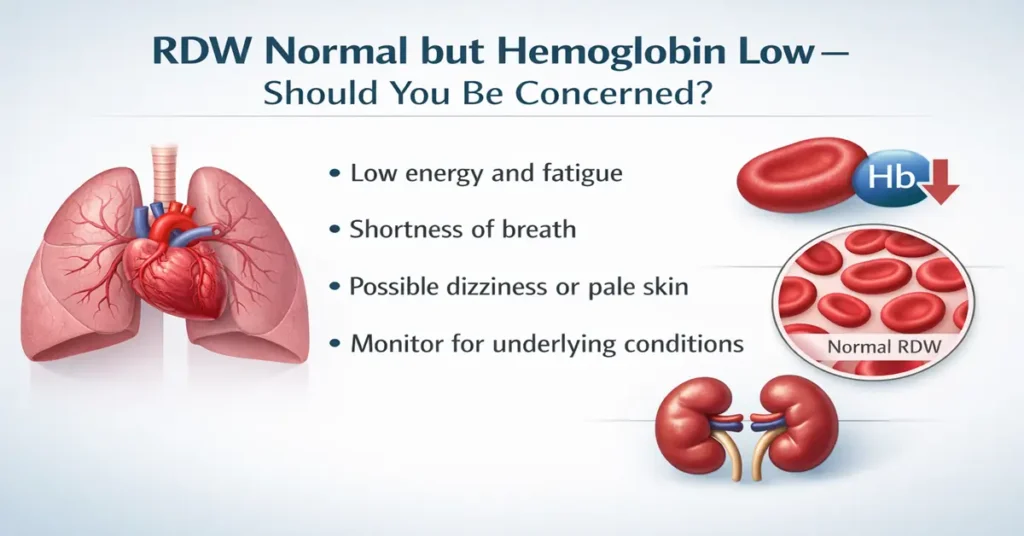
RDW Normal but Hemoglobin Low – What This Report Combination Usually Means
As a lab technician, I see this exact report combination almost every week in OPD and routine health checkups. Patients often come worried because the hemoglobin is low, but at the same time, RDW is reported as normal. Many expect both values to change together, so this feels confusing.
Let me explain this calmly, the same way I explain it at the lab counter or during ward rounds.
This situation does not automatically mean something serious, and in many routine cases, it has a very logical and harmless explanation.
Why This Combination Confuses Patients
Most people have already read or heard that:
- Low hemoglobin usually means anemia
- RDW increases when red blood cells become uneven in size
So when RDW stays normal, the first question is:
“If my hemoglobin is low, why is RDW not high?”
From lab experience, the answer lies in how anemia develops, not just whether anemia is present.
How We See This in Real Lab Practice
In daily reporting, RDW normal + hemoglobin low usually means:
- Red blood cells are uniform in size
- But the overall oxygen-carrying capacity is reduced
- The body is producing red cells in a consistent pattern, just fewer or less effective ones
This pattern is very common in early-stage or stable conditions, not sudden or aggressive problems.
The Most Common Practical Reasons (From OPD Experience)
1. Early or Mild Anemia (Very Common)
In early anemia:
- Hemoglobin starts falling first
- RDW often remains normal initially
The bone marrow is still producing red cells normally and evenly, so RDW does not change yet.
This is something we see a lot in:
- Young adults
- Women with recent menstrual blood loss
- People with dietary gaps caught early
In such cases, doctors usually monitor first rather than panic.
2. Long-Standing, Stable Anemia
If anemia has been present for a long time and is stable:
- The body adapts
- Red blood cells remain similar in size
- RDW stays within range
This is often seen in:
- Chronic mild nutritional deficiency
- People with long-term low hemoglobin but no sudden worsening
Clinically, this is not an emergency pattern.
3. Anemia Related to Chronic Conditions
In patients with long-term conditions:
- Chronic infections
- Inflammatory disorders
- Kidney-related issues
Hemoglobin may fall gradually, but red cell production remains uniform.
From lab practice, these reports often come with:
- Normal RDW
- Mild to moderate hemoglobin reduction
- No dramatic changes in other CBC values
Doctors usually interpret this as a secondary effect, not a primary blood disorder.
4. Recent Blood Loss (Early Phase)
In early blood loss:
- Hemoglobin drops
- RDW may still appear normal
This is because the bone marrow hasn’t yet released new, differently sized red cells.
This pattern is sometimes seen:
- Shortly after surgery
- After recent heavy periods
- Following minor internal bleeding
RDW may change later, not immediately.
What This Combination Usually Does Not Suggest
From years of lab observation, RDW normal with low hemoglobin usually does NOT point toward:
- Serious bone marrow disease
- Blood cancers
- Sudden hemolytic conditions
Those conditions almost always show marked RDW changes and other abnormal CBC parameters.
So if your report shows:
- Only hemoglobin low
- RDW normal
- Other CBC values reasonably stable
That is generally reassuring.
How Doctors Typically Read This Report
Clinically, doctors look at this combination and ask:
- Is the anemia mild or significant?
- Is the patient symptomatic?
- Is this new or long-standing?
- Are other parameters stable?
In most routine OPD cases, the approach is:
- Correlate with history
- Review previous reports if available
- Decide whether observation or further testing is needed
Immediate aggressive action is rare unless symptoms demand it.
When Repeat Testing Is Usually Suggested
From lab practice, repeat testing is advised when:
- Hemoglobin is borderline low
- Patient feels well
- No alarming symptoms are present
A repeat CBC after a few weeks helps confirm:
- Whether hemoglobin is stabilizing
- Whether RDW begins to change
- Whether the pattern is temporary or persistent
In many patients, values normalize or stabilize without complications.
When Repeat Testing Is Often Not Needed Immediately
Doctors may not ask for urgent repeat testing when:
- Hemoglobin is only mildly low
- RDW is normal
- Patient has no weakness, breathlessness, or dizziness
- No other CBC abnormalities are present
In such cases, reassurance and routine follow-up are usually enough.
A Calm Note From Lab Experience
I always tell patients this:
“A single report does not define your health.”
RDW normal with low hemoglobin is one of the calmer anemia patterns we see, especially when caught early or found incidentally during routine testing.
Test Preparation
- No special fasting is required unless combined with other tests
- Avoid testing immediately after acute illness if possible
- Inform the lab if you recently had surgery, blood loss, or transfusion
- Try to test at the same lab for follow-up consistency
When to Consult a Doctor
Consult a doctor if:
- You feel persistent weakness or fatigue
- There is breathlessness on mild activity
- Hemoglobin keeps dropping on repeat tests
- You have chronic illness along with anemia
- There is unexplained weight loss or prolonged symptoms
For mild, stable cases without symptoms, routine follow-up is usually sufficient.
Important Word Explanations
RDW (Red Cell Distribution Width)
Shows how similar or different red blood cells are in size.
Hemoglobin
The part of red blood cells that carries oxygen.
Anemia
A condition where oxygen-carrying capacity of blood is reduced.
Chronic condition
A health issue that lasts for a long time.
CBC (Complete Blood Count)
A routine blood test that checks multiple blood parameters together.
People Also Ask
Can hemoglobin be low while RDW is normal?
Yes, very commonly—especially in early or stable anemia.
Is this report dangerous?
In most routine cases, no. It is usually a mild or manageable pattern.
Does normal RDW rule out anemia?
No. RDW shows variation, not hemoglobin strength.
Will RDW change later?
It can, depending on how the condition progresses or improves.
~END~