
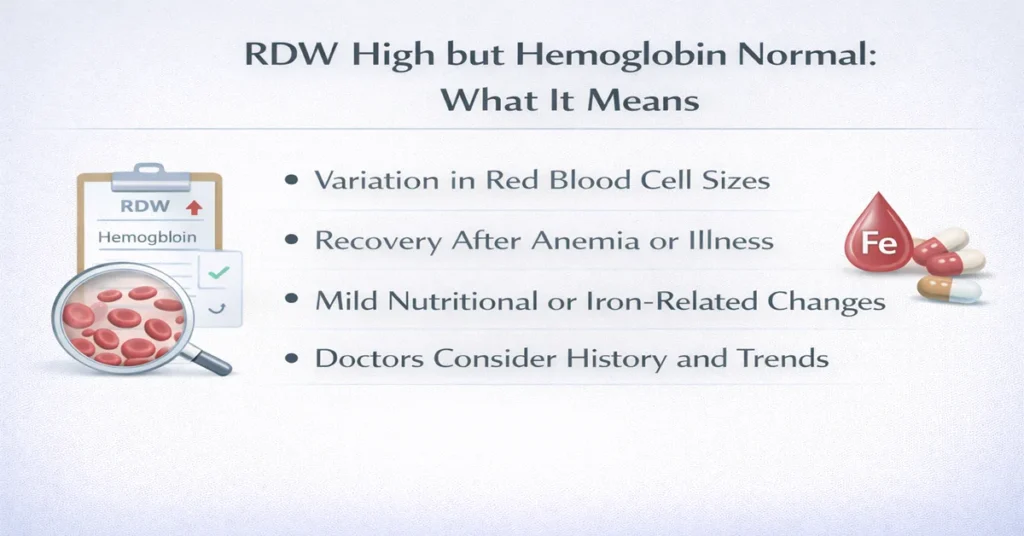
RDW High but Hemoglobin Normal – What This Report Combination Really Means
This is a report combination that creates a lot of confusion in OPD and diagnostic labs:
RDW is high, but hemoglobin is still normal.
Patients often ask:
“Is something wrong even though hemoglobin is normal?”
“Does this mean anemia is starting?”
“Why did the lab mark RDW as high if everything else looks fine?”
From more than 10 years of daily hospital and diagnostic lab experience, I can say this clearly:
RDW can be high even when hemoglobin is normal, and in many routine cases, it is not a serious finding.
This article focuses only on interpreting this exact situation. It does not explain what hemoglobin or RDW are in general, does not list causes of anemia, and does not overlap with treatment or deficiency articles. The aim is to help you understand what doctors actually think when they see this pattern on a CBC report.
Understanding the Confusion First
Most people are taught to look only at hemoglobin. If hemoglobin is normal, they assume everything in the blood report must be fine.
Then they notice RDW is marked high, and suddenly the report feels contradictory.
In real lab practice, this happens very often. RDW and hemoglobin measure different aspects of red blood cells, so it is possible for one to change while the other remains normal.
This does not automatically mean disease.
Why RDW Can Be High While Hemoglobin Is Still Normal
From routine diagnostic experience, this usually happens when red blood cell size variation has started, but overall oxygen-carrying capacity is still maintained.
In simple terms:
- Hemoglobin reflects how much oxygen-carrying protein is present
- RDW reflects how uniform or varied red blood cell sizes are
So RDW can rise earlier, before hemoglobin shows any change.
This is why doctors do not panic when they see this combination.
Real OPD and Lab Examples Seen Every Day
Early nutritional changes
In many patients, especially those with irregular diet or recent illness, RDW increases first. Hemoglobin stays normal for some time before showing any change.
Recovery after illness or blood loss
After fever, infection, surgery, or blood donation, the body produces new red blood cells. Old and new cells differ in size, increasing RDW, while hemoglobin may still appear normal.
Natural body variation
Some people naturally have more variation in red blood cell size without any clinical problem. RDW may stay slightly high for years with no symptoms.
Recent treatment or supplementation
After starting supplements (even without full anemia), RDW may temporarily rise as new cells enter circulation.
These are very common findings in OPD and usually do not require treatment.
How Doctors Clinically Interpret “RDW High, Hb Normal”
From a clinical point of view, doctors usually think in this order:
- Hemoglobin is normal → oxygen delivery is adequate
- RDW is high → red cell sizes are not uniform
- No symptoms → usually observation only
Doctors often see this as an early or transitional change, not a diagnosis.
They look at:
- Other CBC parameters
- Patient history
- Symptoms (if any)
- Previous reports
RDW alone rarely drives decisions.
When This Finding Is Usually Harmless
From daily lab and OPD experience, this combination is usually harmless when:
- Hemoglobin is clearly normal
- RDW is only mildly elevated
- Other CBC values are stable
- The patient feels well
- There is no history of chronic illness
In such cases, doctors often reassure the patient and do not start any treatment.
When Doctors Pay Closer Attention
Doctors may observe more carefully if:
- RDW continues to rise on repeat tests
- Hemoglobin begins to trend downward
- Symptoms like fatigue or weakness appear
- Other indices like MCV or MCH also change
- There is a known chronic or inflammatory condition
Even then, interpretation is gradual and based on trends, not a single report.
Does High RDW with Normal Hemoglobin Mean Anemia Is Coming?
Not always.
From lab experience:
- Sometimes RDW returns to normal on its own
- Sometimes it stays mildly elevated without consequences
- Sometimes it is an early signal that doctors monitor
It is not a confirmation that anemia will develop. It is simply a clue that doctors keep in mind.
Should Iron or Vitamin Supplements Be Taken Automatically?
Clinically, no.
When hemoglobin is normal:
- Deficiency is not confirmed
- Blind supplementation is usually avoided
- Doctors prefer observation or further evaluation if needed
Self-starting supplements based only on RDW is a common mistake.
Is Repeat Testing Always Required?
Not in every case.
From routine practice:
- If the patient is asymptomatic, repeat testing is often delayed
- Doctors may recheck CBC after a few months
- Immediate repeat testing is rarely needed
Repeat tests are used to see trends, not to react to one isolated value.
What This Report Does NOT Mean
This combination does not automatically mean:
- Serious anemia
- Blood cancer
- Bone marrow disease
- Lab error
Most of the time, it reflects normal physiological variation or early, mild changes.
How This Is Explained to Patients in OPD
In everyday OPD conversations, the explanation is usually simple:
“Your hemoglobin is normal. RDW is slightly high, which we often see before or after minor changes in the body. We’ll keep an eye on it, but there is no immediate concern.”
This approach helps patients stay calm and informed.
Test Preparation
To get the most reliable results in future CBC tests:
- Avoid testing during acute illness if possible
- Stay well hydrated before blood sampling
- Inform the lab about recent fever, infection, or blood donation
- Try to test under similar conditions when comparing reports
- Follow any fasting instructions given
Consistent testing conditions reduce unnecessary variation.
When to Consult a Doctor
Consult a doctor if:
- RDW continues to rise on repeated tests
- Hemoglobin starts decreasing
- You develop symptoms like fatigue, dizziness, or weakness
- Other CBC parameters become abnormal
- A doctor specifically advises further evaluation
If none of these apply, routine follow-up is usually sufficient.
Important Word Explanations
RDW (Red Cell Distribution Width)
A measure of variation in red blood cell size.
Hemoglobin
The oxygen-carrying protein inside red blood cells.
CBC (Complete Blood Count)
A test that measures different components of blood.
Red Blood Cells
Cells that carry oxygen from lungs to tissues.
Trend
The pattern seen when comparing multiple test results over time.
People Also Ask
Can RDW be high even if hemoglobin is normal?
Yes. This is a common and often harmless finding.
Does high RDW always mean anemia?
No. RDW can change before hemoglobin or without anemia.
Should I worry about high RDW alone?
Usually not, especially if hemoglobin is normal and you feel well.
Will RDW return to normal on its own?
In many cases, yes.
~END~