
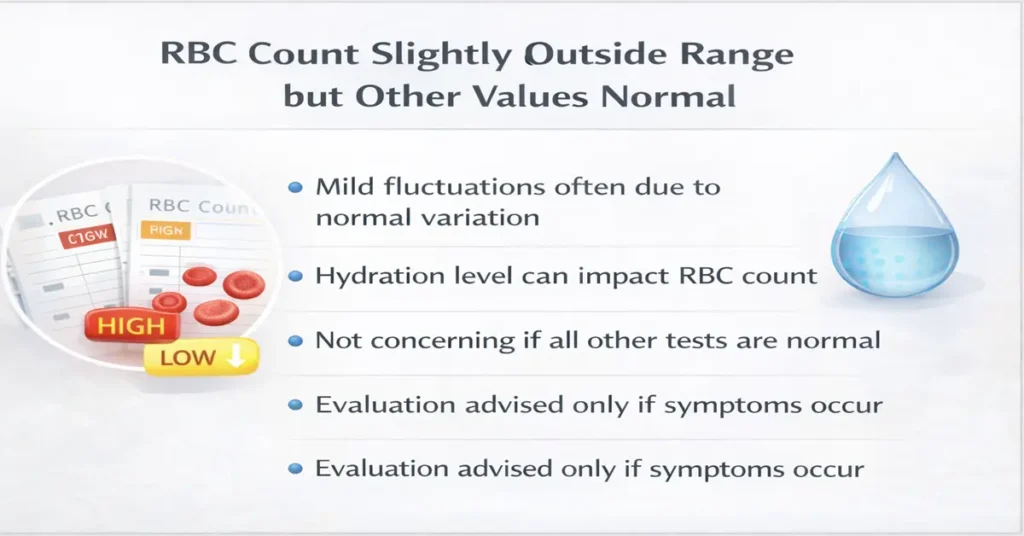
RBC Count Slightly Outside Range but Other Values Normal
A very common report that creates unnecessary worry
In OPD and diagnostic lab practice, one of the most frequent questions I hear is:
“My RBC count is just a little high / a little low, but everything else is normal. Is this a problem?”
This situation is extremely common. Patients notice the RBC value marked in red, while hemoglobin, hematocrit, platelets, and white blood cells all look fine. Naturally, the red highlight creates anxiety.
From more than 10 years of real hospital and lab experience, I can tell you this clearly and calmly:
a slightly abnormal RBC count with all other values normal is very often a harmless, technical, or physiological variation.
This article focuses only on this specific confusion and explains how doctors and lab professionals interpret it in real-world practice.
What “slightly outside range” really means in practice
When a report says RBC is “low” or “high,” many people assume something serious is wrong. But in reality:
- Reference ranges are statistical limits, not strict danger lines
- Being just above or below the cutoff does not automatically mean disease
- Labs flag values based on numbers, not on your overall health
Clinically, doctors always ask one simple question first:
“Baaki values kaise hain?”
If everything else is normal, the interpretation changes completely.
Why this happens so often in real lab work
From daily experience of validating CBC reports, there are several very common reasons why RBC alone can move slightly outside range.
1. Normal biological variation (most common reason)
The human body is not a machine. Blood values change naturally from day to day.
Just like:
- Blood pressure varies
- Sugar fluctuates
- Heart rate changes
RBC count also shows normal biological variation.
A value that is:
- Normal today
- Slightly low or high next time
can still be completely normal for your body.
Clinically, this is considered acceptable variation, not illness.
2. Hydration level at the time of testing
From lab experience, hydration is one of the biggest influencers of RBC count.
- Mild dehydration → RBC may appear slightly high
- Good hydration → RBC may appear slightly low
Many patients tell us:
“Us din pani kam piya tha”
or
“Test se pehle zyada water pi liya tha”
That alone can shift RBC count across the reference line, while all other values remain stable.
3. Timing of the blood sample
The timing of blood collection matters more than people realize.
For example:
- Early morning, fasting → RBC can look a bit higher
- Later in the day → RBC may look slightly lower
Same person. Same lab. Same analyzer.
Different timing → slightly different RBC count.
Doctors are well aware of this and rarely react to small changes.
4. Borderline values crossing the cutoff
Many people naturally sit near the upper or lower edge of the reference range.
In such cases:
- One test shows “normal”
- Another test shows “low” or “high”
The actual difference may be very small and clinically meaningless.
From OPD experience, this is one of the most common reasons for patient confusion.
5. Analyzer and lab-related variation
Inside the lab, RBC count depends on:
- Analyzer calibration
- Sample mixing
- Time between collection and testing
Even in high-quality labs, minor numerical variation is expected.
Doctors understand this and look at the overall pattern, not a single flagged value.
How doctors usually interpret this report combination
In real clinical practice, doctors do not focus on RBC count alone.
They look at:
- Hemoglobin stability
- Hematocrit trend
- RBC indices
- Patient symptoms
If:
- RBC is slightly outside range
- All other CBC values are normal
- Patient feels well
Doctors usually document:
“No clinically significant abnormality.”
In many OPDs, this report is not even discussed in detail unless the patient asks.
When this finding is usually harmless
From long lab and OPD experience, this situation is usually harmless when:
- RBC deviation is mild
- Hemoglobin is normal
- Hematocrit is stable
- Platelets and WBC are normal
- No symptoms like fatigue, dizziness, or breathlessness
In such cases, reassurance and observation are the correct medical approach.
When doctors start paying closer attention
Although uncommon, doctors become more alert if:
- RBC continues to move further outside range on repeat tests
- Hemoglobin also starts changing
- Multiple CBC parameters become abnormal together
- The patient develops symptoms
The concern is based on trend and context, not a single slightly abnormal number.
Should you repeat the test?
From routine lab protocol:
Repeat testing may be advised when:
- The test was done during illness
- Hydration was poor
- Doctor wants to confirm stability
Repeat testing is usually not required immediately when:
- Only RBC is mildly abnormal
- Other values are normal
- You feel fine
Unnecessary repeat testing often increases anxiety rather than clarity.
A common mistake patients make
Many patients:
- Google the RBC value
- Read about serious blood disorders
- Panic unnecessarily
In lab practice, we often reassure patients by saying:
“Sirf RBC thoda upar-neeche hai, baaki sab normal hai — clinically koi issue nahi.”
This reassurance is based on experience, not guesswork.
What this report does NOT automatically mean
A slightly abnormal RBC count with normal other values does not automatically indicate:
- Anemia
- Blood cancer
- Bone marrow disease
- Internal bleeding
Those conditions usually show multiple abnormal parameters and symptoms, not isolated mild RBC changes.
Practical advice from lab experience
- Do not judge your health by one highlighted value
- Always look at the full CBC picture
- Trust clinical correlation more than color-coded flags
Most healthy people will see this pattern at least once in their lifetime.
Test Preparation
To reduce unnecessary RBC variation in future tests:
- Maintain normal hydration (not too little, not excessive)
- Avoid heavy exercise before blood collection
- Try to give samples at a similar time each visit
- Inform the lab about recent illness or recovery
Consistent preparation gives more comparable results.
When to Consult a Doctor
Consult your doctor if:
- RBC abnormality increases over time
- Hemoglobin or other values also change
- You develop symptoms like fatigue or breathlessness
- Doctor advises follow-up based on your history
Otherwise, mild isolated RBC variation is usually not a cause for concern.
Important Word Explanations
RBC (Red Blood Cell): Cells that carry oxygen in blood.
CBC: Complete Blood Count test.
Reference Range: Statistical range used by labs for comparison.
Biological Variation: Normal day-to-day changes in body values.
Analyzer: Machine used to measure blood parameters.
People Also Ask
Is it normal for RBC count to be slightly high or low?
Yes. Mild variation is very common and often normal.
Should I worry if only RBC is abnormal?
Usually no, especially if all other values are normal.
Can dehydration affect RBC count?
Yes. It is one of the most common reasons.
Do I need treatment for mild RBC abnormality?
No treatment is needed unless other values or symptoms are present.
~END~