
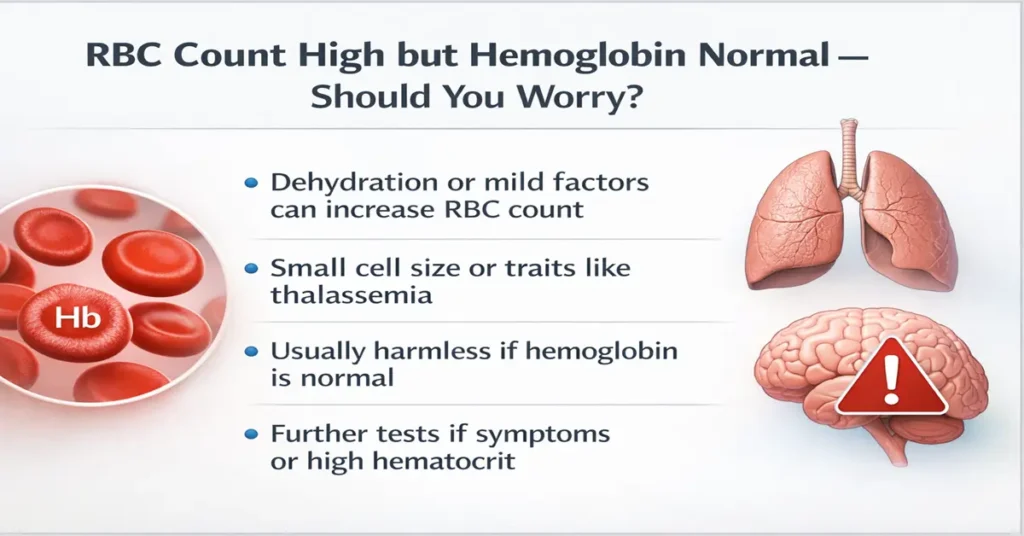
RBC Count High but Hemoglobin Normal – What It Means
Understanding the confusion first (very common in OPD)
In daily lab and OPD practice, one question I hear again and again is:
My RBC count is high, but hemoglobin is normal. Is something wrong?
Patients usually notice the RBC value highlighted in red on the report, while hemoglobin (Hb) looks perfectly fine. This mismatch naturally creates anxiety. Many people immediately think of blood diseases or serious conditions.
From real lab experience, most of the time this combination is not dangerous and often has a simple explanation.
This article focuses only on this exact situation — not general RBC meaning, not hemoglobin basics, and not disease lists. Let’s clear the confusion calmly and practically.
What this report pattern actually means in simple words
Red Blood Cell (RBC) count tells us how many red cells are present in a fixed amount of blood.
Hemoglobin tells us how much oxygen-carrying protein is inside those cells.
So, it is absolutely possible to have:
- More red cells in number
- But normal total hemoglobin
Clinically, this means:
- Each red cell may be slightly smaller, or
- The hemoglobin inside each cell may be a little less,
- But the overall oxygen-carrying capacity remains normal
That is why doctors often say:
“Hb normal hai, tension ki baat nahi.”
Why this happens so often in real lab practice
From routine diagnostic lab experience, there are a few very common, non-serious reasons for this pattern.
1. Mild dehydration on the day of test
This is extremely common.
When the body is slightly dehydrated:
- Plasma (liquid part of blood) reduces
- Blood becomes a little concentrated
- RBC count appears artificially higher
Hemoglobin usually stays stable, so only RBC shows a borderline rise.
This is why labs often ask:
“Paani theek se piya tha?”
A repeat test after good hydration often normalizes the RBC count.
2. Small-sized red blood cells (very common finding)
In many people, especially in India and South Asia:
- Red cells are slightly smaller than average
- Body compensates by producing more RBCs
Hemoglobin remains normal because:
- The total hemoglobin amount is still adequate
Clinically, this is seen with:
- Mild iron-related patterns (without true anemia)
- Genetic traits like thalassemia minor (often already known or asymptomatic)
In OPD, doctors usually correlate this with MCV and MCH values, not panic based on RBC alone.
3. Lab calculation and analyzer behavior
Modern hematology analyzers are very sensitive.
Sometimes:
- RBC count crosses the upper reference slightly
- But Hb, hematocrit, and clinical picture are all normal
In such cases, doctors treat it as a technical or physiological variation, not disease.
From lab experience:
“Single isolated RBC elevation without Hb change rarely means pathology.”
4. Smoking or living at higher altitude
Even mild, regular smoking can:
- Increase RBC production slightly
- Without pushing hemoglobin beyond normal
Similarly, people living at higher altitudes naturally develop:
- More RBCs to adapt to oxygen levels
- Hb may still stay within range
This is a normal physiological response, not illness.
How doctors usually interpret this combination
In OPD and hospital rounds, doctors never look at RBC alone.
They typically check:
- Hemoglobin
- Hematocrit
- MCV, MCH, MCHC
- Patient symptoms (or absence of symptoms)
If:
- Hemoglobin is normal
- Patient feels fine
- No breathlessness, weakness, or weight loss
Then clinically, the report is often labeled as:
“No active concern. Observation only.”
In most routine cases, no treatment and no urgent action is required.
When this finding is usually harmless
From years of lab and OPD coordination, this pattern is usually harmless when:
- Hemoglobin is clearly within normal limits
- Platelets and WBC counts are normal
- No symptoms like dizziness, chest pain, or breathlessness
- RBC is only mildly above range, not extremely high
Many patients repeat the test after 2–4 weeks and see normal values.
Situations where doctors pay closer attention
Although uncommon, doctors become more alert if:
- RBC count is significantly high, not borderline
- Hemoglobin starts trending upward in repeat tests
- Patient has symptoms like headaches, facial redness, or vision issues
- Hematocrit is also elevated
In such cases, further evaluation may be advised — but this is not the usual scenario for most people seeing this report pattern.
Should you repeat the test?
From lab practice, repeat testing is advised when:
- The sample was taken during illness, fever, or dehydration
- Blood was drawn after poor water intake
- The value is just slightly above normal
Repeat testing is not immediately needed if:
- Hb is stable
- No symptoms
- Doctor is satisfied clinically
Doctors always decide repeat testing based on the full picture, not one number.
Common patient mistake to avoid
Many patients:
- Google “high RBC”
- Read about serious blood disorders
- Panic unnecessarily
This is where lab professionals often reassure:
“Agar sirf RBC high hai aur Hb normal hai, toh usually serious problem nahi hoti.”
Context matters more than the bold red number.
Test Preparation
To avoid misleading results next time:
- Drink adequate water the day before and morning of the test
- Avoid heavy exercise just before blood collection
- Inform the lab if you smoke regularly
- Try to give samples in a rested state
Good preparation often prevents borderline abnormalities.
When to Consult a Doctor
Consult your doctor if:
- You have persistent symptoms like breathlessness or chest discomfort
- RBC count keeps rising in repeat reports
- Hemoglobin also starts increasing
- You have a known blood disorder or family history
Otherwise, in most routine cases, simple reassurance is enough.
Important Word Explanations
RBC (Red Blood Cell): Cells that carry oxygen in blood.
Hemoglobin (Hb): Protein inside RBCs that carries oxygen.
MCV: Average size of red blood cells.
MCH: Amount of hemoglobin inside one red blood cell.
Hematocrit: Percentage of blood made up of red cells.
Dehydration: Low body water content causing blood concentration.
People Also Ask
Is high RBC with normal hemoglobin dangerous?
In most routine cases, no. Doctors correlate with other values before worrying.
Can stress or dehydration increase RBC count?
Yes. Mild dehydration is a very common reason.
Does this mean I have a blood disease?
Not usually. Most serious blood disorders show changes in hemoglobin and symptoms too.
Should I take medicine to reduce RBC count?
No. Never self-treat based on a single lab value.
~END~