
Introduction
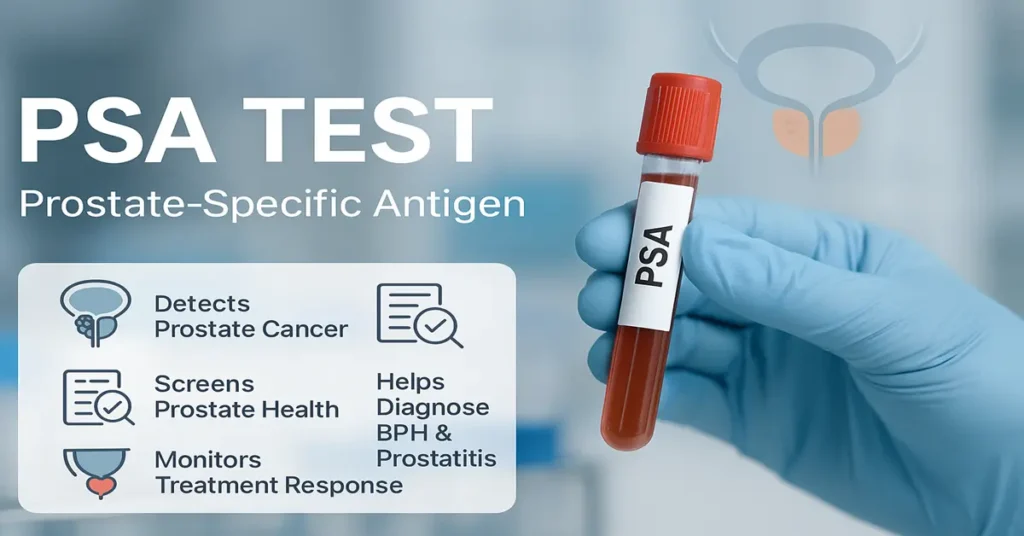
The PSA test (Prostate-Specific Antigen test) is a commonly used blood test for assessing prostate health in men. It supports the evaluation and monitoring of conditions such as prostate cancer, benign enlargement of the prostate, and inflammatory changes within the gland.
PSA is a protein naturally produced by the prostate. Under normal circumstances, only small amounts enter the bloodstream. When the prostate undergoes changes—whether due to enlargement, inflammation, or malignancy—PSA levels in blood may rise. Because of this behavior, PSA testing is often used to identify prostate-related issues at an early stage, sometimes even before noticeable symptoms develop.
What is PSA (Prostate-Specific Antigen)?
PSA, or Prostate-Specific Antigen, is a protein enzyme produced by both normal and abnormal prostate cells. Its primary physiological role is within seminal fluid, where it helps liquefy semen and supports sperm movement.
A small amount of PSA normally leaks into the blood. However, when the structure of the prostate is altered—through enlargement, inflammation, or cancer—greater amounts may enter circulation. This relationship between prostate tissue activity and blood PSA levels makes PSA a useful laboratory marker for prostate health assessment.
Clinical Use of PSA Test
In clinical practice, PSA testing is used to support several aspects of prostate care. It may be part of routine screening in selected men, help guide evaluation when urinary or pelvic symptoms are present, and assist in monitoring men with known prostate cancer. After treatment, PSA trends are followed over time to assess disease control or detect possible recurrence.
Importantly, PSA results are always interpreted alongside clinical findings and, when needed, imaging or biopsy results.
Where is PSA Produced in the Body?
PSA is produced by epithelial cells lining the prostate gland. The prostate is a small gland located below the bladder and in front of the rectum, and it plays an essential role in male reproductive function.
Most PSA is released into seminal fluid. In healthy prostate tissue, only minimal amounts pass into the bloodstream. When the prostate is disrupted by disease or mechanical irritation, blood PSA levels may rise due to increased leakage.
Functions and Importance of PSA
1. Semen Liquefaction
PSA helps break down proteins in semen after ejaculation. This process allows sperm to move freely, which is necessary for normal reproductive function.
2. Marker of Prostate Health
Clinically, PSA serves as an indirect marker of prostate activity. Changes in PSA levels can reflect alterations within prostate tissue, prompting further evaluation when needed.
3. Cancer Detection and Monitoring
PSA testing plays a central role in the detection and follow-up of prostate cancer. Rising or persistently elevated values may signal disease activity, while stable or declining levels often reflect controlled disease.
4. Treatment Monitoring
After prostate cancer treatment, PSA is measured periodically. Trends over time help clinicians assess response and detect early signs of recurrence.
Causes of Low PSA Levels
Low PSA levels are common in healthy men and usually indicate normal prostate function.
In men who have undergone prostate removal surgery or certain forms of hormonal therapy, PSA levels may become very low or undetectable. In these settings, low PSA is generally expected and clinically reassuring.
Symptoms of Low PSA
Low PSA levels do not cause symptoms.
They typically reflect either normal prostate physiology or effective disease control in men previously treated for prostate conditions.
Causes of High PSA Levels
Elevated PSA levels can occur in both malignant and non-malignant conditions.
Cancer-Related Causes
In prostate cancer, PSA levels are often higher than expected for age. Increasing values over time may suggest active or progressive disease, particularly when supported by other clinical findings.
Non-Cancerous Causes
PSA can also rise due to benign conditions. Common contributors include benign prostatic hyperplasia (BPH), inflammation of the prostate, urinary tract infections, or temporary irritation of the gland. PSA levels may also increase with age, even in the absence of disease.
Transient elevations may occur after ejaculation or prostate manipulation, which is why timing and clinical context are important when interpreting results.
Symptoms of High PSA
PSA itself does not produce symptoms. Any symptoms present are related to the underlying prostate condition.
These may include urinary frequency, difficulty with urine flow, discomfort during urination, or pelvic discomfort. In more advanced disease, additional symptoms may occur. Persistent or worsening symptoms should always prompt medical evaluation.
PSA Test Reference Ranges (Blood Levels)
PSA values are often interpreted using age-adjusted reference ranges.
- Men under 50 years: typically lower PSA values
- Men 50–59 years: mild age-related increase
- Men 60–69 years: higher acceptable upper range
- Men 70 years and above: further age-related rise may be seen
A single PSA value above the expected range does not confirm cancer. Clinicians focus on overall trends, rate of change, and associated clinical findings when deciding on further evaluation.
Sample Type and Test Details
- Sample Type: Blood (serum)
- Tube Used: Red-top plain tube
- Test Method: Immunoassay-based analysis
- Fasting: Not required
Test Preparation
No special fasting is needed for PSA testing.
To reduce the chance of temporary PSA elevation, it is generally advised to avoid activities that may irritate the prostate shortly before testing. Informing the doctor about current medications or recent procedures helps ensure accurate interpretation.
When to Consult a Doctor
Medical consultation is recommended if:
- PSA levels are higher than expected for age
- PSA values rise steadily on repeat testing
- Urinary or pelvic symptoms persist
- There is a family history of prostate cancer
- PSA is being monitored during or after treatment
Early discussion with a healthcare provider allows timely evaluation and appropriate follow-up.
Important Word Explanations
- PSA (Prostate-Specific Antigen): A protein produced by prostate cells and measured to assess prostate health
- Prostate Gland: A male reproductive gland located below the bladder
- Prostatitis: Inflammation of the prostate gland
- Benign Prostatic Hyperplasia (BPH): Non-cancerous enlargement of the prostate
- Prostate Cancer: Malignant growth of prostate cells
- Prostatectomy: Surgical removal of the prostate
- Biopsy: A procedure in which tissue samples are examined for disease
~END~
Related Posts
None found