
Platelets: Functions, Importance, Normal Ranges by Age, Gender & Pregnancy, and When High or Low Becomes Risky
Platelets are small blood cells, but in day-to-day clinical practice, their importance is never small. In OPD and lab settings, platelets are often the first parameter doctors look at when there is bleeding, bruising, fever, surgery, or pregnancy-related concerns. Their main role is to prevent blood loss and support healing, but they also quietly assist immunity and blood vessel health.
This article explains what platelets do, why they matter, normal platelet ranges at different life stages, and how doctors judge when low or high platelet levels become a real concern. The explanation stays practical and patient-friendly, exactly how it is discussed in routine medical care.
What Are Platelets? (Short Overview)
Platelets are small, disc-shaped cell fragments produced in the bone marrow. They circulate in the blood and remain inactive until the body needs them.
A platelet count is checked through a CBC (Complete Blood Count) test.
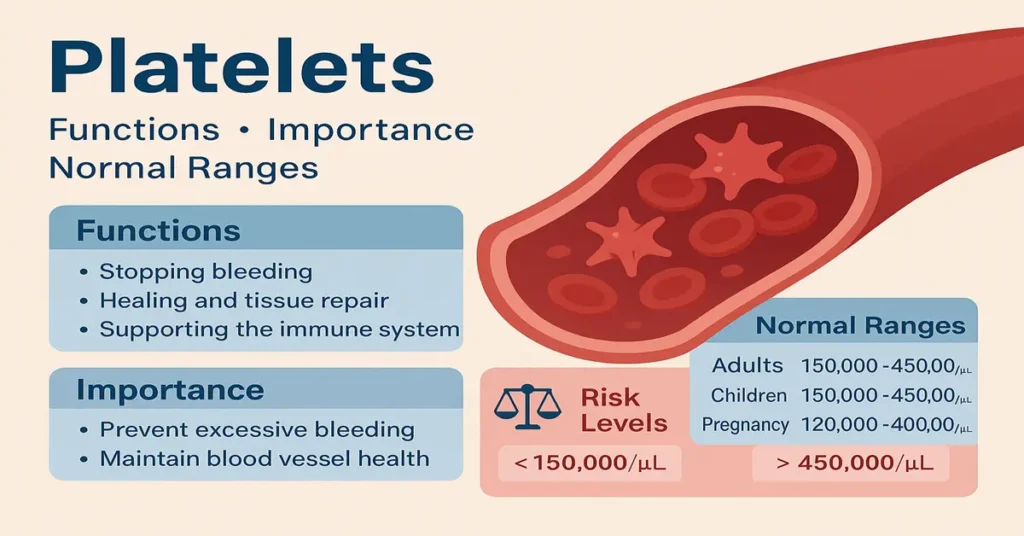
- Normal range: 150,000 – 450,000 per microliter (µL)
Both low platelets (called thrombocytopenia) and high platelets (called thrombocytosis) can create problems if they persist or drop/rise significantly. Clinically, platelets are always interpreted along with symptoms, not in isolation.
Functions of Platelets
From a real-world clinical perspective, platelets perform multiple roles beyond just clotting.
1. Stopping Bleeding
This is their primary and most critical function. When there is a cut, injury, or internal vessel damage, platelets:
- Rush to the site
- Stick together
- Form an initial plug that stops bleeding
This is the body’s first line of defense against blood loss.
2. Healing and Tissue Repair
Platelets release growth factors such as PDGF, TGF-β, and VEGF. These signals help surrounding tissues heal after injury, surgery, or inflammation. This is why low platelets often slow wound healing.
3. Protecting During Surgery, Delivery, and Trauma
In surgical and obstetric practice, platelet count is checked because insufficient platelets can increase bleeding risk, even when clotting tests are otherwise normal.
4. Supporting the Immune Response
Platelets interact with white blood cells and help the body respond to infections. In routine lab work, platelet changes are often seen during infections, even before other parameters shift.
5. Maintaining Blood Vessel Integrity
Platelets help repair tiny, everyday damage inside blood vessels, keeping the vessel lining healthy and stable.
Why Platelets Are Important for Overall Health
Platelets maintain balance in the body. Too few, and bleeding becomes a concern. Too many, and clotting risk increases.
Clinically, normal platelet levels ensure:
- Safe clot formation
- Controlled bleeding
- Smooth recovery after injury
- Protection during infections and inflammation
Stable platelet counts usually mean the body’s internal repair system is working properly.
Normal Platelet Ranges
Platelet counts vary slightly with age, pregnancy, and physiological changes. These variations are well-recognized in routine lab interpretation.
1. Normal Platelet Range in Adults
- Adult men: 150,000 – 400,000/µL
- Adult women: 150,000 – 450,000/µL
Women may show slightly higher upper limits due to hormonal influences and menstrual blood loss.
2. Platelet Ranges in Children
- Newborns: 100,000 – 400,000/µL
- Infants: 150,000 – 450,000/µL
- Children: 150,000 – 450,000/µL
Newborns naturally have a wider range as their blood system adapts after birth.
3. Platelets During Pregnancy
During pregnancy, mild platelet reduction is commonly seen due to increased blood volume.
- First trimester: 150,000 – 400,000/µL
- Second trimester: 130,000 – 400,000/µL
- Third trimester: 120,000 – 390,000/µL
Clinically, this mild drop is often physiological and monitored rather than treated.
When Do Platelet Levels Become Risky?
Doctors assess risk based on levels, symptoms, and trends, not just one report.
Low Platelets (Thrombocytopenia)
Platelet counts below 150,000/µL may be considered low.
Common clinical associations include infections, nutritional deficiencies, autoimmune conditions, liver disease, and pregnancy-related changes.
Risk levels doctors usually follow:
- 50,000 – 150,000: Mild risk, often monitored
- 20,000 – 50,000: Moderate risk, bleeding risk increases
- Below 20,000: High risk, medical emergency level
At very low levels, even minor trauma can cause significant bleeding.
High Platelets (Thrombocytosis)
Platelet counts above 450,000/µL are considered high.
Most cases seen in practice are secondary (reactive), often linked to infection, inflammation, dehydration, or iron deficiency.
Risk levels commonly considered:
- 450,000 – 600,000: Mild elevation, often temporary
- 600,000 – 800,000: Higher clot risk, needs evaluation
- Above 1,000,000: Very high, urgent assessment required
Persistent or unexplained high platelets raise suspicion for bone marrow disorders.
How Platelet Levels Are Checked and Interpreted
Platelets are measured through a CBC test. If abnormal, doctors may correlate results with:
- Peripheral blood smear
- Iron studies
- Inflammatory markers
- Vitamin levels
- Liver and kidney function tests
In routine lab practice, platelet values are always interpreted in context.
Maintaining Healthy Platelet Levels (General Clinical Perspective)
Doctors usually advise:
- Balanced nutrition
- Adequate hydration
- Avoiding smoking
- Limiting alcohol
- Managing chronic illnesses
- Regular follow-up if abnormalities persist
These steps support stable platelet production but are not substitutes for medical evaluation.
Test Preparation (For Platelet / CBC Test)
- No fasting required
- Normal water intake recommended
- Avoid intense exercise just before testing
- Inform about medications
- Ongoing fever or infection can temporarily alter results
When to Consult a Doctor
Medical review is advised if:
- Platelets fall below 120,000/µL or rise above 500,000/µL
- There is unexplained bruising or bleeding
- Platelet levels change rapidly
- There are symptoms of clotting (chest pain, limb swelling)
- You are pregnant and platelet levels continue to drop
Important Word Explanations
- Thrombocytopenia: Low platelet count
- Thrombocytosis: High platelet count
- Bone marrow: Tissue where blood cells are made
- Clotting: Process that stops bleeding
- Inflammation: Body’s response to injury or infection
People Also Ask
Is a low platelet count always dangerous?
No. Mild reductions are common during infections or pregnancy and are often temporary.
Can platelet levels change from one test to another?
Yes. Platelets can fluctuate due to hydration, infection, or recovery phases.
Does high platelet count always mean a blood disorder?
No. Most high counts are reactive and related to infection or inflammation.
When do doctors usually worry about platelets?
Concern rises when levels are very low, very high, or persistently abnormal with symptoms.
Is repeat testing common for platelet abnormalities?
Yes. Trends over time are more important than a single value.
Can platelet problems exist without symptoms?
Yes. Many people feel normal despite abnormal platelet counts, which is why CBC testing is important.
~END~