
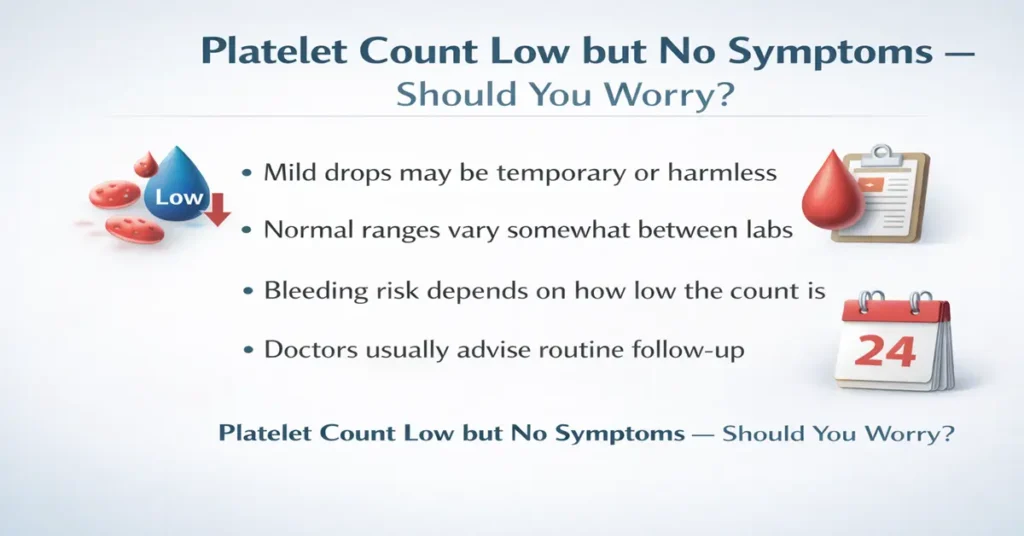
Platelet Count Low but No Symptoms – What This Situation Usually Means
This is a very common situation I see in daily OPD work.
A patient comes with a routine blood report, notices that the platelet count is a little low, but feels completely fine. No bleeding, no bruises, no weakness. Naturally, the first question is:
“If my platelets are low, why don’t I have any symptoms?”
From real hospital and diagnostic lab experience, the answer is often simple and reassuring:
In many routine cases, a low platelet count without symptoms is not immediately dangerous.
What matters most is how low the count is, whether it is stable, and whether the patient has any bleeding signs. Platelet numbers alone never tell the full story.
Let me explain this calmly, the same way I explain it to patients sitting across the lab desk.
Why This Report Combination Creates Confusion
Most people associate platelets directly with bleeding. So when they see a “low” mark on the report, they expect symptoms like:
- Nosebleeds
- Gum bleeding
- Easy bruising
When none of these are present, it feels confusing and scary.
In real-world lab practice, however, many patients with mildly low platelet counts feel completely normal. This is because the body has a safety margin, and platelets do not cause problems until they fall to much lower levels.
What “Low Platelet Count Without Symptoms” Usually Means in Practice
From daily CBC reporting experience, this combination often means:
- The platelet count is only mildly reduced
- Platelet function is still adequate
- The body’s clotting system is working normally
- There is no active bleeding risk
Clinically, this is often observed rather than treated aggressively.
Common Real-Life Reasons We See in OPD
1. Temporary or Incidental Lab Finding (Very Common)
One of the most frequent situations.
A patient does a routine test:
- During a health checkup
- For job screening
- Before surgery
The platelet count comes slightly low, but the patient feels fine.
From lab experience, many of these cases:
- Normalize on repeat testing
- Are due to temporary factors
- Do not represent a disease
This is why doctors often advise repeat testing before worrying.
2. Recent Viral Illness or Fever
This is extremely common.
After a viral infection:
- Platelet counts may drop slightly
- Symptoms may already have resolved
- The count improves gradually on its own
We see this pattern regularly after:
- Viral fevers
- Seasonal infections
- Mild flu-like illnesses
In such cases, no symptoms does not mean the report is wrong—it means recovery is already happening.
3. Individual Baseline Variation
Some people naturally have platelet counts that stay near the lower limit.
From OPD experience:
- These patients feel normal
- Past reports show similar values
- There is no bleeding history
Clinically, doctors often label this as a stable baseline, not a problem.
4. Lab-Related or Sample Factors
This is something patients rarely realize.
Platelet counts can appear low due to:
- Sample handling issues
- Mild platelet clumping
- Delay in processing
In such cases, the patient has:
- No symptoms
- No bleeding history
- Normal repeat test
This is why one report is never enough for conclusions.
5. Mild Bone Marrow Suppression That Is Clinically Silent
Sometimes, platelet production slows slightly due to:
- Stress
- Recent illness
- Medications
But not enough to cause symptoms.
From lab experience, these cases:
- Are usually mild
- Do not cause bleeding
- Improve with time
Doctors monitor rather than intervene.
Why Symptoms May Be Absent Even If Platelets Are Low
This is an important point.
The body can function normally even when platelets are reduced, as long as:
- The count is not critically low
- Platelets function well
- Other clotting factors are normal
That’s why many patients with low platelet counts do not have nosebleeds, bruises, or bleeding.
When Low Platelets Without Symptoms Is Usually Harmless
From OPD and hospital experience, it is often harmless when:
- Platelet count is only mildly reduced
- The patient has no bleeding signs
- Other CBC values are stable
- There is no history of bleeding
- The value is similar to previous reports
In such cases, doctors usually reassure the patient and advise follow-up only.
When This Situation Needs More Attention
Even without symptoms, attention is needed if:
- Platelet count keeps falling on repeat tests
- The drop is sudden or significant
- Other blood counts are also abnormal
- There is a history of bleeding disorders
- The patient is on medications affecting platelets
Still, even in these cases, investigation is done calmly and step by step, not as an emergency unless symptoms appear.
How Doctors Usually Interpret This Report
Clinically, doctors do not panic over platelets alone.
They usually look at:
- Absolute platelet number
- Trend over time
- Presence or absence of bleeding
- Patient history and medications
If platelets are low but the patient feels well, the approach is usually:
- Observation
- Repeat CBC after a short interval
- Clinical correlation
Immediate treatment is rarely needed without symptoms.
Is Repeat Testing Necessary?
Repeat Testing Is Usually Advised When:
- This is the first time platelets are low
- There was a recent illness
- The value is borderline
- The doctor wants to confirm stability
Repeat Testing Is Often Not Urgent When:
- Platelet count is stable over time
- The patient has no symptoms
- Previous reports show similar values
From lab experience, many repeat tests show improvement or no change.
A Practical Note From the Lab Counter
I often tell patients:
“Platelet count tells us how many soldiers you have, not whether a battle is happening.”
If there is no bleeding and the count is stable, the body is usually managing well.
Test Preparation
- No fasting is required for platelet testing
- Avoid testing during active fever if possible
- Inform the lab about recent infections or medications
- Try to use the same lab for repeat tests to compare trends
When to Consult a Doctor
Consult a doctor if:
- You notice bleeding from gums or nose
- There are unexplained bruises
- Platelet count keeps dropping
- You feel excessive fatigue or weakness
- You are scheduled for surgery or dental procedures
If platelets are low but you feel fine, routine medical follow-up is usually sufficient.
Important Word Explanations
Platelets
Small blood components that help stop bleeding.
CBC (Complete Blood Count)
A blood test that measures different components of blood together.
Bone marrow
The tissue inside bones that produces blood cells.
Bleeding tendency
A tendency to bleed easily due to low platelets or clotting problems.
Repeat testing
Doing the same blood test again to confirm or track changes.
People Also Ask
Can platelets be low without symptoms?
Yes. This is very common, especially when the drop is mild.
Is low platelet count always dangerous?
No. Many mild cases are stable and harmless.
Do low platelets always cause bleeding?
No. Bleeding usually occurs only at much lower levels.
Should I panic if platelets are low once?
No. Repeat testing and clinical correlation are more important.
~END~