
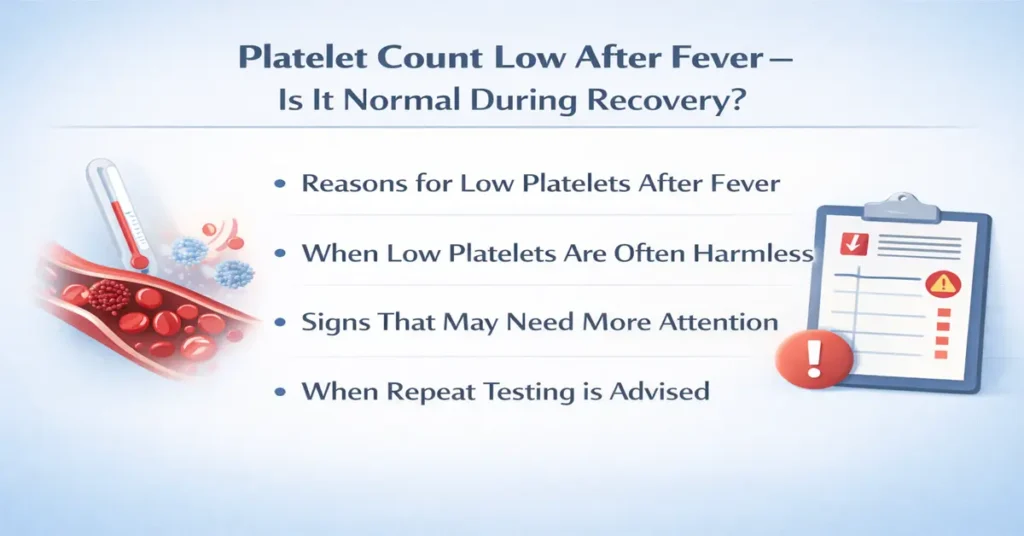
Platelet Count Low After Fever – What This Report Usually Means in Real Lab Practice
As a senior medical laboratory technician, this is one of the most frequent questions I hear after viral seasons, monsoons, or community outbreaks:
“My fever is gone, but my platelet count is low. Why did this happen now?”
In routine OPD and diagnostic lab practice, low platelet count after fever is very common and, in most cases, part of the natural recovery phase, not a new disease. The confusion usually happens because patients expect blood reports to normalize immediately once the fever settles—but the body doesn’t work that way.
This article is written only to explain this exact situation, based on daily lab experience. It is not a general platelet guide and not about treatment or disease naming.
Why Platelets Often Drop After Fever Ends
From real-world lab observation, platelets don’t always fall during fever. In many viral and febrile illnesses, they drop after the temperature comes down. This timing confuses patients the most.
Clinically, fever triggers:
- Immune activation
- Temporary bone marrow suppression
- Increased platelet consumption
Once the fever settles, the body is still in recovery mode, and platelet production may take a few days to catch up.
So when a blood test is done after fever, the report may suddenly show low platelets—even though the patient feels better.
Common Real OPD Situations Where This Happens
1. Blood Test Done Right After Fever Subsides
Very often, patients test their blood:
- On day 1–3 after fever
- When weakness is still present
- For reassurance
This is exactly when platelet count can appear low. From lab experience, this is one of the most common scenarios, and usually self-corrects.
2. Viral Infections and Post-Viral Phase
Most viral fevers temporarily affect platelet production. Even when:
- Fever is gone
- Appetite improves
- Body pain reduces
platelets may still lag behind.
Doctors usually interpret this as post-viral thrombocytopenia, not a fresh problem.
3. Immune System “Cleanup” Phase
After fever, the immune system continues clearing damaged cells. Platelets may be:
- Used up faster
- Destroyed temporarily
This does not mean permanent damage. From lab follow-ups, platelet counts often start rising within a week.
4. Dehydration During Fever
Fever causes fluid loss. After recovery:
- Blood concentration changes
- Lab values fluctuate
Once hydration improves, platelet readings often stabilize.
Why Patients Feel Fine Even with Low Platelets
This is another major confusion:
“Platelets are low, but I have no bleeding. How?”
From clinical experience:
- Mild to moderate platelet drops do not cause symptoms
- Bleeding risk usually appears only at much lower levels
That’s why many patients:
- Feel normal
- Have no bruising
- Have no nose or gum bleeding
And yet, the report shows a low count.
Doctors look at clinical condition first, not just numbers.
When This Situation Is Usually Harmless
In most routine OPD cases, low platelets after fever are considered temporary and harmless when:
- Fever has resolved
- No active infection signs remain
- No bleeding symptoms are present
- Platelet count is stable or improving
- Other blood parameters are settling
From lab experience, most patients fall into this category and recover without intervention.
Doctors often reassure and advise observation.
When Doctors Pay Extra Attention
While most cases are simple, doctors become cautious when:
- Platelets continue to fall instead of rise
- There is active bleeding or bruising
- Fever keeps coming back
- Other blood counts worsen
- Patient has chronic illness or immune disorder
Even then, doctors don’t jump to conclusions. They usually:
- Repeat tests
- Monitor trends
- Correlate clinically
How Doctors Interpret “Low Platelets After Fever”
In daily OPD practice, doctors typically think in this order:
- Timing of the test – Was it done too early?
- Recovery status – Is the patient improving clinically?
- Trend – Is this the first report or a repeat?
- Symptoms – Any bleeding or warning signs?
If the patient is improving and asymptomatic, the interpretation is usually:
“Post-fever recovery phase. Observe and repeat if needed.”
This approach prevents unnecessary panic and overtreatment.
Is Repeat Testing Always Required?
Repeat testing is commonly advised when:
- Platelets are moderately low
- The test was done very soon after fever
- Doctor wants to see recovery trend
Repeat testing may not be urgent when:
- Platelet count is only mildly reduced
- Patient feels well
- No bleeding signs are present
From lab experience, doctors often repeat the test after 3–7 days, not immediately.
Common Myths Patients Believe
- “Low platelets after fever means something serious” ❌
- “Platelets should become normal the next day” ❌
- “Immediate treatment is required” ❌
In most routine cases, these beliefs are not correct. Blood recovery takes time.
Test Preparation
For accurate platelet reporting after fever:
- Be well hydrated
- Avoid heavy exercise before testing
- Inform the lab about recent fever
- Prefer morning sample if repeating
- Avoid testing too frequently unless advised
Good preparation helps avoid misleading values.
When to Consult a Doctor
Consult your doctor if:
- Platelet count keeps dropping on repeat tests
- You notice bleeding, bruising, or red spots
- Fever returns or persists
- There is dizziness, severe weakness, or pain
- Doctor specifically advises evaluation
If you feel well and the fever has resolved, consultation is usually not urgent, but follow medical advice.
Important Word Explanations
Platelets
Blood cells that help prevent bleeding by forming clots.
Post-viral phase
Recovery period after a viral illness when the body restores normal function.
Thrombocytopenia
Medical term for low platelet count.
Bone marrow suppression
Temporary slowing of blood cell production during illness.
Clinical correlation
Interpreting lab results along with symptoms and examination.
People Also Ask
Is low platelet count after fever common?
Yes, it is very common in routine lab practice.
How long does it take for platelets to recover?
In most cases, they start improving within a few days to a week.
Can platelets drop after fever even if I feel fine?
Yes. Symptoms do not always match lab values immediately.
Should I test again immediately?
Usually no. Doctors often wait a few days unless symptoms appear.
~END~