
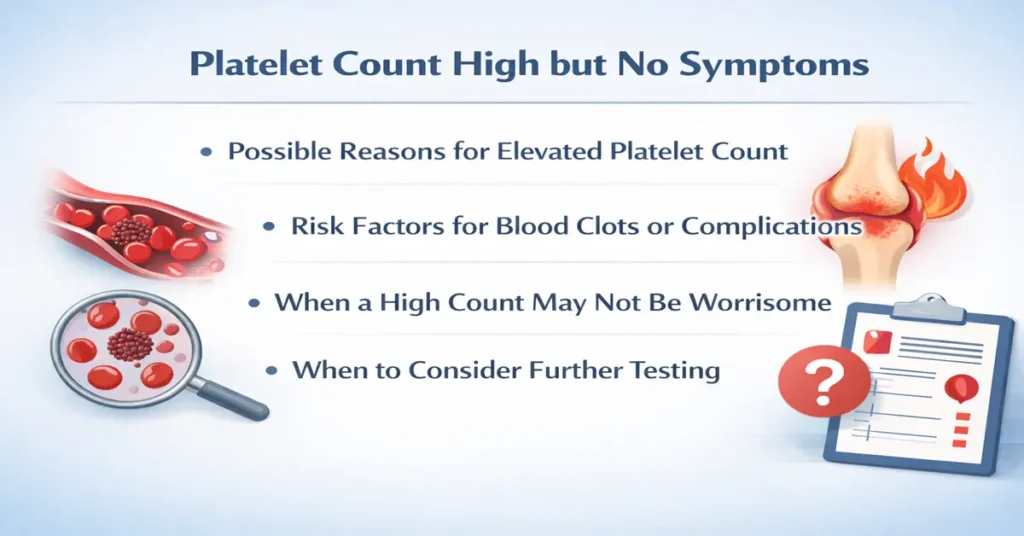
Platelet Count High but No Symptoms – What It Really Means in Daily Lab Practice
As a senior medical laboratory technician, this is one of the most common report-related doubts I hear in OPDs and diagnostic centers:
“My platelet count is high, but I feel completely fine. Is something wrong?”
In most routine lab settings, a high platelet count without any symptoms is not an emergency and often not a disease by itself. Still, seeing a bold or flagged number on a report can make anyone anxious. This article is written to clear that exact confusion, using real-world lab experience—not textbook fear.
This is not a general platelet overview and not about reducing platelets. It is only about understanding this specific situation and how doctors usually interpret it.
Why Platelets Can Be High Even When You Feel Normal
From daily lab experience, a raised platelet count without symptoms is usually picked up incidentally. The patient often came for:
- A routine health check
- A pre-employment test
- Follow-up after fever or infection
- Another unrelated blood test
Clinically, platelets can rise silently. Unlike hemoglobin or white cells, mild to moderate platelet elevation does not always cause noticeable symptoms.
In many cases, the body increases platelets as a temporary response, not as a warning sign.
What “High Platelet Count” Usually Means in Practical Terms
In real lab practice, doctors rarely react to a single mildly high platelet value if:
- The patient feels well
- There is no bleeding or clotting history
- Other blood parameters look stable
A slightly or moderately high platelet count is often treated as a reaction, not a diagnosis.
From a technician’s perspective, the context of the test matters more than the number itself.
Common Real-World Reasons Seen in OPD and Labs
1. Recovery Phase After Infection or Fever
One of the most frequent lab patterns we see:
- Platelets rise after the fever settles
- Patient feels normal again
- No active infection present
This is called a reactive rise, and it often normalizes on its own within a few weeks.
2. Recent Inflammation or Minor Illness
Even small issues like:
- Dental infections
- Minor injuries
- Hidden inflammation
can stimulate the bone marrow to produce more platelets temporarily, without causing symptoms.
3. Stress, Physical Strain, or Dehydration
In OPD practice, patients tested:
- After travel
- During stress
- Without proper hydration
may show a mildly elevated platelet count. This is usually not clinically significant.
4. Iron Deficiency (Even Without Symptoms)
This surprises many patients.
Even without fatigue or weakness, iron deficiency can push platelet counts up. This is a very common lab finding and often missed unless iron studies are checked.
5. Laboratory or Sample-Related Factors
From lab experience:
- Delayed sample processing
- Mild clotting in the sample
- Hemoconcentration
can slightly affect platelet values. That’s why doctors often prefer repeat testing before conclusions.
When High Platelets Are Usually Harmless
Clinically and practically, platelet elevation is often considered benign when:
- The patient has no symptoms
- There is no history of clots or bleeding
- White blood cell count is normal or improving
- The rise is not progressive over time
In such cases, doctors often:
- Reassure the patient
- Advise hydration
- Suggest follow-up only if needed
From lab experience, most asymptomatic high platelet reports fall into this category.
When Doctors Pay Closer Attention
While most cases are harmless, doctors become more alert when:
- Platelet count is persistently very high
- The value keeps rising on repeated tests
- There is a personal or family history of clotting
- Other blood parameters are abnormal
- The patient has unexplained weight loss, night sweats, or fatigue
Even then, doctors don’t panic. They correlate clinically and may advise further evaluation if required.
How Doctors Usually Interpret This Combination
In routine OPD settings, doctors typically ask:
- Was there a recent infection or fever?
- Is this the first test or a repeat?
- Are there any symptoms at all?
- What do the other blood values show?
If everything else is stable, the interpretation is often:
“Likely reactive. Observe and repeat if needed.”
This approach avoids unnecessary testing and anxiety.
Is Repeat Testing Always Needed?
From lab and OPD experience:
Repeat testing is usually advised when:
- Platelets are significantly above previous values
- The test was done during illness
- The report was unexpected
Repeat testing is often not urgent when:
- The rise is mild
- The patient is asymptomatic
- There is a clear temporary cause
Doctors generally prefer to wait 2–4 weeks before repeating, unless there is a clinical reason to do it earlier.
What Patients Often Misunderstand
Many patients believe:
- High platelets always mean cancer ❌
- High platelets always cause clots ❌
- Immediate treatment is needed ❌
From real lab experience, these assumptions are incorrect in most routine cases. Numbers alone do not define disease.
Test Preparation
For accurate platelet results:
- Stay well hydrated before testing
- Avoid heavy exercise just before sample collection
- Inform the lab about recent illness or fever
- Prefer morning sample if repeat testing is planned
Proper preparation helps avoid misleading values.
When to Consult a Doctor
Consult a doctor if:
- Platelet count remains high on repeated tests
- You develop new symptoms like unexplained pain, swelling, or bleeding
- There is a history of clotting disorders
- Your doctor specifically advises further evaluation
If you feel normal and this is a one-time finding, consultation is usually not urgent, but follow your doctor’s advice.
Important Word Explanations
Platelets
Tiny blood cells that help in clot formation and bleeding control.
Reactive Platelet Increase
A temporary rise in platelets due to infection, inflammation, or recovery—not a disease.
Asymptomatic
Having no noticeable symptoms.
Bone Marrow
The soft tissue inside bones where blood cells are produced.
Hemoconcentration
A temporary increase in blood cell concentration due to dehydration.
People Also Ask (Common Patient Questions)
Can high platelets be temporary?
Yes, very often. Especially after fever or inflammation.
Should I worry if I feel fine?
In most routine cases, no. Observation is usually enough.
Do high platelets always need treatment?
No. Treatment depends on cause, persistence, and clinical context.
Can stress affect platelet count?
Yes, physical and emotional stress can cause mild changes.
~END~