
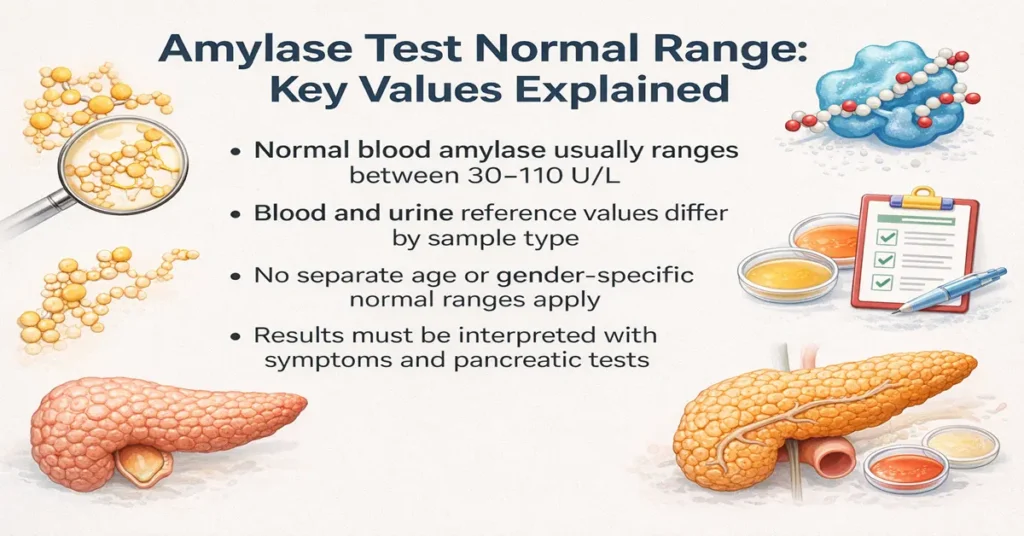
Normal Range of Amylase Test
The amylase test is a common laboratory investigation used to assess digestive enzyme activity, mainly related to the pancreas and salivary glands. Amylase helps break down carbohydrates into simpler sugars so the body can absorb and use them for energy. Measuring its level in blood or urine helps doctors understand whether the pancreas or related organs are functioning as expected.
Knowing the normal range of the amylase test is important because even small deviations can act as clinical signals. At the same time, a single value never tells the full story. In routine lab practice, this result is always read alongside symptoms, medical history, and other investigations.
Why Normal Range Matters
The normal range serves as a reference point to decide whether amylase levels are low, normal, or high. When values fall outside this range, it can suggest inflammation, blockage, irritation, or damage involving the pancreas, salivary glands, or organs responsible for clearing the enzyme.
Clinically, this is where doctors usually pause and correlate the number with the patient’s symptoms. For example, a person with sudden severe upper abdominal pain and vomiting who shows amylase levels several times above normal raises concern for acute pancreatitis. On the other hand, someone with long-standing pancreatic disease may show normal or even low amylase levels because enzyme-producing cells are already damaged.
This is why understanding the normal range helps avoid unnecessary panic and keeps the focus on meaningful clinical interpretation.
General Reference Range
In most laboratories, the normal blood (serum) amylase range for adults is approximately:
30 to 110 units per liter (U/L)
Some labs may report slightly different limits, such as 25–125 U/L. These differences are expected and depend on the testing method and equipment used. The reference range printed on the lab report is always the correct one to use.
Amylase can also be measured in urine. Urine amylase reflects enzyme excretion over time and may be used when blood levels change quickly. Typical urine values may be reported up to 400–800 U/L, but this varies widely between laboratories and sample types.
A value just outside the reference range does not automatically mean disease. Context matters.
Age-Wise Normal Range
Amylase levels show mild variation with age, especially early in life.
Newborns and infants
Amylase activity is naturally low because the pancreas is still developing. Mildly low values at this age are usually normal unless symptoms are present.
Children
As the digestive system matures, amylase levels gradually rise. By childhood and adolescence, values usually approach adult ranges, though some labs provide separate pediatric references.
Adults
Healthy adults typically fall within the standard reference range. Age alone does not cause major changes in amylase once adulthood is reached.
Older adults
Levels usually remain within the same range. However, reduced kidney function with age can sometimes cause slightly higher blood amylase due to slower clearance, even without pancreatic disease.
Gender-Wise Normal Range
There is no meaningful difference in normal amylase levels between males and females. Laboratories use the same reference range for all adults.
Any minor variation seen between individuals is usually related to hydration, kidney function, medications, or temporary illness rather than gender itself.
Pregnancy-Specific Normal Range
Pregnancy does not require a separate normal range for amylase. In most pregnant women, amylase levels remain within the standard adult range.
Mild fluctuations can occur due to physiological changes in pregnancy, but clearly elevated amylase is not considered normal and should always be evaluated, especially if abdominal pain or vomiting is present.
Factors That Affect Test Values
Several factors can influence amylase results and must be considered before drawing conclusions.
Recent food intake may cause mild, temporary changes, especially related to salivary amylase.
Alcohol consumption can irritate the pancreas and may raise levels even after short-term intake.
Kidney function is important because amylase is cleared through the kidneys; reduced clearance can raise blood levels.
Medications such as diuretics, opioids, oral contraceptives, and some chemotherapy drugs can affect readings.
Salivary gland conditions, like infections or inflammation, can raise amylase without pancreatic involvement.
Additional Information
Amylase is rarely interpreted alone. It is commonly tested along with lipase, which is more specific to pancreatic disease and stays elevated longer in many cases.
Normal amylase levels do not completely rule out pancreatic disease. Imaging studies and clinical assessment may still be required when symptoms persist.
In routine lab practice, doctors often look for patterns rather than isolated values.
Test Preparation
Preparation is usually simple.
Fasting for 6–8 hours may be advised, depending on the lab
Avoid alcohol for at least 24 hours before testing
Inform your doctor about all medications and supplements
Stay well hydrated unless advised otherwise
Always follow the laboratory or doctor’s instructions.
When to See a Doctor
Consult a doctor if abnormal amylase results are accompanied by symptoms such as:
Severe or persistent upper abdominal pain
Pain radiating to the back
Repeated vomiting or nausea
Fever with abdominal discomfort
Unexplained weight loss or ongoing digestive problems
Lab values should never be interpreted without clinical evaluation.
Sample Type
The amylase test can be performed using:
Blood (serum), which is most commonly used
Urine, which may be helpful in selected situations
The choice depends on symptoms and clinical judgment.
Important Word Explanations
Amylase
A digestive enzyme that breaks down carbohydrates into simple sugars
Pancreas
An organ behind the stomach that produces digestive enzymes and hormones like insulin
Reference Range
The expected range of values seen in healthy individuals
Pancreatitis
Inflammation of the pancreas, which can be acute or chronic
Salivary Glands
Glands in the mouth that produce saliva and contribute to amylase production
People Also Ask
Is a slightly abnormal amylase result serious?
Not always. Mild changes can be temporary and may not indicate disease.
Can amylase levels be temporarily high?
Yes. Alcohol intake, recent illness, or salivary gland problems can cause temporary elevation.
Does normal amylase always mean the pancreas is healthy?
No. Some pancreatic conditions can exist even with normal amylase levels.
When do doctors usually worry about amylase levels?
When levels are clearly outside the normal range and symptoms suggest pancreatic or abdominal disease.
Is repeat amylase testing common?
Yes. Repeat testing is often done to track trends or recovery.
Can kidney problems affect amylase results?
Yes. Reduced kidney function can cause higher blood amylase due to slower clearance.
~END~