
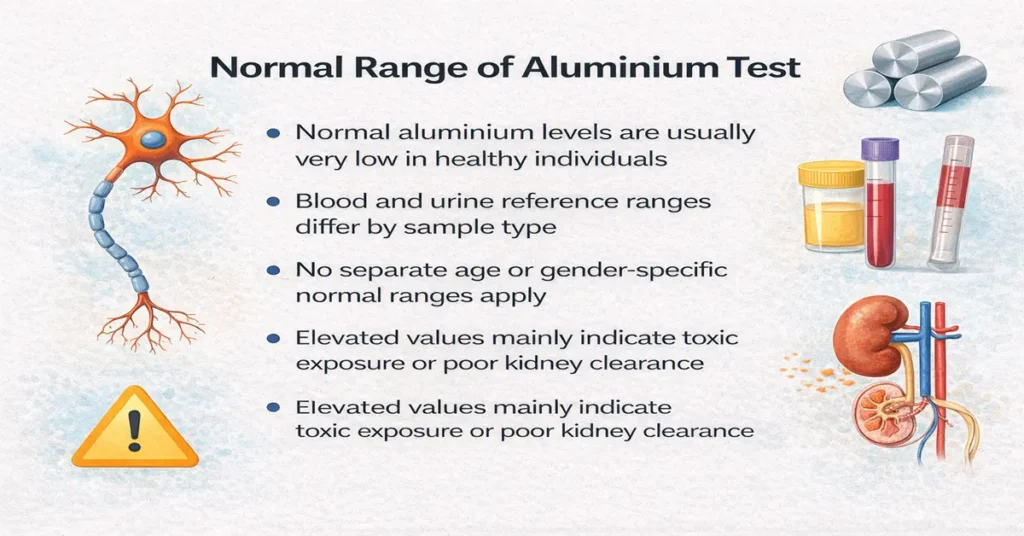
Normal Range of Aluminium Test
Why Normal Range Matters
The Aluminium Test measures the amount of aluminium present in the body, usually in blood or urine. Aluminium has no essential biological role in humans. Because of this, the idea of a “normal range” for aluminium is not about adequacy, but about safety. The normal range helps doctors identify whether aluminium exposure is within acceptable limits or whether it has reached a level that could be harmful.
Clinically, this matters most because aluminium accumulates quietly. People often do not feel symptoms until levels have been high for a long time, especially if kidney function is reduced. Using the correct reference range allows doctors to pick up early accumulation, review exposure sources, and prevent long-term complications affecting the brain, bones, or blood.
Normal range values also help distinguish harmless environmental exposure from medically significant aluminium retention that needs attention.
General Reference Range
The reference range for aluminium depends on the type of sample tested and the laboratory method used. In individuals with normal kidney function and no unusual exposure, aluminium levels are usually very low.
For blood (serum or plasma) samples, aluminium levels are typically:
Below 10 µg/L in most healthy adults
Values slightly above this may sometimes be seen with minor environmental exposure, but persistent elevation above the laboratory limit is considered abnormal and needs evaluation.
For urine samples, aluminium reflects recent exposure and elimination. There is no single fixed number used in isolation. Results are usually interpreted along with creatinine levels and clinical context.
Because aluminium is a trace element, different laboratories may use slightly different cut-offs. Doctors always rely on the reference range printed on the lab report rather than a universal number.
Age-Wise Normal Range
Age does not significantly change aluminium levels under normal circumstances. Aluminium is not required by the body, so there is no age-related physiological rise or fall.
In children, aluminium levels are usually very low. Elevated values in this age group are uncommon and raise concern for environmental, dietary, or medical exposure.
In adults, aluminium levels remain stable as long as kidney function is normal and exposure is limited.
In older adults, levels may increase if kidney function declines. However, age itself does not justify higher aluminium values. Any elevation should be assessed in relation to kidney health, medications, and exposure history.
For this reason, the same reference limits are generally applied across all age groups.
Gender-Wise Normal Range
There is no meaningful difference in aluminium levels between males and females. Aluminium absorption and elimination are not influenced by gender or sex hormones.
Both men and women share the same reference range for blood and urine aluminium tests. Any abnormal value is interpreted in the same way, regardless of gender.
If differences are seen, they are usually related to occupation, medication use, or medical conditions rather than gender itself.
Pregnancy-Specific Normal Range
There is no separate normal range for aluminium during pregnancy. Aluminium is not needed for fetal development, and levels are expected to remain low in healthy pregnant individuals.
Aluminium can cross the placenta, so unnecessary exposure during pregnancy is avoided. If testing is done, results are interpreted using standard adult reference ranges, with added caution.
Routine aluminium testing is not recommended in pregnancy unless there is a clear exposure risk or a specific medical reason.
Factors That Affect Test Values
Several factors can influence aluminium test results:
Kidney function is the most important factor. Reduced clearance allows aluminium to accumulate.
Medications such as aluminium-containing antacids or phosphate binders can raise levels, especially with long-term use.
Occupational exposure in metal processing, welding, or manufacturing may increase aluminium over time.
Dialysis-related factors, including contaminated water or aluminium-based treatments, are a known cause of elevated levels.
Sample contamination is a common issue. Aluminium is widespread in the environment, so improper collection can falsely elevate results. This is why trace-element–free tubes are essential.
Because of these influences, aluminium results are never interpreted in isolation.
Additional Information
The aluminium “normal range” mainly defines an upper safety limit. There is no beneficial or optimal aluminium level in the body.
Mild elevation without symptoms may only require monitoring and exposure review. Significantly raised or persistent values usually prompt further investigation.
Doctors often review aluminium levels along with kidney function, calcium, phosphate, and bone markers to understand the full clinical picture.
Self-interpretation of aluminium results is discouraged, as unnecessary worry or unsafe actions can follow.
Test Preparation
Fasting is not usually required for the Aluminium Test. Patients should inform their doctor about all medications, especially antacids, phosphate binders, or supplements that may contain aluminium.
Some labs may advise avoiding aluminium-containing products before testing, but only if specifically instructed.
For urine tests, proper collection using lab-provided containers is essential to prevent contamination.
When to See a Doctor
Medical advice is recommended if aluminium levels are above the laboratory reference range, even if symptoms are absent.
Urgent evaluation is important for patients with kidney disease, those on dialysis, or individuals with neurological symptoms, bone pain, or unexplained anemia.
People with occupational exposure should seek professional guidance if results are abnormal.
Sample Type
The Aluminium Test may be performed using:
Blood (serum or plasma) to assess current circulating aluminium
Urine to assess recent exposure and excretion
In some cases, both are used together for clearer interpretation.
Important Word Explanations
Aluminium: A metal widely present in the environment with no essential role in the human body
Reference Range: Laboratory limits used to interpret whether a test result is normal or abnormal
Toxicity: Harmful effects caused by excessive exposure to a substance
Dialysis: A procedure that removes waste from the blood when kidneys cannot function properly
Osteomalacia: Softening of bones due to defective mineralization, sometimes linked to aluminium accumulation
People Also Ask
Is a slightly high aluminium level serious?
Not always. Mild elevations may reflect recent exposure and need correlation with symptoms and kidney function.
Can aluminium levels be temporarily high?
Yes. Recent medication use, environmental exposure, or dialysis-related factors can cause temporary increases.
Does a normal aluminium level rule out toxicity?
Not completely. Aluminium can be stored in bones and tissues, so clinical context remains important.
When do doctors usually worry about aluminium results?
When levels are persistently elevated, rising over time, or associated with neurological, bone, or blood abnormalities.
Is repeat testing common for aluminium?
Yes. Repeat testing is often done to confirm results or monitor levels after exposure reduction.
Can aluminium be high even with normal kidneys?
Yes. Occupational exposure or long-term aluminium-containing medications can raise levels despite normal kidney function.
~END~