
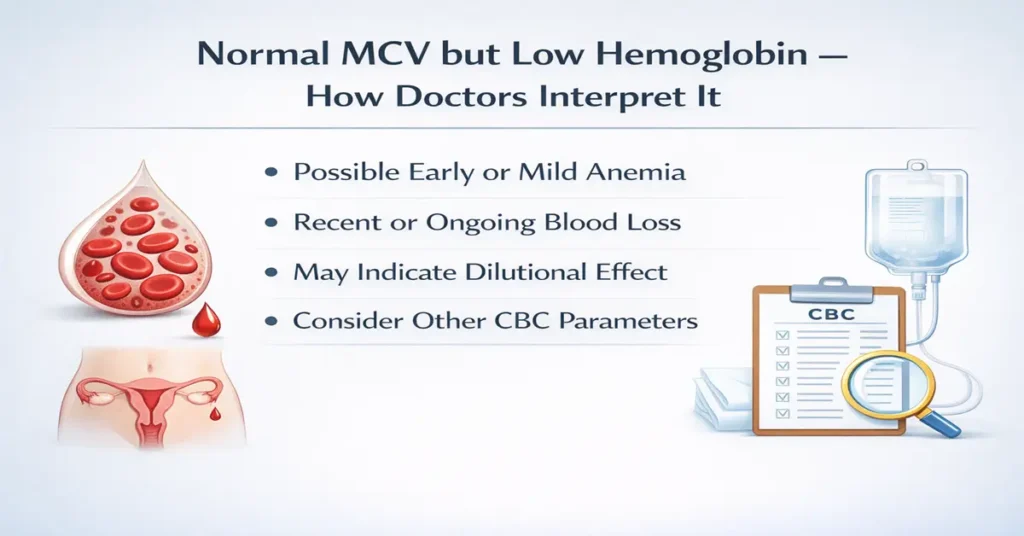
Normal MCV but Low Hemoglobin – How Doctors Interpret It
This is a report combination I see very often in OPD and routine health checkups. A patient looks at the CBC and says,
“MCV is normal, but hemoglobin is low. What does that mean?”
At first glance, this feels confusing. Many people think that if MCV is normal, hemoglobin should also be normal. But in real laboratory and clinical practice, that’s not always how the body behaves.
This article is written only for this specific situation—normal MCV with low hemoglobin.
Not to repeat basic test definitions, and not to compete with general anemia articles, but to explain how doctors actually interpret this pattern in day-to-day practice.
I’ll explain it calmly, the same way I explain it to patients sitting across the table from me.
Why This Result Creates Confusion
Most patients associate MCV with anemia type. When MCV is normal, they assume everything about red blood cells is fine. So when hemoglobin comes low in the same report, doubt starts.
From lab experience, I can tell you this clearly:
Normal MCV does not rule out anemia.
It only tells us that the size of red blood cells is normal, not the quantity or the hemoglobin content overall.
What This Combination Means in Simple Words
When:
- MCV is normal → red blood cells are of average size
- Hemoglobin is low → total oxygen-carrying capacity is reduced
In simple terms:
Your red blood cells look normal in size, but there are either fewer of them, or they are carrying less hemoglobin overall.
This pattern is actually very common and well understood by doctors.
Why This Happens in Real-World Lab Practice
1. Early or Mild Anemia (Most Common Reason)
This is the most frequent explanation I see.
In early stages of anemia:
- Hemoglobin starts dropping first
- Red blood cell size (MCV) remains normal initially
So the report shows:
- Normal MCV
- Low hemoglobin
Clinically, this is called early or mild anemia, not a complicated condition.
Doctors often catch it during routine tests before symptoms become obvious.
2. Recent Blood Loss or Ongoing Minor Blood Loss
From OPD experience, this pattern is very common in:
- Women with heavy or prolonged menstrual bleeding
- Patients with recent surgery or injury
- Chronic minor blood loss (for example, gastrointestinal)
In these cases:
- The body has not yet changed red cell size
- Hemoglobin drops first
MCV remains normal for some time.
3. Dilutional Effect (Temporary)
Sometimes hemoglobin appears low because of increased plasma volume, not because red cells are abnormal.
This is seen in:
- Pregnancy
- IV fluids before testing
- Overhydration
From lab perspective, this is a functional change, not a disease.
4. Recovery Phase After Treatment
I often see reports where:
- Hemoglobin is still low but improving
- MCV is already normal
This happens when:
- A patient has started treatment
- The body is recovering
- New red cells are being produced normally
Doctors see this as a positive trend, not a concern.
When This Pattern Is Usually Harmless
In routine clinical practice, doctors are usually not worried when:
- Hemoglobin is only mildly low
- MCV is stable and normal
- The patient feels generally fine
- There are no alarming symptoms
- This is the first abnormal report
In such cases, doctors often advise:
“Let’s observe and repeat later.”
No urgency. No panic.
When Doctors Pay More Attention
Doctors look deeper when:
- Hemoglobin continues to fall over time
- Symptoms like fatigue, breathlessness, or dizziness appear
- There is known chronic illness
- There is a history of blood loss
- Other CBC parameters also start changing
Even then, the approach is step-by-step, not aggressive.
How Doctors Actually Interpret This Combination
From real hospital practice, doctors usually think like this:
- Normal MCV → red cell size is preserved
- Low hemoglobin → reduced oxygen-carrying capacity
- Interpretation → early anemia, blood loss, or dilutional effect
Doctors do not jump to conclusions based on MCV alone.
They always correlate:
- Patient history
- Symptoms
- Previous reports
- Clinical findings
Is This Always Iron Deficiency?
Not always.
This is an important point.
Many patients assume:
“Low hemoglobin means iron deficiency.”
From lab experience:
- Iron deficiency often starts with normal MCV
- But not every case of low hemoglobin is due to iron
That’s why doctors may:
- Observe first
- Or order further tests only if needed
Is Repeat Testing Always Needed?
No. Repeat testing depends on the situation.
From OPD and lab practice:
- Mild drop + no symptoms → repeat later
- First-time finding → observation
- Persistent or worsening values → repeat sooner
Doctors base the decision on clinical judgment, not fear.
Why This Report Should Be Read Calmly
One mistake many patients make is assuming:
- Normal MCV = no anemia
- Or low hemoglobin = serious disease
Neither assumption is correct on its own.
In hospitals, this report combination is very common and often manageable.
Understanding it properly prevents unnecessary stress.
What This Result Does Not Automatically Mean
Let me be very clear from experience:
- It does not automatically mean severe anemia
- It does not mean bone marrow disease
- It does not mean emergency treatment
- It does not mean hospitalization
It simply means:
Hemoglobin is low, and the reason needs proper interpretation—not panic.
Test Preparation
For accurate hemoglobin and CBC results:
- Stay well hydrated (not excessive)
- Avoid heavy physical activity before testing
- Inform the lab about recent illness or blood loss
- Follow same lab for repeat tests when possible
- Prefer morning sample for consistency
These steps help avoid misleading variations.
When to Consult a Doctor
Consult a doctor if:
- You feel persistent fatigue or weakness
- There is breathlessness on routine activity
- Dizziness or paleness appears
- Hemoglobin continues to drop in follow-up reports
- Your doctor advises further evaluation
If you feel well and active, routine follow-up is often enough.
Important Word Explanations
MCV (Mean Corpuscular Volume):
Average size of red blood cells.
Hemoglobin:
Protein in red blood cells that carries oxygen.
CBC (Complete Blood Count):
Blood test that evaluates red cells, white cells, and platelets.
Dilutional Effect:
Apparent lowering of values due to increased fluid volume in blood.
Early Anemia:
Initial stage where hemoglobin drops before other changes appear.
People Also Ask
Can hemoglobin be low if MCV is normal?
Yes. This is very common, especially in early anemia.
Does normal MCV mean anemia is ruled out?
No. Anemia is defined by hemoglobin, not MCV alone.
Should I be worried about this report?
In most routine cases, no. Doctors assess trends and symptoms.
Is repeat testing required?
Only if advised by your doctor or if symptoms appear.
Can this correct on its own?
In some cases, yes—especially if the cause is temporary.
~END~