
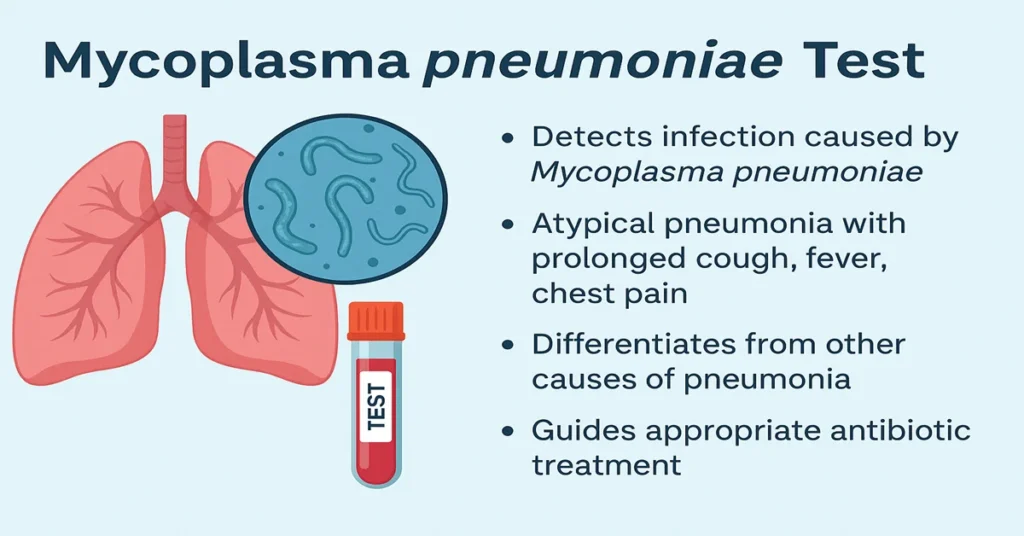
What is the Mycoplasma pneumoniae Test?
The Mycoplasma pneumoniae Test is used to identify infection caused by Mycoplasma pneumoniae, a bacteria commonly associated with respiratory tract infections, including what is often referred to as “walking pneumonia.” Unlike typical pneumonia, this infection may cause relatively mild symptoms, allowing some individuals to continue routine activities without realizing they are unwell.
From a laboratory and clinical perspective, this organism behaves differently from many common bacteria. It lacks a cell wall, which affects both how it causes infection and how it responds to certain antibiotics. The infection spreads through close contact and respiratory droplets, making it more common in group settings.
Doctors usually consider this test when a patient presents with a persistent dry cough, fever, chest discomfort, or pneumonia that does not respond as expected to routine antibiotics. It is frequently seen in children, adolescents, and young adults, particularly those living or working in shared environments such as schools, hostels, or training facilities.
Where Does Mycoplasma pneumoniae Come From?
Mycoplasma pneumoniae is not produced by the body. It is an external bacterial organism that spreads from person to person, mainly through inhalation of infected respiratory droplets.
Once inhaled, the bacteria attach to the lining of the respiratory tract. Over time, they multiply along the airway surfaces, leading to irritation and inflammation of the throat and lungs. Because the organism grows slowly, symptoms often develop gradually rather than appearing suddenly. This delayed onset is one reason infections may initially be overlooked or mistaken for minor viral illnesses.
Why is the Mycoplasma pneumoniae Test Important?
Although the bacteria itself has no beneficial role, identifying it through laboratory testing provides valuable clinical clarity.
Confirms the Infection
Symptoms caused by Mycoplasma pneumoniae often overlap with viral infections, asthma-related symptoms, or more typical bacterial pneumonias. Testing helps clarify whether this specific organism is involved, reducing uncertainty when symptoms persist or behave atypically.
Guides Correct Antibiotic Treatment
From a laboratory standpoint, identifying this organism is important because it does not respond to antibiotics that target bacterial cell walls. Confirming the diagnosis helps clinicians avoid ineffective medications and select agents known to work against this type of bacteria.
Prevents Complications
While many infections remain mild, some patients may develop additional respiratory or systemic involvement. Laboratory confirmation supports closer observation when symptoms are prolonged or unusual.
Helps Identify Outbreaks
In shared living or working environments, testing plays a role in recognizing clusters of infection early. This helps healthcare teams and public health authorities manage spread more effectively.
Types of Mycoplasma pneumoniae Tests
PCR Test (Polymerase Chain Reaction)
PCR testing detects the genetic material of the bacteria directly from respiratory samples. It is valued in clinical practice for its speed and accuracy, particularly in early infection.
Serology (Antibody Testing)
Blood tests measure the body’s immune response to infection. IgM antibodies generally suggest a recent exposure, while IgG antibodies indicate past or ongoing immune recognition. In some cases, combining PCR and antibody testing provides a clearer overall picture.
Causes of Low or Negative Test Results
A negative result may be seen when there is no active infection or when testing is performed very early, before detectable levels are present. Recent antibiotic use can also reduce bacterial levels, affecting test detection. As with many respiratory infections, sample quality and timing play an important role.
Clinically, a negative result does not always completely exclude infection, especially when symptoms strongly suggest it. Results are therefore interpreted alongside the clinical picture.
Symptoms When Test is Negative
When results are truly negative, symptoms are unlikely to be related to Mycoplasma pneumoniae. In such cases, doctors often consider other respiratory causes, including viral infections, typical bacterial pneumonia, asthma-related conditions, or allergies.
If symptoms persist or worsen, further evaluation may be advised to identify the underlying cause.
Causes of High or Positive Test Results
A positive result indicates evidence of Mycoplasma pneumoniae infection. This may be due to detection of bacterial DNA through PCR or identification of antibodies reflecting recent or ongoing infection. In laboratory reporting, these findings support a clinical diagnosis when symptoms are consistent.
Symptoms of a Positive Infection
Patients with confirmed infection commonly report a persistent dry cough, fever, fatigue, and chest discomfort. Headache, sore throat, ear pain, or mild breathing difficulty may also be present. Symptoms often develop gradually rather than abruptly.
Severe or Rare Complications
In a smaller number of cases, the infection may be associated with neurological symptoms, blood-related changes, skin reactions, asthma worsening, or more extensive lung involvement. These situations are uncommon but are monitored carefully in clinical settings.
Reference Ranges
A normal or negative result indicates no laboratory evidence of Mycoplasma pneumoniae at the time of testing. Abnormal or positive results include detection of bacterial DNA or antibodies associated with recent or past exposure. Antibody levels are interpreted with caution and in relation to symptom timing.
Sample Types
Depending on the test method, samples may include throat or nasopharyngeal swabs, sputum, or blood. In hospitalized patients, more advanced respiratory samples may be collected. PCR-based tests are commonly preferred when rapid confirmation is needed.
Who Should Get This Test?
Testing is generally considered for individuals with a prolonged cough, pneumonia that does not respond as expected to standard antibiotics, chest symptoms accompanied by fever, or known exposure to confirmed cases. It is also useful during outbreaks in schools, hostels, or training centers.
Limitations of the Test
No diagnostic test is perfect. False-negative results can occur if testing is done too early or after antibiotics have already reduced bacterial levels. Antibody responses may take time to develop, and test availability may vary between locations. Results should always be interpreted in clinical context.
Test Preparation
No fasting is required. Patients are usually advised to avoid mouthwashes or throat sprays before swab collection. Informing the doctor about recent antibiotic use and providing an accurate symptom timeline helps ensure correct interpretation.
When to Consult a Doctor
Medical review is advised for persistent cough, ongoing fever, breathing difficulty, chest pain, or ear and throat discomfort. Worsening respiratory symptoms or unusual neurological or skin changes require prompt attention.
Emergency care is necessary if severe breathing difficulty, confusion, seizures, bluish discoloration of lips or fingertips, or sudden widespread skin reactions occur.
Important Word Explanations
- Atypical Pneumonia: Pneumonia with milder or unusual symptoms compared to typical bacterial pneumonia
- PCR: A laboratory method that detects bacterial genetic material
- IgM: An antibody usually associated with recent infection
- IgG: An antibody indicating past or ongoing immune response
- Hemolytic Anemia: A condition involving increased breakdown of red blood cells
~END~
Related Posts
None found
Excellent article. Keep posting such kind of information on your blog.
Im really impressed by your blog.
Hi there, You’ve done a fantastic job. I’ll definitely digg it and individually
recommend to my friends. I am sure they’ll be benefited from this web site.
Hi there, i read your blog from time to time and i own a similar one and i
was just curious if you get a lot of spam feedback? If so
how do you reduce it, any plugin or anything you
can suggest? I get so much lately it’s driving me mad so any support
is very much appreciated.