
Overview
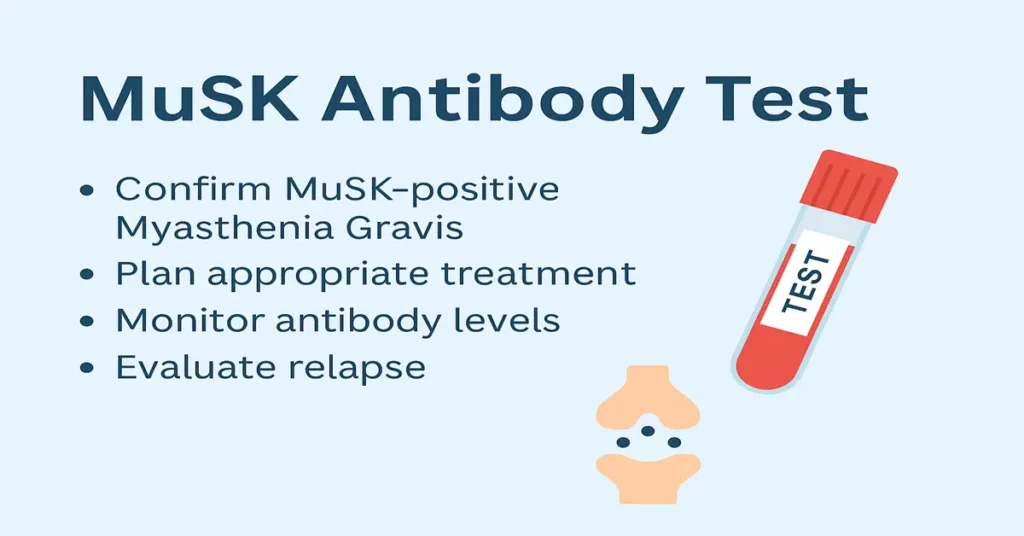
The MuSK Antibody Test (Anti–Muscle-Specific Kinase Antibody Test) is a specialized blood test used to detect antibodies directed against a protein called muscle-specific kinase (MuSK). MuSK plays a critical role at the neuromuscular junction—the point where nerves communicate with muscles to produce movement.
When antibodies interfere with this protein, nerve-to-muscle signaling becomes inefficient. The result is muscle weakness that typically worsens with activity and improves with rest, a pattern characteristic of Myasthenia Gravis (MG). This test is particularly valuable in patients who have symptoms suggestive of MG but test negative for acetylcholine receptor (AChR) antibodies. In such cases, the MuSK antibody test helps identify a distinct subtype known as MuSK-positive Myasthenia Gravis.
Purpose of the Test
Clinicians request the MuSK antibody test when the clinical picture suggests Myasthenia Gravis, but standard antibody testing does not provide clear confirmation.
The test is mainly used to support the diagnosis of MuSK-positive MG, guide clinical decision-making, and better understand the underlying disease mechanism. Because this subtype can behave differently from other forms of MG, identifying MuSK antibodies helps doctors tailor further evaluation and long-term management strategies.
Where MuSK Antibodies Are Produced
MuSK antibodies are produced by B lymphocytes, which are immune cells responsible for antibody formation. In autoimmune conditions, these cells mistakenly recognize normal body proteins as threats.
In MuSK-positive Myasthenia Gravis, the immune system targets the MuSK protein at the neuromuscular junction. The antibodies generated against MuSK disrupt the normal clustering and function of receptors required for effective nerve-to-muscle communication, leading to muscle weakness.
Main Functions and Clinical Importance
Diagnostic Value
The presence of MuSK antibodies strongly supports the diagnosis of MuSK-positive Myasthenia Gravis, particularly when AChR antibody tests are negative. This helps distinguish this condition from other neuromuscular disorders that may present with similar symptoms.
Clinical Differentiation
Identifying MuSK antibodies allows clinicians to recognize a specific MG subtype, which often has a different clinical pattern and progression compared with AChR-positive MG.
Monitoring Disease Activity
In selected cases, repeat testing may be used to observe trends in antibody levels over time. While levels do not always correlate directly with symptoms, changes can sometimes reflect shifts in immune activity.
Causes of Low MuSK Antibody Levels
Low or undetectable MuSK antibody levels usually indicate that there is no measurable immune reaction against the MuSK protein at the time of testing. This may be seen when:
- MuSK-positive Myasthenia Gravis is not present
- The disease is in an early stage before antibodies are detectable
- Immune activity has been reduced due to effective therapy
- Immune-suppressing medications are influencing antibody production
These results are interpreted alongside clinical findings rather than in isolation.
Symptoms When Levels Are Low
Low MuSK antibody levels themselves do not cause symptoms. Clinically, such results suggest either absence of MuSK-positive MG or a state of reduced immune activity. If symptoms persist despite low levels, doctors may consider alternative diagnoses or additional investigations.
Causes of High MuSK Antibody Levels
Elevated MuSK antibody levels generally reflect active autoimmune targeting of the MuSK protein. This pattern is most commonly seen in:
- Active MuSK-positive Myasthenia Gravis
- Periods of increased disease activity or relapse
- Situations where immune suppression is incomplete or ineffective
In rare instances, MuSK antibodies may coexist with other autoimmune conditions, but their strongest association remains with MG.
Symptoms Associated with High MuSK Antibody Levels
The antibodies themselves do not directly produce symptoms. Instead, symptoms arise from impaired neuromuscular transmission caused by immune interference.
When MuSK antibodies are present, patients may experience muscle weakness affecting the eyes, face, neck, and throat. Difficulty with sustained muscle activity, such as speaking for long periods or chewing, is common. In more severe cases, weakness can involve muscles responsible for breathing. The characteristic feature is fatigability—muscles weaken with use and recover with rest.
Reference Ranges
Results are generally reported as positive or negative rather than as exact numerical values.
- Negative: No detectable MuSK antibodies, making MuSK-positive MG unlikely
- Positive: MuSK antibodies detected, supporting the diagnosis of MuSK-positive MG
Cut-off values can vary depending on the laboratory method used, so results are always interpreted in the clinical context.
Sample Type and Collection
The test is performed on a blood sample, collected as serum in a plain or red-top tube. No special preparation is typically required.
Samples are analyzed in specialized laboratories using methods such as ELISA or immunoblot techniques designed to detect MuSK-specific antibodies.
Test Preparation
Fasting is not required. Patients should inform their doctor about current medications, especially immunosuppressive treatments, as these may influence antibody levels.
If antibody-modifying therapies such as intravenous immunoglobulin or plasmapheresis were recently given, testing may be delayed to ensure accurate interpretation.
When to Consult a Doctor
Medical evaluation is recommended if symptoms such as unexplained muscle weakness, drooping eyelids, difficulty swallowing or speaking, or shortness of breath develop—especially when symptoms worsen with activity and improve with rest.
For individuals already diagnosed with Myasthenia Gravis, a sudden change or worsening of symptoms should prompt timely medical review, as it may reflect increased disease activity.
Important Word Explanations
- Antibody: A protein produced by the immune system to recognize specific targets.
- Autoimmune Reaction: A process in which the immune system mistakenly attacks the body’s own tissues.
- MuSK (Muscle-Specific Kinase): A protein essential for proper nerve-to-muscle communication.
- Myasthenia Gravis (MG): An autoimmune disorder characterized by muscle weakness and fatigability.
- Neuromuscular Junction: The site where nerve signals are transmitted to muscle fibers.
- B Lymphocytes: Immune cells responsible for producing antibodies.
- ELISA: A laboratory technique used to detect specific antibodies in blood samples.
~END~
Related Posts
None found