
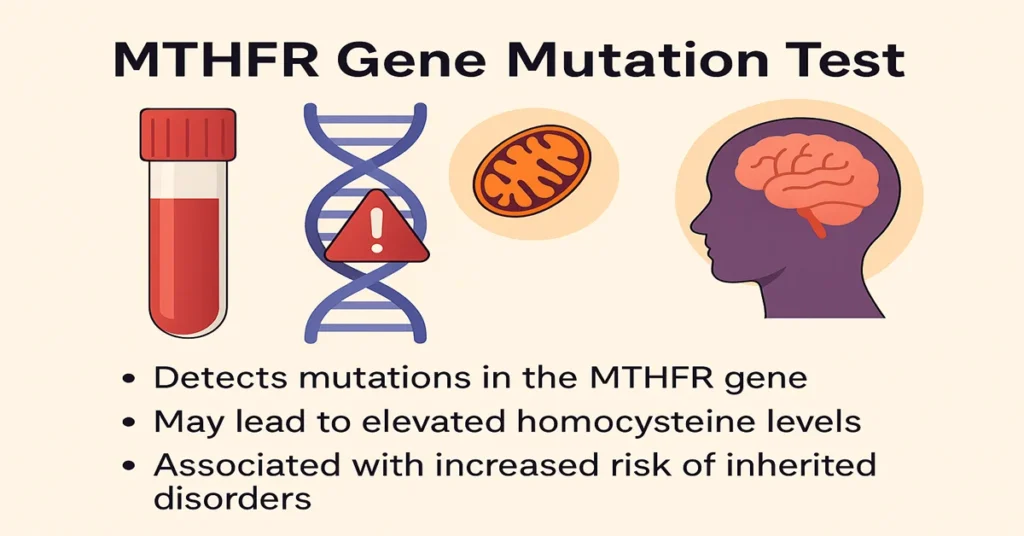
What is the MTHFR Gene Mutation Test?
The MTHFR (Methylenetetrahydrofolate Reductase) Gene Mutation Test is a genetic test that looks for specific changes in the MTHFR gene. This gene provides instructions for making the MTHFR enzyme, which plays an important role in how the body processes folate (vitamin B9) and regulates homocysteine, a naturally occurring amino acid in the blood.
When the MTHFR enzyme works efficiently, folate is converted into its active form and homocysteine is kept at normal levels. If certain gene mutations are present, enzyme activity may be reduced. As a result, folate metabolism can become less efficient and homocysteine levels may rise.
Persistently elevated homocysteine has been associated with a higher likelihood of cardiovascular disease, blood clots, stroke, pregnancy-related complications, and some neurological concerns. Because of this, doctors may suggest the MTHFR test in people with unexplained clotting problems, recurrent pregnancy loss, infertility, a strong family history of related conditions, or elevated homocysteine levels that do not have an obvious cause.
Where is the MTHFR Enzyme Produced in the Body?
The MTHFR enzyme is produced in many cells throughout the body, with particularly active roles in organs involved in metabolism, such as the liver. This is where much of homocysteine processing takes place.
The enzyme is encoded by the MTHFR gene, which is located on chromosome 1. When variations occur in this gene, the enzyme produced may be less efficient. This can slow the activation of folate, interfere with normal methylation processes, and allow homocysteine to accumulate in the bloodstream.
MTHFR gene changes are inherited, meaning they are passed from parents to children and remain present throughout life.
Why is the MTHFR Test Important?
The MTHFR test does not diagnose a specific disease on its own. Instead, it provides genetic information that can help doctors understand why certain metabolic patterns are present.
One of its main uses is clarifying elevated homocysteine levels. Reduced MTHFR activity can slow homocysteine breakdown, which may contribute to vascular and clotting risks in some individuals.
The results can also support clinical decision-making. In selected situations, doctors may use this information to guide further testing, monitor homocysteine levels more closely, or consider vitamin-related factors as part of a broader management plan.
In reproductive health, MTHFR mutations have been studied in relation to recurrent miscarriages, neural tube defects, and certain pregnancy complications. While the relationship is complex and not absolute, test results may add context during fertility or prenatal evaluations.
Because the mutation is inherited, the test can also be useful in genetic counseling. It helps families understand inheritance patterns and assess whether close relatives may share similar genetic variations.
Finally, the test may help distinguish genetic contributors to symptoms from other medical causes when homocysteine-related issues are being evaluated.
Causes of Low/Negative Results
A negative MTHFR test means that no commonly tested mutation was detected. This usually reflects a normal MTHFR gene structure and typical enzyme function.
In such cases, folate processing and homocysteine metabolism are generally not affected by this gene. If homocysteine levels are normal, a negative result often reassures clinicians that MTHFR-related genetic factors are unlikely to be contributing to the patient’s condition.
Symptoms of a Negative Result
There are no symptoms caused by a negative test result itself. If symptoms such as fatigue, clotting events, or pregnancy complications are present, they are usually related to other medical or genetic factors that require separate evaluation.
Causes of High/Positive Results
A positive result indicates that one or more MTHFR gene variants are present. The two most commonly reported changes are the C677T and A1298C mutations.
The C677T variant can significantly reduce enzyme activity, particularly when both copies of the gene carry the mutation (homozygous state). The A1298C variant usually has a milder effect but may become more relevant when combined with another mutation.
It is important to note that the presence of a mutation does not act in isolation. Its clinical impact is influenced by folate status, vitamin B12 and B6 levels, overall health, and other lifestyle or medical factors.
Symptoms Associated with Positive Results
The mutation itself does not directly cause symptoms. Instead, symptoms—when they occur—are usually related to elevated homocysteine levels or reduced folate activity.
People with a positive result may experience nonspecific issues such as fatigue, mood changes, or, less commonly, numbness or tingling. In some individuals, there may be a history of recurrent pregnancy loss, pregnancy complications, or unexplained blood clots.
Not everyone with an MTHFR mutation develops symptoms or health problems. Many individuals remain completely asymptomatic throughout life.
Reference Ranges
Because this is a genetic test, results are described by gene status rather than numerical values.
Results are typically reported as normal (wild type), heterozygous (one altered gene copy), or homozygous (two altered copies). The degree of enzyme impact varies with each pattern.
The test is often interpreted alongside a homocysteine level. While exact cutoffs vary by laboratory, homocysteine levels below 15 µmol/L are generally considered within the usual range, and higher levels suggest metabolic impact that may warrant further assessment.
Sample Type
The MTHFR gene mutation test can be performed using a blood sample or a buccal (cheek) swab. Both provide sufficient DNA for analysis and are routinely used in clinical practice.
Who Should Get the Test?
Doctors may consider this test in people with unexplained blood clots, recurrent pregnancy loss, early-onset heart disease or stroke, persistently high homocysteine levels, infertility, or a family history of thrombotic conditions or related genetic findings.
Limitations of the Test
Not all MTHFR mutations lead to health problems, and a positive result does not predict disease with certainty. Likewise, a negative result does not exclude all genetic or metabolic causes of elevated homocysteine.
Homocysteine levels are influenced by many factors, including diet, kidney function, medications, and other genes, so results must always be interpreted in clinical context.
Test Preparation
No special preparation is required for this test. Patients should share relevant family history, medical conditions, and current medications or supplements with their doctor. Genetic results should not be used for self-treatment without professional guidance.
When to Consult a Doctor
Medical advice is recommended for individuals with recurrent blood clots, pregnancy losses, early cardiovascular events, or persistently elevated homocysteine levels. Ongoing fatigue, mood changes, or neurological symptoms should also be evaluated.
Emergency care is required for sudden chest pain, difficulty breathing, severe leg swelling or pain, or any symptoms suggestive of stroke.
Important Word Explanations
- Gene mutation: A change in DNA that can affect how a gene functions
- Homocysteine: An amino acid in the blood linked to vascular and clotting risk
- Folate: Vitamin B9, essential for DNA synthesis and cell growth
- Homozygous: Having two copies of the same gene mutation
- Heterozygous: Having one normal gene copy and one mutated copy
~END~
Related Posts
None found