
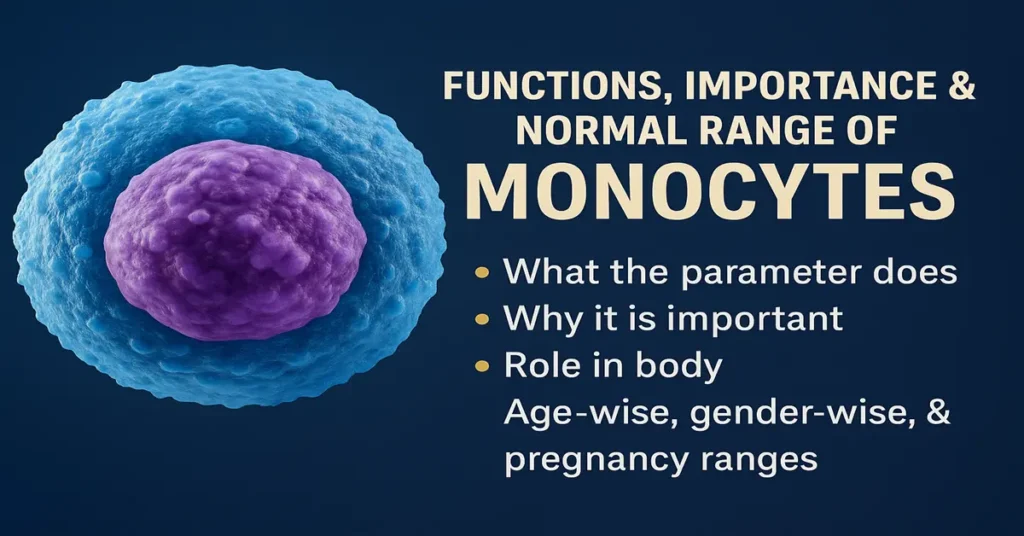
Functions, Importance & Normal Range of Monocytes
Monocytes are a type of white blood cell that work quietly but continuously to protect the body. In routine lab reports, monocytes are often overlooked because their percentage is small. But clinically, they play a critical role in long-term immunity, inflammation control, and tissue repair. Doctors regularly assess monocyte levels through a Complete Blood Count (CBC) to understand how the immune system is behaving beneath the surface.
When monocyte levels shift higher or lower than normal, it usually reflects how the body is responding to infection, stress, recovery, or chronic inflammation. Understanding this parameter helps patients, students, and clinicians read blood reports with more confidence and less confusion.
What Does the Monocyte Parameter Do?
Monocytes are produced in the bone marrow and circulate in the blood for a short time before moving into tissues. In day-to-day practice, they act as support and coordination cells rather than frontline attackers.
Their main functions include identifying harmful organisms, clearing damaged cells, and guiding other immune cells on what to do next. This is why monocytes are often associated with chronic or ongoing immune activity rather than sudden infections.
Key Functions of Monocytes
Monocytes recognize bacteria, viruses, fungi, and abnormal cells in the bloodstream. Once identified, they engulf and break down these harmful agents, limiting the spread of infection.
They also function as the body’s cleaning system. By removing dead cells and tissue debris, monocytes keep the internal environment stable and allow healthy tissue to regenerate.
After leaving the bloodstream, monocytes transform into macrophages inside organs like the lungs, liver, spleen, and skin. These macrophages provide long-term immune surveillance and protection.
Another important role is healing. Monocytes release chemical signals that promote tissue repair after infection, injury, or surgery.
Finally, monocytes help regulate immune balance. They communicate with other white blood cells, telling the immune system when to stay active and when to calm down. This prevents excessive inflammation.
Why Monocytes Are Important
From a clinical perspective, monocytes give insight into the type of immune response happening in the body.
They often rise early in chronic infections, even before symptoms become severe. This makes them useful for early detection of long-standing infections or inflammation.
Persistently raised monocytes can point toward chronic inflammatory conditions such as arthritis or bowel disease, helping doctors look beyond short-term illness.
Very low or very high monocyte levels may also reflect bone marrow stress or blood-related disorders, especially when other blood counts are abnormal.
During recovery, monocyte levels often fluctuate. Doctors use this trend to understand whether healing is progressing normally.
Autoimmune conditions frequently alter monocyte behavior, making this parameter useful in evaluating immune imbalance.
Role of Monocytes in the Body
Monocytes protect the body in several coordinated ways.
They defend against infection by engulfing germs, releasing enzymes, and activating other immune cells.
Inside tissues, they become macrophages and dendritic cells. Macrophages destroy pathogens and clean damaged tissue, while dendritic cells help activate T-cells and build long-term immune memory.
Monocytes also manage inflammation. Depending on the situation, they can either promote inflammation to fight infection or suppress it to prevent tissue damage.
They play an essential role in organ protection. Specialized macrophages are present in the liver, lungs, brain, spleen, and skin, where they protect against toxins and infections.
Healing and tissue repair depend heavily on monocyte activity, especially after surgery or injury.
Normal Range of Monocytes
Monocytes are reported in two forms:
• Absolute Monocyte Count (AMC)
• Percentage of total white blood cells
Both values are important and should be interpreted together.
Age-Wise Normal Ranges
In newborns, monocyte levels are naturally higher because the immune system is still developing. Absolute counts may range from about 1,000 to 3,600 cells/µL, with percentages between 5–15%.
In infants up to one year, counts usually fall between 400 and 2,000 cells/µL, with percentages around 5–12%.
Children aged 1–10 years typically show 200–900 cells/µL, making up about 4–10% of white blood cells.
In healthy adults, monocytes usually range between 200–800 cells/µL, accounting for 2–8% of total WBCs. This narrower range reflects immune stability.
In older adults, a slight increase is common. Counts may range from 300–900 cells/µL with percentages around 3–9%, often due to low-grade inflammation associated with aging.
Gender-Wise Normal Ranges
There is no meaningful difference between men and women in normal monocyte ranges.
Both generally fall within 2–8%. Minor variations seen in practice are usually related to lifestyle factors such as stress, smoking, or temporary illness rather than gender itself.
Monocyte Range in Pregnancy
Pregnancy naturally alters the immune system.
In the first trimester, monocytes may show a mild increase as the body adapts hormonally.
During the second trimester, levels may rise slightly further as immune activity stabilizes.
In the third trimester, percentages may reach up to 10% as the body prepares for delivery and tissue repair.
These changes are usually mild and not concerning unless accompanied by symptoms or very high counts.
When Abnormal Monocyte Levels Become Risky
High monocytes, known as monocytosis, are usually considered when levels exceed about 8–10% or absolute counts rise above the upper reference range.
Common causes include chronic infections like tuberculosis, viral or fungal infections, autoimmune disorders, long-standing inflammation, recovery after illness, smoking, stress, and liver or spleen conditions. Rarely, blood cancers may be responsible.
Doctors become concerned when monocytes remain elevated for weeks, rise steadily, or are accompanied by fever, weight loss, night sweats, or other abnormal blood findings.
Low monocytes, called monocytopenia, are usually seen below 1–2%.
This may occur due to bone marrow suppression, chemotherapy, severe infections, steroid use, nutritional deficiencies, or extreme stress. Risk increases when immunity becomes weak or multiple blood parameters are low together.
Test Preparation for Monocyte Testing
Monocytes are measured through a standard CBC test. Fasting is not required. Staying hydrated, avoiding heavy exercise before the test, and informing the doctor about medications helps ensure accurate results. If you are unwell, it’s important to mention symptoms, as illness can temporarily affect counts.
When to Consult a Doctor
Medical review is advised if monocyte levels are repeatedly abnormal, fever persists, unexplained weight loss occurs, night sweats develop, fatigue is ongoing, infections are frequent, or other blood counts are abnormal. Further evaluation helps identify the cause early.
Important Word Explanations
Phagocytosis – Process by which immune cells engulf and destroy germs
Macrophages – Strong immune cells formed from monocytes inside tissues
Inflammation – The body’s protective response to injury or infection
Bone marrow – Tissue inside bones where blood cells are produced
Chronic – A condition that lasts for a long time
Autoimmune disease – When the immune system attacks the body’s own tissues
People Also Ask
Is a high monocyte count always serious?
No. Mild elevation is common and often related to infection or recovery.
Can monocyte levels change temporarily?
Yes. Stress, illness, and healing phases can cause short-term changes.
Does abnormal monocytes always mean disease?
Not always. Many changes are reactive and settle on their own.
When do doctors usually worry about monocytes?
When levels stay abnormal for weeks or rise along with symptoms.
Is repeat testing common for monocytes?
Yes. Trends over time are more important than a single value.
Can monocytes be normal but still have illness?
Yes. Monocytes are only one part of the immune picture.
~END~