
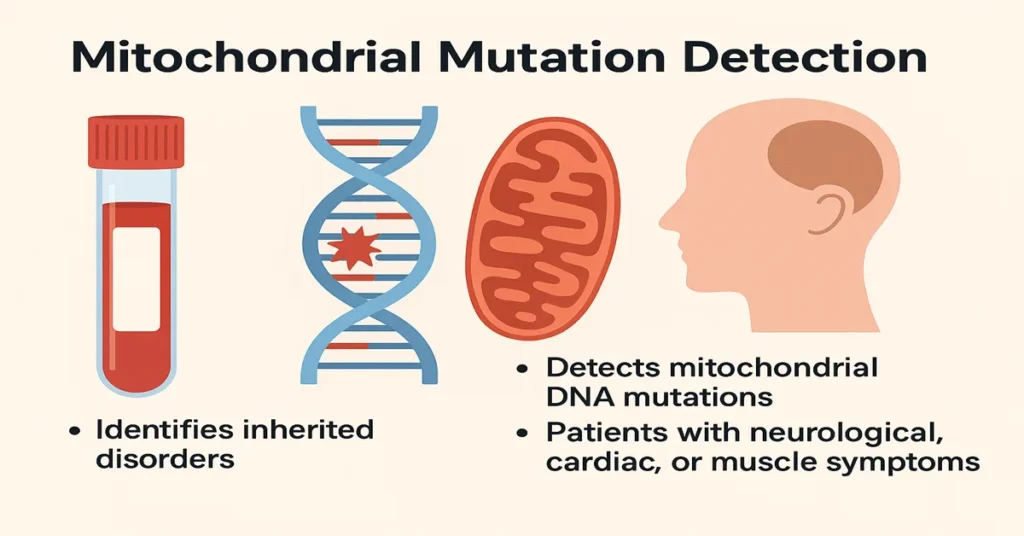
What is Mitochondrial Mutation Detection?
Mitochondrial Mutation Detection is a genetic test designed to identify changes, known as mutations, in mitochondrial DNA (mtDNA). Mitochondria are small structures found inside nearly every cell and are responsible for producing the energy required for normal body function. Organs with high energy demands—such as the brain, muscles, heart, and eyes—are especially sensitive to mitochondrial problems.
Mitochondrial DNA differs from nuclear DNA in a few important ways. It is inherited only from the mother, exists in multiple copies within each cell, and is directly involved in energy production. When mutations affect this DNA, mitochondria may not generate enough energy, leading to a group of conditions broadly referred to as mitochondrial diseases.
These disorders include well-recognized syndromes such as MELAS, MERRF, and Leigh syndrome. Because their symptoms often overlap with many other neurological or metabolic conditions, this test is typically ordered when routine evaluations do not fully explain a patient’s clinical picture.
Where Do These Mutations Come From?
Mitochondrial DNA is located inside the mitochondria rather than in the cell nucleus. Mutations can arise in two main ways.
Some mutations are inherited. Because mtDNA is passed down only through the mother, a woman carrying a mutation may transmit it to all her children, while fathers do not pass mitochondrial DNA to their offspring.
Other mutations occur spontaneously, without a family history. These are called de novo mutations and can appear early in development or later in life.
An important concept in mitochondrial genetics is heteroplasmy. This refers to the presence of both normal and mutated mtDNA within the same cell. The proportion of mutated mtDNA plays a major role in determining how severe symptoms are and which organs are affected. Lower levels may result in mild or delayed symptoms, while higher levels are often associated with more significant disease.
Why is Mitochondrial Mutation Detection Important?
From a clinical perspective, this test serves several key purposes.
First, it helps confirm a diagnosis. Mitochondrial disorders can resemble many other neurological, muscular, or metabolic diseases. Identifying an mtDNA mutation can clarify the underlying cause when symptoms are otherwise unexplained.
Second, it supports clinical decision-making. While there is no single cure for mitochondrial disease, recognizing the diagnosis early helps clinicians anticipate complications, coordinate supportive care, and avoid factors that may worsen mitochondrial stress.
Third, the test is valuable for genetic counseling. Because mtDNA is maternally inherited, results help families understand potential risks for other relatives and future generations.
Finally, in selected situations, repeat testing may be used to observe changes in mutation levels over time, providing additional insight into disease progression.
Causes of Low or Negative Results
A negative result means that no disease-causing mitochondrial mutation was detected in the tested sample. This can occur for several reasons.
In some cases, the individual truly does not have a mitochondrial DNA–related disorder. In others, symptoms may be due to conditions affecting nuclear genes or non-genetic causes altogether.
Low-level heteroplasmy can also lead to negative results, especially if the proportion of mutated mtDNA is below the test’s detection limit. Additionally, mutation levels can vary between tissues. A mutation may be present in muscle or nerve tissue but not detectable in blood, which is why sample choice matters.
Symptoms When the Test is Negative
A negative test result does not produce symptoms on its own. If symptoms persist despite a negative result, clinicians often consider further evaluations, including testing of nuclear genes, metabolic studies, or tissue-based analyses, depending on the clinical scenario.
Causes of High or Positive Results
A positive result indicates that a pathogenic mitochondrial DNA mutation has been identified. This may reflect an inherited maternal mutation or a spontaneous change that developed in the individual.
Higher levels of mutated mtDNA, reflected by higher heteroplasmy percentages, are generally associated with more pronounced clinical effects, though symptom patterns can still vary widely between individuals.
Symptoms Associated with Positive Results
Mitochondrial disorders are known for their wide range of symptoms, which depend on the specific mutation and the organs most affected.
Muscle-related features often include weakness, rapid fatigue with activity, and exercise intolerance. Neurological involvement may present as seizures, coordination problems, developmental delay, or stroke-like episodes at a young age.
Because mitochondria are central to energy metabolism, some patients develop metabolic disturbances such as lactic acid buildup, leading to low stamina and poor energy levels. Sensory organs may also be affected, resulting in hearing loss or visual problems.
Involvement of other organs, including the heart, gastrointestinal tract, or kidneys, can occur and may evolve gradually over time. Many mitochondrial conditions are progressive, although the rate of progression varies.
Reference Ranges
Results are typically reported as either no mutation detected or a pathogenic mutation detected. When applicable, heteroplasmy levels are expressed as a percentage.
Higher percentages generally correlate with greater disease burden, but clinical interpretation always takes symptoms and organ involvement into account rather than relying on numbers alone.
Sample Types
Mitochondrial mutation testing can be performed on several types of samples. Blood is often the first choice because it is easy to collect. Buccal swabs, urine epithelial cells, or muscle tissue may also be used.
In cases where blood testing is inconclusive but suspicion remains high, a muscle biopsy may be recommended, as muscle tissue often contains higher levels of mutated mtDNA.
Who Should Take This Test?
Doctors may consider this test for individuals with unexplained muscle weakness, early-onset neurological symptoms, recurrent stroke-like episodes, or unexplained hearing or vision loss. It is also relevant for children with developmental delay or families with a known history of mitochondrial disease.
Risks and Limitations
The test itself carries minimal physical risk, as most samples involve routine collection methods. However, it may not detect very low-level mutations, and results do not always predict disease severity or progression.
A negative result does not completely exclude mitochondrial disease, particularly those caused by nuclear gene mutations rather than mtDNA changes.
Test Preparation
No special preparation is usually required. Patients are encouraged to share detailed symptom histories and family information with their clinician. If a muscle biopsy is planned, specific instructions will be provided in advance.
When to Consult a Doctor
Medical evaluation is advised for ongoing or progressive muscle weakness, unexplained seizures, stroke-like episodes at a young age, or sensory changes such as hearing or vision loss. In children, developmental delays or loss of previously acquired skills warrant prompt attention.
Urgent medical care is necessary if there are sudden neurological changes, severe breathing difficulty, or signs of significant metabolic imbalance, as these may indicate acute complications of mitochondrial disease.
Important Word Explanations
- Mitochondria: Cell structures responsible for energy production
- mtDNA: DNA located within mitochondria
- Heteroplasmy: A mixture of normal and mutated mitochondrial DNA in a cell
- De novo mutation: A new genetic change not inherited from parents
- Cardiomyopathy: A disorder affecting the heart muscle
~END~
Related Posts
None found