
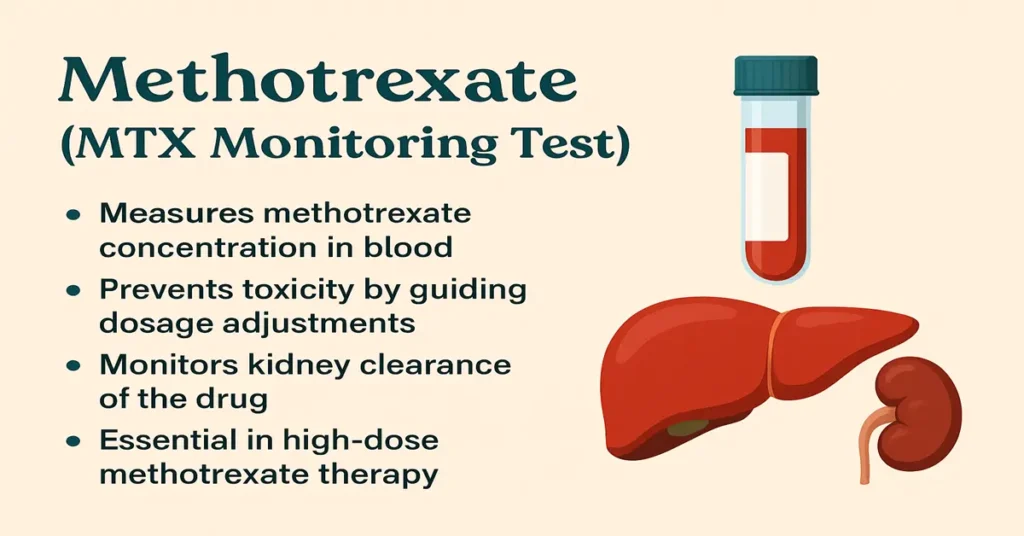
What is the Methotrexate (MTX) Monitoring Test?
Overview
The Methotrexate (MTX) Monitoring Test is a blood test used to measure the amount of methotrexate circulating in the bloodstream after the medication has been given. Methotrexate is a potent drug with two very different but equally important roles. In higher doses, it is used as part of chemotherapy regimens to slow or stop the growth of cancer cells. In much lower doses, it is widely used as an immunosuppressant to control abnormal immune activity in autoimmune conditions.
Doctors commonly use methotrexate in conditions such as certain cancers, autoimmune diseases like rheumatoid arthritis and psoriasis, and in specific situations such as ectopic pregnancy. While the drug is highly effective, it must be used carefully. The margin between a helpful dose and a harmful one can be narrow, particularly in high-dose cancer treatment. The MTX Monitoring Test helps doctors confirm that methotrexate levels are falling as expected and are not reaching a range that could harm vital organs.
This test is not about diagnosing disease. Instead, it supports safe treatment by guiding dose adjustments, monitoring drug clearance, and preventing serious toxicity affecting the bone marrow, liver, kidneys, or lungs.
Why is Monitoring Methotrexate Important?
From a clinical perspective, methotrexate is a drug that demands respect. Even small delays in clearance can lead to significant side effects. Monitoring is important because methotrexate can:
Suppress bone marrow, leading to low blood cell counts
Strain or injure the kidneys, slowing drug elimination further
Irritate the gastrointestinal lining, causing painful mouth ulcers
Affect liver function over time
Regular monitoring allows doctors to confirm that the drug is doing its job without accumulating to dangerous levels. It also provides reassurance that treatment can continue safely, especially during high-dose therapy where close observation is essential.
Where is Methotrexate Produced in the Body?
Methotrexate is not produced naturally by the human body. It is a synthetic medication manufactured under controlled pharmaceutical conditions.
Once administered, either orally or by injection, methotrexate is absorbed into the bloodstream and distributed to body tissues. A portion of the drug is processed in the liver, but most of it is removed unchanged by the kidneys through urine. Because kidney function plays such a central role in clearing methotrexate, any reduction in kidney performance can quickly result in rising drug levels. This is one of the key reasons why blood level monitoring is so important.
Main Functions and Importance of the MTX Monitoring Test
The MTX Monitoring Test serves several practical clinical purposes.
First, it confirms whether methotrexate levels are within the expected range for a given time after dosing. This helps clinicians understand whether the drug is clearing normally.
Second, it acts as an early warning system for toxicity. If levels are higher than expected, doctors can respond promptly by adjusting therapy or delaying further doses.
Third, it plays a central role in guiding leucovorin (folinic acid) rescue therapy. Leucovorin is given to protect healthy cells from methotrexate’s toxic effects, and the dose and duration of rescue depend directly on measured methotrexate levels.
Finally, the test helps identify delayed clearance, often related to kidney function changes, dehydration, or drug interactions. Detecting this early can prevent serious complications.
Causes of Low or Negative Methotrexate Levels
Low methotrexate levels usually indicate that the drug has been cleared efficiently. This may be seen when kidney function is good and the dose was appropriate. Other situations include a lower-than-planned dose, a missed dose, or blood sampling performed later than the recommended time window.
In these cases, low levels are generally not dangerous. Clinically, they may suggest that the drug exposure was less than intended, which can sometimes explain a reduced treatment response.
Symptoms of Low Levels
Low methotrexate levels themselves do not cause physical symptoms. Instead, their significance lies in treatment effectiveness. In cancer therapy, low exposure may reduce treatment impact. In autoimmune conditions, it may be associated with persistent or returning disease activity.
Causes of High or Elevated Methotrexate Levels
Elevated methotrexate levels are more concerning and usually require prompt attention. They may occur during planned high-dose therapy, but they can also result from delayed drug clearance.
Common contributing factors include reduced kidney function, dehydration, and interactions with other medications that interfere with methotrexate elimination. Accidental overdose or dosing errors can also lead to unexpectedly high levels.
Symptoms of High Levels
When methotrexate levels remain high, patients may begin to develop signs of toxicity. These can include nausea, vomiting, mouth sores, fatigue, and changes in blood counts. Laboratory abnormalities may show liver or kidney strain.
In more severe situations, complications can involve the lungs or nervous system and may become life-threatening if not addressed quickly. Any suspicion of high methotrexate levels requires immediate medical evaluation.
Reference Ranges for Methotrexate Levels
Methotrexate levels are always interpreted in relation to the time since the dose was given. In general clinical practice, expected values fall progressively over time. For example, levels are expected to be lower at 48 hours than at 24 hours, and very low by 72 hours.
If measured levels are higher than expected at any of these time points, it suggests delayed clearance and signals the need for closer monitoring and supportive measures. Exact thresholds may vary by treatment protocol and laboratory method, so interpretation is always individualized.
How is the Sample Collected?
The test is performed on a blood sample, usually serum or plasma. In high-dose treatment protocols, samples are typically collected at fixed intervals such as 24, 48, and 72 hours after dosing.
Accurate timing is essential. A sample drawn too early or too late can lead to misleading conclusions, which is why strict adherence to the sampling schedule is emphasized in clinical settings.
Who Should Get the MTX Monitoring Test?
This test is routinely recommended for patients receiving high-dose methotrexate as part of cancer treatment. It is also important for individuals with known kidney or liver impairment, those experiencing symptoms suggestive of toxicity, or patients taking medications that may interfere with methotrexate clearance.
In low-dose weekly methotrexate used for autoimmune diseases, routine blood level monitoring is not always required. However, regular checks of kidney function, liver enzymes, and blood counts remain essential.
Risks and Limitations of the Test
The blood test itself carries minimal risk beyond standard blood collection discomfort. The main limitation lies in interpretation. Results must always be viewed in context, considering timing, dose, kidney function, and the overall clinical picture. The test measures drug concentration, not treatment success.
Test Preparation
Patients should inform their healthcare provider about all medications they are taking, including over-the-counter drugs. Staying well hydrated and attending blood draws at the scheduled times are important for reliable results. Additional blood tests may be done alongside methotrexate levels to assess kidney and liver function.
When to Consult a Doctor Immediately
Medical attention should be sought promptly if symptoms such as severe nausea, mouth ulcers, unusual fatigue, yellowing of the skin or eyes, reduced urine output, unexplained bruising, or breathing difficulty develop during methotrexate therapy. These can be early signals of toxicity and should never be ignored.
Important Word Explanations
- Immunosuppressant: A medication that reduces immune system activity
- Toxicity: Harmful effects caused by excessive drug levels
- Leucovorin rescue: Protective treatment used to limit methotrexate damage to healthy cells
- Bone marrow suppression: Reduced production of blood cells
- Clearance: The rate at which a drug is removed from the body
~END~
Related Posts
None found