
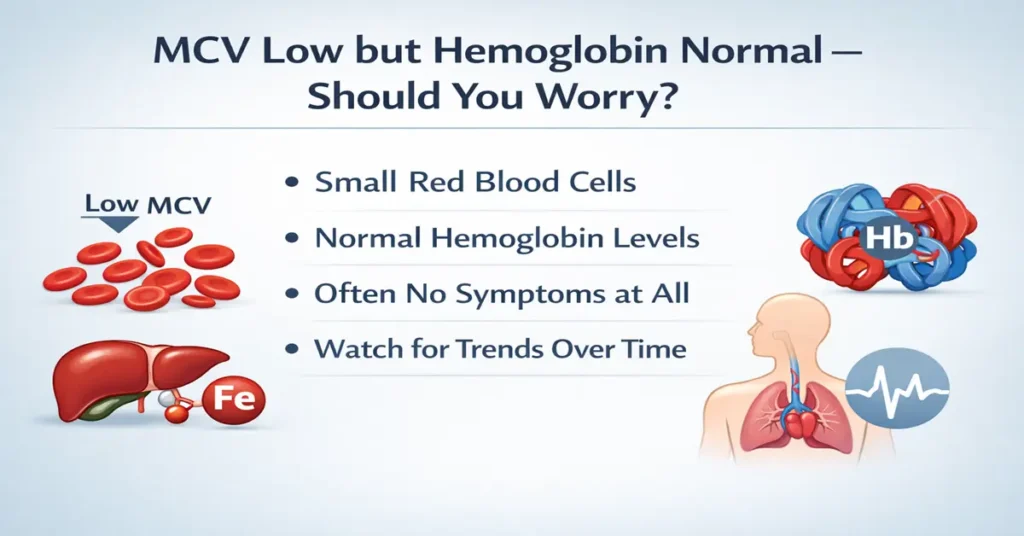
MCV Low but Hemoglobin Normal – What It Means
As a laboratory technician, I see this report combination almost every day in OPD and routine health checkups. A patient looks at the report and says, “My hemoglobin is normal, but MCV is low. Is something wrong?”
This confusion is very common—and in many cases, it is not a serious problem.
This article is written only to explain this exact situation:
low MCV with normal hemoglobin
Nothing more, nothing extra, and nothing repetitive.
I’ll explain it the same way I explain it to patients sitting in front of me at the lab counter.
Understanding the Confusion in Simple Words
Hemoglobin being normal usually makes people feel relieved. But when they see MCV marked low, doubt starts. Many immediately think of anemia or iron deficiency.
From real lab experience, I can tell you this clearly:
Low MCV does not always mean disease, especially when hemoglobin is normal.
This pattern is often an early, mild, or physiological change, not a diagnosis.
What This Combination Means Clinically
MCV tells us about the average size of red blood cells, not how much hemoglobin is working in the body.
So when:
- Hemoglobin is normal → oxygen-carrying capacity is adequate
- MCV is low → red cells are slightly smaller than average
In simple terms:
Your body is still doing its job well, but the red cells are on the smaller side.
In routine OPD practice, this is often seen in:
- Young adults
- Women of reproductive age
- People coming for routine health checkups
- Patients without any symptoms
Why This Happens in Real Lab Practice
1. Early Iron Depletion (Not Deficiency Yet)
This is the most common reason I see.
Iron stores in the body reduce before hemoglobin drops.
So the sequence usually is:
- Iron stores start reducing
- Red cells become smaller (MCV falls)
- Hemoglobin remains normal initially
At this stage, the body is compensating well.
This is not anemia, but a warning stage, and many doctors simply observe it.
2. Genetic Red Cell Size Variation (Very Common)
Some people naturally have smaller red blood cells.
We see this often in:
- Certain families
- People from specific ethnic backgrounds
They may have:
- Low MCV
- Normal hemoglobin
- Normal daily energy
Clinically, this is often harmless and needs no treatment.
3. Recovery Phase After Past Anemia
From lab records, I often notice:
- Hemoglobin has improved after treatment
- MCV remains low for some time
MCV takes longer to normalize than hemoglobin.
This delay is normal and expected.
Doctors usually do nothing in such cases except follow-up.
4. Lab Calculation Variations
MCV is a calculated value. Mild dehydration, recent illness, or even sample timing can slightly affect it.
That’s why:
- A mildly low MCV with normal Hb
- And no symptoms
is often ignored clinically.
When This Pattern Is Usually Harmless
From OPD experience, doctors usually consider it harmless when:
- Hemoglobin is clearly within normal limits
- Patient has no weakness, breathlessness, or fatigue
- Other RBC parameters are stable
- This is a routine checkup finding
In such cases, doctors often say:
“Nothing to worry. Just keep an eye on it.”
No medicines. No panic.
When Doctors Pay More Attention
Doctors become more alert if:
- MCV keeps dropping over time
- Hemoglobin starts trending downward
- Patient has symptoms like tiredness or paleness
- There is a known history of anemia
- There is heavy menstrual bleeding or chronic blood loss
Even then, the approach is step-by-step, not aggressive.
How Doctors Usually Interpret This Report
In most routine cases, doctors interpret it like this:
- Normal Hb → body oxygen supply is okay
- Low MCV → possible early nutritional issue or natural variation
- Action → observe, repeat test later if needed
Rarely is this combination treated as an emergency or serious disorder.
Is Repeat Testing Always Needed?
No. Repeat testing is not always required.
From lab practice:
- If patient is healthy → no repeat needed immediately
- If found during annual checkup → repeat after few months
- If symptoms appear → repeat sooner
Doctors decide based on clinical picture, not one number.
Why You Should Not Panic Seeing This
One mistake many patients make is googling “low MCV” and assuming the worst.
In real hospital practice:
- Low MCV + normal Hb is one of the calmest report combinations
- Most patients go home without any treatment
- Many never develop anemia at all
Understanding the context matters more than the value.
Test Preparation
For accurate CBC results:
- Do the test in a well-hydrated state
- Avoid heavy exercise just before sampling
- Inform the lab if you had recent illness
- Prefer morning sample if possible
- Follow same lab for repeat tests to compare values properly
When to Consult a Doctor
Consult a doctor if:
- You feel unexplained weakness or fatigue
- Hemoglobin starts falling in follow-up reports
- You have heavy menstrual bleeding
- There is a known history of anemia
- MCV continues to decline over time
If you feel normal and active, routine follow-up is usually enough.
Important Word Explanations
MCV (Mean Corpuscular Volume):
Average size of red blood cells.
Hemoglobin:
Protein in red cells that carries oxygen.
Iron Stores:
Iron reserve in the body, mainly stored in liver and bone marrow.
Anemia:
Condition where hemoglobin is lower than normal.
CBC (Complete Blood Count):
Basic blood test that evaluates red cells, white cells, and platelets.
People Also Ask
Is low MCV dangerous if hemoglobin is normal?
In most routine cases, no. It is often mild and temporary.
Can this turn into anemia later?
Sometimes, if iron stores continue to drop. That’s why doctors monitor trends.
Do I need iron tablets immediately?
Not always. Doctors decide based on symptoms and other tests.
Should I repeat the test?
Only if your doctor advises or if symptoms develop.
Can diet alone correct this?
In many mild cases, yes—without medicines.
~END~