
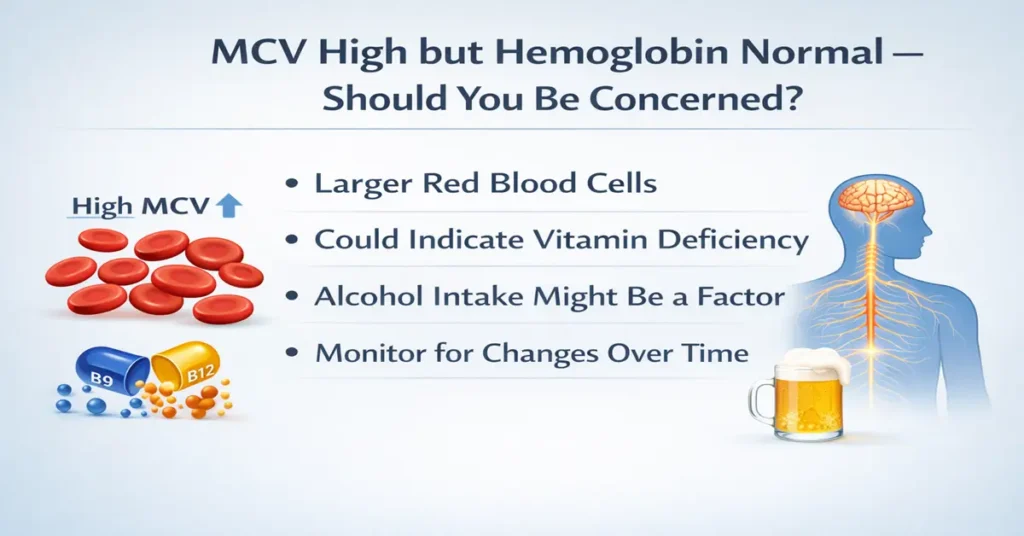
MCV High but Hemoglobin Normal – Should You Worry?
As a laboratory technician with years of OPD and hospital experience, I see this report pattern very often. A patient looks at the CBC, feels relieved seeing hemoglobin is normal, then suddenly notices MCV is high and asks, “Is something wrong with my blood?”
This article is written only to clear this specific confusion.
Not to diagnose, not to scare, and not to repeat basic test explanations you may have already read elsewhere.
Let me explain this calmly, the same way I explain it to patients at the lab desk.
Why This Result Creates Confusion
Most people connect MCV directly with anemia. So when MCV is high, the first thought is usually, “Is this serious?”
But in real lab practice, high MCV with normal hemoglobin is often not a disease. It is usually a signal, not a conclusion.
Clinically, doctors look at this combination very differently from “high MCV with low hemoglobin.”
What This Combination Means in Simple Terms
When:
- Hemoglobin is normal → oxygen-carrying capacity is adequate
- MCV is high → red blood cells are larger than average
In simple words:
Your red blood cells are bigger in size, but they are still doing their job properly.
That is why many people with this report feel completely normal.
Why This Happens in Real-World Lab Practice
From daily lab experience, there are a few common, practical reasons for this pattern.
1. Early Vitamin Changes (Before Anemia Develops)
This is one of the most frequent reasons.
In many patients, especially:
- Office workers
- People with irregular meals
- Alcohol users
- Elderly individuals
Vitamin B12 or folate levels start declining before hemoglobin drops.
The body compensates well initially:
- Red cells become larger
- Hemoglobin remains normal
This stage is often detected only on routine health checkups.
2. Temporary Bone Marrow Response
Sometimes, after:
- Recent illness
- Recovery from mild anemia
- Infection or inflammation
The bone marrow releases slightly larger red cells into circulation.
In lab terms, this raises MCV temporarily while hemoglobin stays normal.
Clinically, this is considered a transient and harmless finding.
3. Alcohol Intake (Very Common Finding)
From OPD experience, even moderate alcohol intake can:
- Increase red cell size
- Raise MCV
- Keep hemoglobin normal
Many patients are surprised when this comes up, but it’s a very common explanation doctors consider.
4. Natural Individual Variation
Some people naturally have:
- Slightly higher MCV
- Stable hemoglobin
- No symptoms at all
When past reports show the same pattern, doctors usually label it as individual baseline variation, not disease.
When This Pattern Is Usually Harmless
In most routine cases, doctors are not worried when:
- Hemoglobin is clearly normal
- Patient feels well and active
- There are no nerve symptoms, fatigue, or weakness
- Other CBC values are stable
- This is a first-time or incidental finding
In such cases, doctors often advise:
“No treatment needed now. Just observe.”
When Doctors Pay More Attention
Doctors look deeper if:
- MCV keeps rising over time
- Hemoglobin starts trending downward
- There is numbness, tingling, or memory issues
- Patient has long-term alcohol use
- There is known vitamin deficiency history
Even then, the approach is gradual and cautious, not urgent.
How Doctors Usually Interpret This Combination
From clinical experience, this is how doctors think:
- Normal Hb → no anemia right now
- High MCV → possible early nutritional issue or lifestyle factor
- Action → correlate with history, symptoms, and previous reports
Doctors rarely treat based on MCV alone.
Is Repeat Testing Always Needed?
No, repeat testing is not automatic.
From lab practice:
- If patient is asymptomatic → repeat later or during next routine check
- If this is a follow-up case → compare trends
- If symptoms exist → repeat sooner with additional tests
Doctors decide based on clinical context, not fear.
Why You Should Not Panic Seeing This Report
One of the biggest problems today is reading lab values without context.
In real hospital settings:
- High MCV with normal hemoglobin is often a watch-and-wait finding
- Many patients never develop anemia
- Many never need medication
Understanding this saves unnecessary anxiety and testing.
What This Result Does Not Automatically Mean
Let me be very clear from experience:
- It does not automatically mean anemia
- It does not mean serious disease
- It does not mean you need injections or long-term treatment
It simply means the report needs interpretation, not panic.
Test Preparation
For accurate CBC results:
- Avoid alcohol for at least 24 hours before testing
- Stay well hydrated
- Inform the lab about recent illness or medications
- Prefer morning sample if possible
- Use the same lab for repeat tests to track trends accurately
When to Consult a Doctor
Consult a doctor if:
- You feel persistent fatigue or weakness
- There is numbness or tingling in hands or feet
- Memory or balance issues appear
- MCV keeps increasing on follow-up
- Hemoglobin starts decreasing
If you feel normal, routine follow-up is usually enough.
Important Word Explanations
MCV (Mean Corpuscular Volume):
Average size of red blood cells.
Hemoglobin:
Protein in red blood cells that carries oxygen.
Folate:
A vitamin important for red blood cell formation.
Vitamin B12:
A vitamin needed for nerve health and red blood cell production.
CBC (Complete Blood Count):
A test that evaluates red cells, white cells, and platelets.
People Also Ask
Is high MCV dangerous if hemoglobin is normal?
In most routine cases, no. It often indicates early or mild changes.
Can this turn into anemia later?
Sometimes, if the underlying issue continues. That’s why doctors monitor trends.
Do I need treatment immediately?
Not always. Many cases only require observation.
Should I repeat the test?
Only if advised by your doctor or if symptoms appear.
Can lifestyle changes affect MCV?
Yes, especially diet and alcohol intake.
~END~