
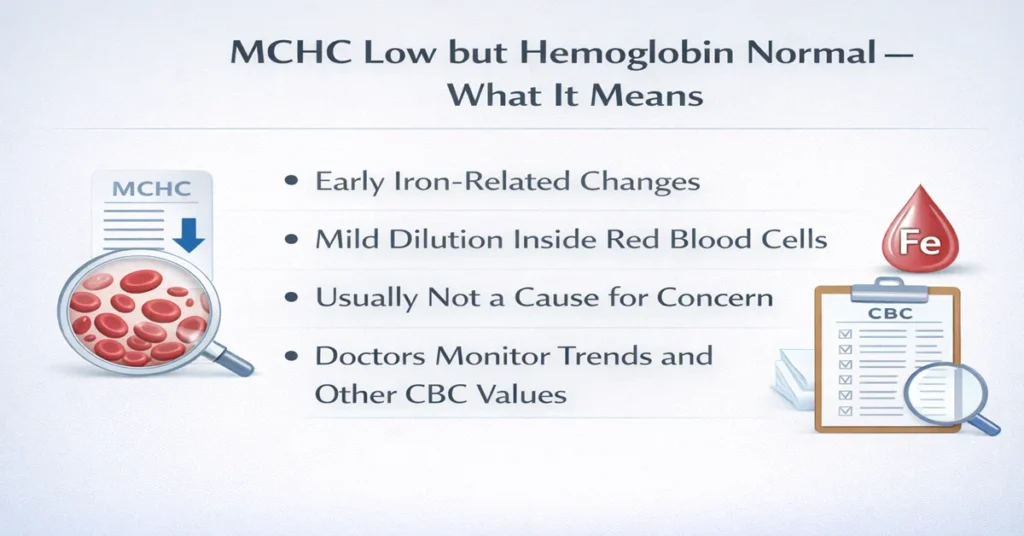
MCHC Low but Hemoglobin Normal – What It Means
This is a report pattern I see very often at the lab counter. A patient checks the CBC and says,
“My hemoglobin is normal, but MCHC is low. Should I be worried?”
This confusion is completely understandable. Many people have never heard of MCHC until it is flagged on the report. When hemoglobin looks fine but another red cell parameter is low, doubt naturally comes in.
This article is written only for this exact situation:
low MCHC with normal hemoglobin.
Not to diagnose disease, not to repeat basic test theory, but to explain how this combination is interpreted in real hospital and OPD practice.
I’ll explain it calmly, the same way I explain it to patients sitting in front of me every day.
Why This Result Feels Confusing
Most people think hemoglobin tells the full story. When Hb is normal, they assume everything related to red blood cells must also be normal.
But in real lab practice, hemoglobin and MCHC describe different aspects of red blood cells.
So it is absolutely possible to have:
- Normal hemoglobin
- Low MCHC
And in many cases, this is not serious.
What This Combination Means in Simple Words
MCHC tells us how concentrated hemoglobin is inside each red blood cell.
So when:
- Hemoglobin is normal → total oxygen-carrying capacity is adequate
- MCHC is low → hemoglobin inside individual red cells is slightly diluted
In simple terms:
You have enough hemoglobin overall, but it is spread a little more thinly inside the red blood cells.
From lab experience, this is often a very early or mild change, not a disease.
Why MCHC Can Be Low When Hemoglobin Is Normal
1. Early Iron-Related Changes (Most Common Reason)
This is the most frequent explanation I see.
In many patients, iron-related changes happen in stages:
- Iron stores begin to reduce
- Hemoglobin inside red cells becomes less concentrated
- MCHC drops
- Hemoglobin may still remain normal
At this stage:
- The body is compensating well
- Oxygen delivery is still adequate
Clinically, this is not anemia yet. Doctors usually observe rather than treat aggressively.
2. Mild or Borderline Red Cell Changes
From OPD experience, some patients naturally have:
- Slightly lower MCHC
- Normal hemoglobin
- No symptoms at all
This can be due to:
- Individual variation
- Minor nutritional imbalance
- Past history of low iron that has partially recovered
Doctors often note this and move on.
3. Hydration Status at the Time of Testing
This is a very practical point.
MCHC is affected by:
- Plasma volume
- Red cell water content
From lab observations:
- Overhydration can slightly lower MCHC
- Dehydration can affect values in the opposite direction
These are temporary effects, not medical problems.
4. Recovery Phase After Anemia or Illness
I often see reports where:
- Hemoglobin has returned to normal
- MCHC is still a little low
This happens because:
- New red blood cells are being produced
- Red cell hemoglobin concentration takes time to normalize
Clinically, this is seen as a recovery pattern, not a warning sign.
5. Lab Calculation and Technical Factors
MCHC is a calculated parameter, not a directly measured one.
That means:
- Small variations in other values
- Instrument differences
- Sample handling
Can slightly influence MCHC.
Doctors are well aware of this and rarely react to isolated mild MCHC changes.
When This Pattern Is Usually Harmless
In routine clinical practice, doctors are usually not concerned when:
- MCHC is only mildly low
- Hemoglobin is clearly normal
- The patient has no fatigue or weakness
- Other CBC values are stable
- This is an incidental finding
In such cases, doctors often say:
“No treatment needed. Just keep an eye on it.”
And that is usually enough.
When Doctors Pay More Attention
Doctors look deeper if:
- MCHC keeps falling over time
- Hemoglobin starts to decrease
- MCV and MCH also start changing
- The patient has symptoms like tiredness or paleness
- There is known blood loss or nutritional risk
Even then, the approach is gradual and calm, not urgent.
How Doctors Actually Interpret This Combination
From real hospital practice, this is how doctors usually think:
- Normal hemoglobin → oxygen delivery is okay
- Low MCHC → early or mild red cell hemoglobin dilution
- Action → correlate with history, symptoms, and trends
Doctors do not diagnose anything based on MCHC alone.
They look at:
- Patient history
- Symptoms
- Previous reports
- Other CBC parameters
Is This the Same as Anemia?
No. This is an important point.
Anemia is defined primarily by low hemoglobin, not MCHC.
From lab experience:
- Many patients with low MCHC never develop anemia
- Many remain stable for years
That’s why doctors don’t panic over this finding.
Is Repeat Testing Always Required?
No. Repeat testing depends on the context.
From OPD and lab practice:
- Mild low MCHC + normal Hb + no symptoms → no urgent repeat
- Routine health check finding → repeat during next annual check
- Symptoms or changing values → repeat sooner if advised
Doctors decide based on clinical picture, not just numbers.
Why This Result Should Be Read Calmly
One common mistake is assuming:
- Any “low” value means disease
In real clinical work:
- Low MCHC with normal hemoglobin is one of the calmer report patterns
- Most patients require reassurance, not treatment
Understanding this saves unnecessary worry.
What This Result Does Not Automatically Mean
Let me be very clear from experience:
- It does not automatically mean iron deficiency anemia
- It does not mean serious blood disorder
- It does not mean urgent treatment
- It does not mean hospitalization
It simply means:
A mild red cell parameter change that needs context, not fear.
Test Preparation
To get reliable CBC and MCHC results:
- Stay normally hydrated before testing
- Avoid heavy exercise just before sample collection
- Inform the lab about recent illness or blood loss
- Use the same lab for follow-up tests if possible
- Prefer morning samples for consistency
These steps help avoid misleading variations.
When to Consult a Doctor
Consult a doctor if:
- You feel persistent fatigue or weakness
- There is breathlessness on routine activity
- Pallor or dizziness appears
- MCHC continues to fall in repeated reports
- Hemoglobin also starts decreasing
If you feel well, routine follow-up is usually enough.
Important Word Explanations
MCHC (Mean Corpuscular Hemoglobin Concentration):
Measures how concentrated hemoglobin is inside red blood cells.
Hemoglobin:
Protein in red blood cells that carries oxygen.
CBC (Complete Blood Count):
Blood test that evaluates red cells, white cells, and platelets.
Red Blood Cell:
Cell responsible for carrying oxygen in the blood.
Early Iron Changes:
Initial stage where iron-related parameters change before anemia develops.
People Also Ask
Can MCHC be low with normal hemoglobin?
Yes. This is common and often mild.
Is low MCHC dangerous if hemoglobin is normal?
In most routine cases, no.
Does this mean iron deficiency?
Not always. Doctors look at the full picture before deciding.
Should I take supplements immediately?
Only if advised by your doctor. Many cases need observation only.
Should the test be repeated?
Only if your doctor recommends or symptoms appear.
~END~