
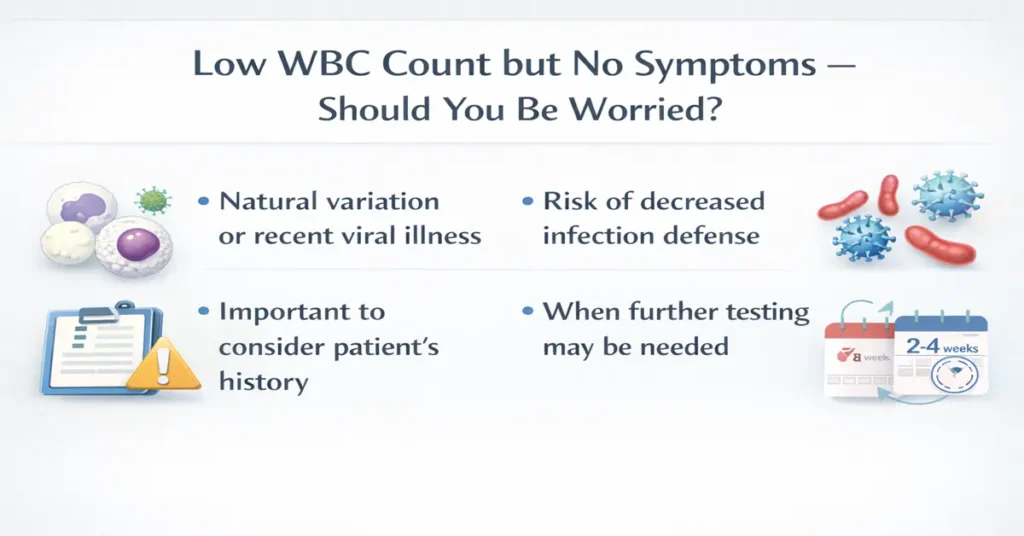
WBC Count Low but No Symptoms
Many people get worried when they see low WBC count written on their blood report, especially when they feel absolutely normal. No fever, no weakness, no frequent infections—yet the report shows a low value. As a senior lab technician, I see this confusion daily in OPD and diagnostic labs. Patients often come and ask, “If my WBC is low, why am I not feeling sick?” This article is written exactly for that situation.
Let me explain this clearly, calmly, and from real lab experience—without creating fear or confusion.
Why this report finding feels confusing
In most people’s minds, low WBC is directly linked to poor immunity or serious illness. So when the report says “low” but the body feels fine, it doesn’t make sense to them. Patients assume something is being missed or that a hidden disease is present.
Clinically, that is not how doctors or labs interpret this finding. A low WBC count without symptoms is a very common lab situation and, in most routine cases, it is not dangerous.
What low WBC without symptoms usually means in real practice
From lab experience, WBC count can go slightly low without causing any problem to the body. The immune system is complex, and a single number does not reflect its full strength.
In OPD settings, many people with low WBC:
- Are active and healthy
- Have no history of repeated infections
- Came for routine testing, insurance, or health checkups
- Had no idea about the low count until they saw the report
This tells us one important thing: numbers alone do not define health.
Common real-world reasons behind low WBC without symptoms
This section is not about listing diseases. It is about what we commonly see in labs.
Normal individual variation
Some individuals naturally have slightly lower WBC counts compared to population averages. This is especially seen in:
- Young adults
- Slim individuals
- People with no medical complaints
Clinically, if such a person has always had similar values and no symptoms, doctors usually consider it normal for that individual.
Recent viral illness that has already passed
From lab experience, one of the most common reasons is a recent viral infection. Even if the fever or cold is gone, WBC can remain low for some time during recovery.
Patients often say, “I had a mild fever two weeks ago, but I’m fine now.”
This history explains the report very well.
Temporary bone marrow response
The body sometimes temporarily reduces WBC production due to:
- Stress
- Fatigue
- Poor sleep
- Nutritional imbalance
This does not mean bone marrow disease. It is usually a short-term adjustment.
Lab timing and sample-related factors
Sometimes WBC appears low because of:
- Early morning sample
- Mild dehydration
- Recent fasting
- Minor technical variation
This is why doctors rarely act on a single report.
Why doctors usually stay calm in this situation
When doctors see low WBC without symptoms, they look beyond the number. Clinically, they focus on:
- Patient’s general condition
- History of infections
- Other blood parameters
- Previous reports
- Physical examination
If the patient looks well and other values are stable, doctors often do nothing immediately except observation.
When low WBC is usually harmless
From years of OPD and lab observation, low WBC without symptoms is usually harmless when:
- The drop is mild
- The patient feels healthy
- There are no recurrent infections
- Other blood counts are normal
- It is a first-time finding
In such cases, reassurance is often the only “treatment.”
Situations where doctors pay closer attention
Although uncommon, attention is needed if:
- WBC keeps falling on repeat tests
- Low WBC is persistent over months
- Patient starts getting frequent infections
- Other blood parameters also become abnormal
- There is unexplained weight loss or fever
Even in these cases, doctors proceed step by step. It does not automatically mean something serious.
How repeat testing is usually advised
Repeat testing is a very practical and safe approach.
From lab experience:
- Doctors usually repeat CBC after 2–4 weeks
- Many times WBC returns to previous level
- No medicines are started before repeat test
- Repeat testing is done when patient is clinically stable
This helps confirm whether the finding was temporary or persistent.
Why self-treatment is not advised
One mistake patients often make is starting supplements or medicines on their own. This is not recommended.
Low WBC without symptoms:
- Does not require antibiotics
- Does not need immune boosters unless advised
- Should not be “treated” without a clear cause
Doctors prefer monitoring rather than unnecessary intervention.
What doctors actually explain to patients in OPD
I often hear doctors say:
“Let’s repeat the test later.”
“You are clinically fine.”
“This value alone does not worry me.”
These statements are based on experience, not ignorance.
Why symptoms matter more than the report value
In real medical practice, symptoms guide decisions. A patient with no complaints and low WBC is often safer than a patient with symptoms and normal numbers.
Doctors treat patients, not reports.
Practical reassurance from lab experience
I have seen countless reports where:
- WBC was low once
- Patient panicked
- Repeat test was normal
- No issue ever developed
This is why calm interpretation is important.
Test Preparation
For repeat or follow-up testing:
- Be well-rested before sample collection
- Avoid heavy exercise just before the test
- Inform the doctor about recent illness or medicines
- Try to get repeat tests done at the same lab
- Stay hydrated unless advised otherwise
Proper preparation helps avoid misleading variations.
When to Consult a Doctor
You should consult your doctor if:
- Low WBC persists on repeat tests
- You develop frequent infections
- You have unexplained fever or weakness
- Other blood parameters change
- Your doctor advises further evaluation
If you feel healthy and your doctor is not concerned, reassurance is appropriate.
Important Word Explanations
WBC (White Blood Cells)
Cells that help the body fight infections and maintain immune defense.
CBC (Complete Blood Count)
A routine blood test that measures different blood components.
Asymptomatic
Having no symptoms or complaints.
Repeat Testing
Rechecking blood values after a period to observe trends.
Clinical Correlation
Interpreting lab results along with patient condition and history.
People Also Ask
Can WBC be low and still be normal?
Yes, in many people it is a normal individual variation.
Does low WBC always mean weak immunity?
No. Many people with low WBC have no infections at all.
Should I worry if I feel fine?
In most routine cases, no. Doctors focus on symptoms and trends.
How long does it take for WBC to improve?
Often a few weeks if the cause is temporary.
Is one low report enough for diagnosis?
No. Diagnosis is never based on a single report.
~END~