
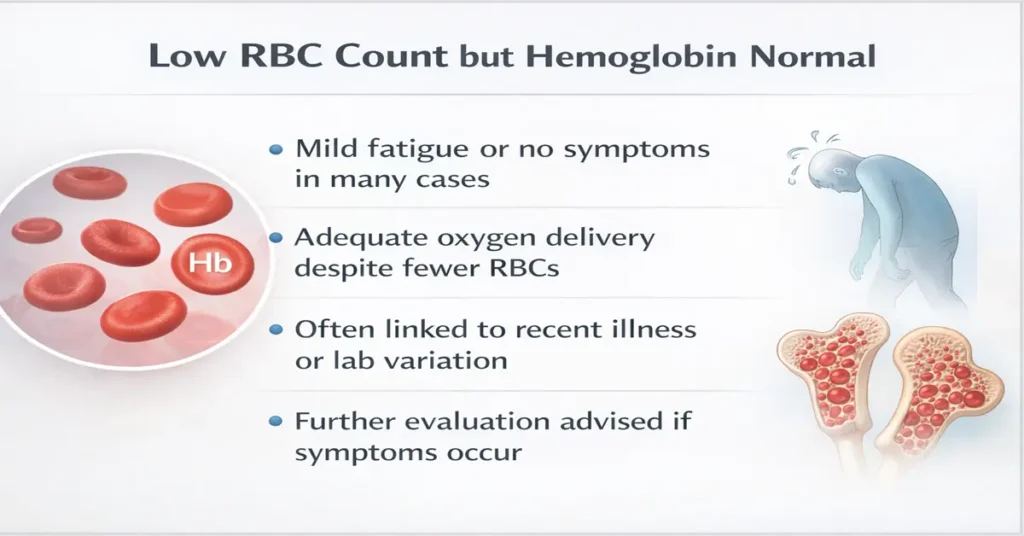
Low RBC Count but Hemoglobin Normal – Should You Worry?
A very common lab report confusion (seen daily in OPD)
One of the most frequent questions patients ask when they see their CBC report is:
“My RBC count is low, but hemoglobin is normal. Is this serious?”
From real hospital and diagnostic lab experience, I can say this clearly and calmly:
in many routine cases, this finding is not dangerous and does not mean disease.
The confusion happens because people naturally expect RBC count and hemoglobin to move together. When one is flagged low and the other looks normal, it feels contradictory. This article focuses only on this specific situation and explains how doctors and lab professionals interpret it in real practice.
What this combination means in simple words
RBC count tells us how many red blood cells are present.
Hemoglobin tells us how much oxygen-carrying protein is available in total.
So it is possible to have:
- Fewer red blood cells
- But each cell contains enough hemoglobin
- Result: overall hemoglobin stays normal
Clinically speaking, oxygen delivery to the body is still adequate. That is why many doctors do not react strongly when they see this pattern alone.
Why this happens in real-world lab practice
From daily experience handling hundreds of CBC reports, this pattern appears for a few very practical reasons, not serious illness.
1. Larger or well-filled red blood cells
Sometimes red blood cells are:
- Slightly larger
- Or contain more hemoglobin per cell
So even though the number of cells is lower, the total hemoglobin remains normal.
In lab terms, doctors often see this along with:
- Normal or slightly high MCV
- Normal MCH
This is a mathematical balance, not a disease.
2. Temporary bone marrow response
Your body does not produce red blood cells at a fixed speed every day.
After:
- Recent illness
- Mild viral fever
- Recovery from infection
- Blood donation
The RBC count may look slightly low for a short time, while hemoglobin stays normal.
From lab experience, this is very common and self-correcting.
3. Sample timing and hydration status
Blood results depend heavily on:
- Time of sample collection
- Hydration level
- Recent physical activity
Sometimes:
- RBC count appears borderline low
- Hemoglobin remains stable
Repeat testing under proper conditions often normalizes the RBC count.
This is why doctors ask:
“Test kis condition mein diya tha?”
4. Lab reference variation (not always abnormal)
Every lab has:
- Slightly different reference ranges
- Analyzer-based cutoffs
Many “low” RBC values are only marginally below range and clinically meaningless when hemoglobin is normal.
In OPD, doctors often say:
“Value borderline hai, clinically normal.”
How doctors usually interpret this combination
In real OPD practice, doctors do not treat RBC count alone.
They look at:
- Hemoglobin (most important)
- Patient symptoms
- MCV, MCH
- Clinical history
If:
- Hemoglobin is normal
- Patient has no weakness, breathlessness, or dizziness
- Other CBC values are stable
Then clinically, this report is often considered acceptable and not treated as anemia.
When this finding is usually harmless
From long lab experience, this combination is usually harmless when:
- Hemoglobin is clearly normal
- Platelet and WBC counts are normal
- No symptoms like fatigue or shortness of breath
- RBC is only mildly low, not severely reduced
In such cases, doctors often advise observation only, not medication.
Situations where doctors pay closer attention
Although uncommon, doctors become more alert if:
- RBC count keeps falling on repeat tests
- Hemoglobin starts trending downward later
- Patient has ongoing fatigue, paleness, or breathlessness
- MCV is persistently high or very low
In these cases, further evaluation may be advised — not because of RBC alone, but because of the overall pattern.
Should you repeat the test?
From routine lab protocol, repeat testing is advised when:
- The test was done during illness or recovery
- Blood was drawn after poor sleep or dehydration
- RBC is borderline low without symptoms
Repeat testing is usually not required urgently when:
- Hemoglobin is normal
- Patient feels well
- Doctor is satisfied clinically
Doctors always decide this case-by-case.
A common mistake patients make
Many patients:
- Google “low RBC”
- Read about anemia or serious conditions
- Panic unnecessarily
In reality, lab professionals often reassure patients by saying:
“Hb normal hai, toh oxygen carrying capacity theek hai.”
Context matters more than one highlighted number.
What this report does NOT automatically mean
This combination does not automatically mean:
- Severe anemia
- Bone marrow disease
- Internal bleeding
- Chronic illness
Those conditions usually show hemoglobin changes and symptoms, not isolated RBC reduction.
Practical advice from lab experience
- Do not self-diagnose based on RBC alone
- Always see how hemoglobin and symptoms align
- Trust clinical correlation more than color highlights on reports
Many healthy individuals carry this pattern for years without any problem.
Test Preparation
To avoid confusing results in future tests:
- Give blood after proper rest
- Drink adequate water before the test
- Avoid heavy exercise just before sampling
- Inform the lab about recent illness or blood donation
Good preparation improves report accuracy.
When to Consult a Doctor
Consult your doctor if:
- You feel persistent weakness or breathlessness
- RBC continues to drop on repeat reports
- Hemoglobin also starts falling
- You have a known blood disorder
Otherwise, in most routine cases, reassurance is enough.
Important Word Explanations
RBC (Red Blood Cell): Cells that carry oxygen in blood.
Hemoglobin (Hb): Oxygen-carrying protein inside RBCs.
MCV: Average size of red blood cells.
MCH: Amount of hemoglobin in one red blood cell.
CBC: Complete Blood Count test.
People Also Ask
Is low RBC count with normal hemoglobin dangerous?
In most routine cases, no. Doctors focus more on hemoglobin and symptoms.
Can illness temporarily lower RBC count?
Yes. Viral infections and recovery phases often show this pattern.
Does this mean anemia?
Not if hemoglobin is normal and you feel well.
Should I take iron supplements?
Never start supplements without medical advice when hemoglobin is normal.
~END~