
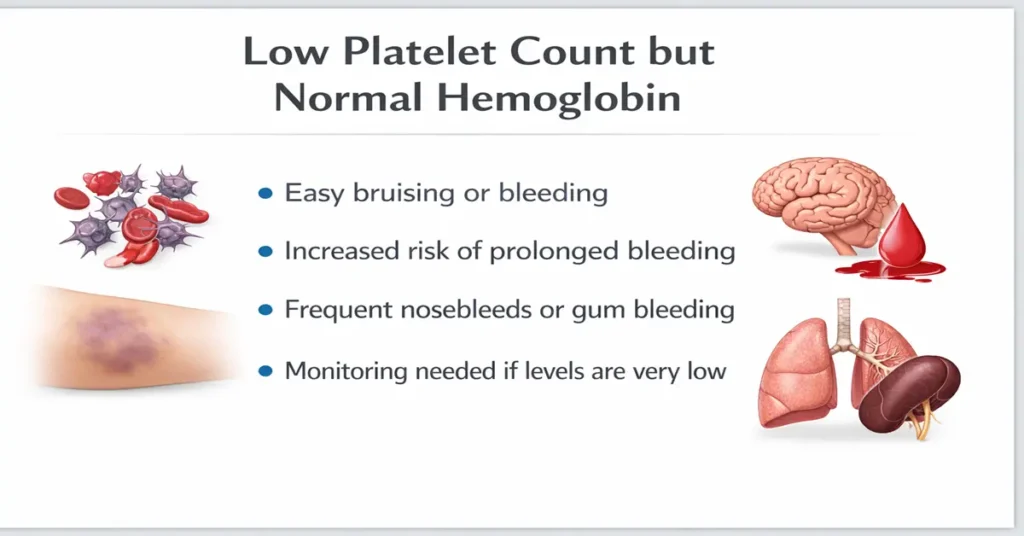
Platelet Count Low but Hemoglobin Normal – What This Report Combination Usually Means
As a senior lab technician, this is one of the most common report combinations I explain every week—sometimes every day.
A patient looks at the report and says:
“Platelets are low, but hemoglobin is normal. Is something serious wrong?”
The short answer in most routine cases is: not necessarily.
This combination often creates confusion because people expect all blood values to go up or down together. In real lab practice, that rarely happens. Blood components behave independently, and each tells a different story.
This article focuses only on this specific situation—low platelet count with normal hemoglobin—and explains how we interpret it in daily OPD and diagnostic lab settings.
Understanding the Confusion (In Simple Words)
Hemoglobin reflects oxygen-carrying red blood cells.
Platelets are responsible for blood clotting.
They are made from different cell lines in the bone marrow and are affected by different conditions.
So it is completely possible—and quite common—to see:
- Hemoglobin → normal
- Platelet count → mildly or moderately low
This does not automatically mean anemia, cancer, or internal bleeding, despite what Google may suggest.
Why This Pattern Happens So Often (From Lab Experience)
In day-to-day lab work, low platelets with normal hemoglobin usually appear due to temporary or isolated factors, not because the entire blood system is failing.
Here are the most practical reasons we see:
1. Recent Viral Illness (Most Common Reason)
Clinically, this is the number one cause.
After viral infections such as:
- seasonal fever
- viral flu
- dengue recovery phase
- COVID or post-viral fatigue
Platelets often drop for a short time, while hemoglobin stays normal.
From lab experience:
- Platelets may remain low for 1–3 weeks
- Hemoglobin is unaffected because red cells have a longer lifespan
In most such cases, the platelet count recovers on its own without treatment.
2. Sample-Related or Lab-Related Factors
This is something patients rarely hear, but technicians see it often.
Sometimes the platelet count appears low due to:
- platelet clumping in the tube
- delay in sample processing
- EDTA-related pseudothrombocytopenia
In these cases:
- Patient feels completely fine
- No bleeding symptoms
- Repeat test often comes back normal
This is why doctors sometimes ask for a repeat CBC, especially if the platelet drop does not match the clinical picture.
3. Mild Bone Marrow Suppression (Temporary)
Bone marrow can slow platelet production briefly due to:
- infections
- recent medications (antibiotics, antivirals, painkillers)
- physical stress or dehydration
When this happens:
- Platelets drop first
- Hemoglobin remains normal
Clinically, doctors usually observe rather than treat in such cases.
4. Nutritional Deficiency (Early Stage)
In early vitamin deficiencies (especially B12 or folate):
- Platelets may fall first
- Hemoglobin may still remain in the normal range
This is not anemia yet.
It is often picked up early through routine testing.
When This Combination Is Usually Harmless
From OPD and lab experience, this report is usually not dangerous when:
- Platelet count is above 80,000–100,000
- Hemoglobin is stable
- No active bleeding
- No bruising, gum bleeding, or nosebleeds
- Patient feels mostly well
In such cases, doctors often:
- Advise hydration
- Review recent illness history
- Repeat CBC after 1–2 weeks
- Avoid unnecessary medications
No emergency action is needed in most routine cases.
When Doctors Pay More Attention
Doctors become more cautious when low platelets are accompanied by:
- Rapid downward trend on repeat tests
- Platelet count below 50,000
- Bleeding symptoms
- Abnormal white blood cell counts
- Liver or spleen enlargement
- Long-standing unexplained low platelets
Even then, hemoglobin being normal is still a reassuring sign, because it means there is no ongoing major blood loss or marrow failure affecting red cells.
How Doctors Interpret This Report Combination
In real clinical practice, doctors do not look at one value in isolation.
They consider:
- Recent fever or infection
- Medication history
- Previous CBC reports
- Physical symptoms
- Peripheral smear (if needed)
If hemoglobin is normal, it usually tells the doctor:
- Oxygen-carrying capacity is intact
- No active internal bleeding
- No major marrow suppression
So the focus remains on monitoring, not panic treatment.
Is Repeat Testing Always Required?
No. Repeat testing is not automatic.
Doctors usually recommend a repeat CBC when:
- Platelets are moderately to severely low
- Report does not match patient’s condition
- There was recent illness
- Lab artifact is suspected
If platelet count is only slightly low and patient is asymptomatic, many clinicians simply observe clinically.
What This Report Does NOT Mean
This combination does not automatically indicate:
- Blood cancer
- Bone marrow failure
- Internal bleeding
- Serious anemia
Those conditions usually affect multiple blood parameters, not just platelets alone.
Test Preparation
For accurate platelet results:
- Stay well hydrated before testing
- Avoid heavy exercise just before blood draw
- Inform the lab about recent illness or medications
- Follow timing instructions if repeat testing is advised
Simple preparation helps avoid misleading results.
When to Consult a Doctor
Consult a doctor promptly if you notice:
- Nosebleeds or gum bleeding
- Easy bruising
- Blood in urine or stool
- Very heavy menstrual bleeding
- Platelet count falling on repeat reports
If you feel normal and hemoglobin is stable, consultation can usually be non-urgent.
Important Word Explanations
- Platelets: Blood cells that help stop bleeding by forming clots
- Hemoglobin: Protein in red blood cells that carries oxygen
- CBC: Complete Blood Count test
- Bone marrow suppression: Temporary slowdown in blood cell production
- Peripheral smear: Microscopic examination of blood cells
People Also Ask
Can platelets be low without anemia?
Yes. This is very common, especially after infections.
Is low platelet count dangerous if hemoglobin is normal?
Usually no, unless platelet levels are very low or symptoms are present.
Do low platelets always need treatment?
No. Many cases resolve naturally with monitoring.
Should I repeat the test immediately?
Only if advised by a doctor or if symptoms appear.
~END~