
Causes and Symptoms of Low Acid Phosphatase Levels
Overview of Low Levels
Acid phosphatase is an enzyme present in several body tissues, including the prostate, liver, spleen, blood cells, and bones. Its role is supportive rather than central, helping with the breakdown of certain phosphate-containing compounds involved in normal cell function. When acid phosphatase levels are lower than expected, it usually does not cause illness by itself. Instead, it acts as a quiet laboratory signal that may reflect changes in bone activity, blood cell turnover, hormonal balance, or general metabolism.
In routine lab practice, low acid phosphatase values are often picked up incidentally. The test is usually ordered for another reason, and the low result appears without obvious symptoms. Clinically, this is where doctors pause and look at the bigger picture rather than the number alone. In many cases, the finding turns out to be harmless, temporary, or related to individual variation.
Major Medical Causes of Low Acid Phosphatase Levels
Low acid phosphatase levels can occur for several reasons, and each reflects a different underlying biological mechanism rather than a direct disease process.
Reduced bone activity
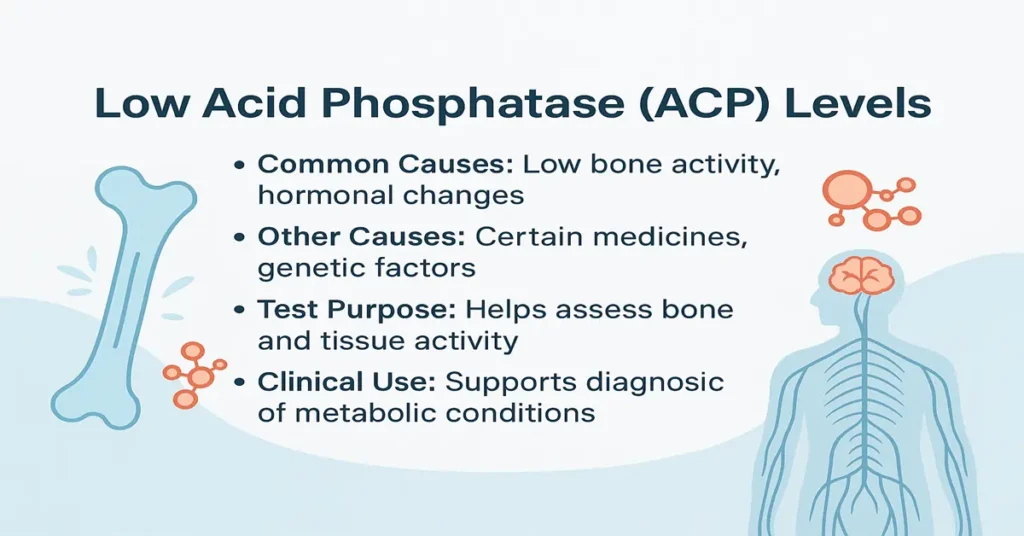
A portion of acid phosphatase comes from bone tissue. When bone turnover is lower than usual, enzyme release may decrease. This can be seen with prolonged inactivity, age-related slowing of bone metabolism, or certain bone-related conditions. In practice, this is often mild and only becomes relevant if supported by other findings.
Certain medications
Some drugs can influence enzyme levels indirectly. Long-term use of medications affecting bone metabolism, immune function, or liver enzymes may lead to mildly reduced acid phosphatase values. This is why medication history is always reviewed before interpreting the result.
Genetic factors
A small number of individuals naturally have lower enzyme levels due to inherited traits. These people are otherwise healthy, and the finding has no clinical consequence. This variation is usually discovered only when testing is done for unrelated reasons.
Hormonal conditions
Hormones that influence bone and blood cell activity, such as thyroid hormones, estrogen, or testosterone, can affect enzyme production. When these hormones are imbalanced, acid phosphatase levels may shift slightly. In OPD settings, this is considered alongside symptoms and other hormone tests.
Laboratory or sample handling issues
Occasionally, a low value is technical rather than biological. Delayed processing, storage issues, or analytical variation can affect enzyme activity. Repeating the test often helps clarify whether the result is genuine.
Symptoms Seen in Low Levels
Most people with low acid phosphatase levels have no symptoms at all. The enzyme itself does not cause discomfort when reduced. Any symptoms that do appear are usually related to the underlying condition rather than the low enzyme value.
Some individuals may report general fatigue, low energy, or mild weakness, especially if the cause involves hormonal or bone-related changes. Mild joint stiffness or a sense of reduced physical endurance can sometimes be present. Mood changes or persistent tiredness may occur when hormone imbalance is involved. Rarely, slower healing of minor injuries may be noticed.
Clinically, it is important to understand that these symptoms are not caused by low acid phosphatase directly. They reflect the broader physiological context.
Health Risks of Persistently Low Levels
A low acid phosphatase result is rarely dangerous by itself. The main concern is whether it points toward an underlying issue that needs monitoring.
If persistently low levels are ignored, there is a small risk of missing reduced bone activity that may affect long-term bone strength, ongoing hormonal imbalance, or another condition that would benefit from follow-up. There is also the risk of misinterpretation if the test result was influenced by technical factors.
This is why doctors rely on repeated testing, clinical examination, and supporting laboratory values before drawing conclusions.
How to Improve Levels Safely
There is no direct or safe way to target acid phosphatase levels alone. In medical practice, the enzyme is never treated as a standalone problem. The focus remains on identifying and addressing the reason behind the low value.
Doctors may first confirm the result with repeat testing. If hormonal imbalance is suspected, further evaluation helps guide appropriate management, which often leads to normalization of enzyme levels over time. When medications are involved, reviewing and adjusting them may be sufficient.
From a clinical perspective, the goal is not to raise the enzyme number but to ensure that bone health, hormonal balance, and overall metabolism are stable.
Additional Information
Low acid phosphatase levels are generally less clinically significant than high levels, which are more strongly associated with prostate or bone-related disorders. In many cases, a low value does not indicate disease at all.
Doctors usually interpret the result alongside age, activity level, symptoms, and related tests such as alkaline phosphatase, calcium, and complete blood count. A single low reading is almost never used for diagnosis. Patterns over time are far more meaningful.
Test Preparation
The acid phosphatase test usually does not require special preparation. Normal eating and drinking are allowed unless otherwise advised. It is helpful to inform the doctor or laboratory about ongoing medications, especially hormonal or bone-related drugs.
Avoiding heavy physical exertion just before testing is generally advised, as it may influence related enzyme markers and confuse interpretation.
When to See a Doctor
Medical advice is recommended if low acid phosphatase levels are seen repeatedly or if they are accompanied by unexplained fatigue, weakness, bone discomfort, or known hormonal conditions. People on long-term medications that affect bone or metabolism should also discuss results with their doctor.
Follow-up helps ensure that the finding is understood correctly and that no underlying issue is overlooked.
Sample Type
The acid phosphatase test is performed using a blood sample drawn from a vein, usually from the arm. Depending on the clinical question, total enzyme levels or specific fractions may be measured.
Important Word Explanations
Enzyme: A protein that helps chemical reactions occur efficiently in the body.
Bone turnover: The ongoing process of bone breakdown and new bone formation.
Hormonal imbalance: A state where hormone levels are outside expected ranges.
Metabolism: The body’s chemical processes that support energy use and tissue maintenance.
Reference range: The normal value range used to interpret test results.
People Also Ask
Is a low acid phosphatase level serious?
Usually no. Most low values are mild and not linked to serious disease.
Can low acid phosphatase be temporary?
Yes. Temporary illness, medications, or test-related factors can cause short-term changes.
Does a low value always mean a bone problem?
No. Many low results are unrelated to bone disease and reflect normal variation.
When do doctors usually worry about low levels?
Concern arises mainly when low levels are persistent and accompanied by symptoms or other abnormal tests.
Is repeat testing common for this result?
Yes. Doctors often repeat the test to confirm whether the finding is consistent or temporary.
~END~