
Overview
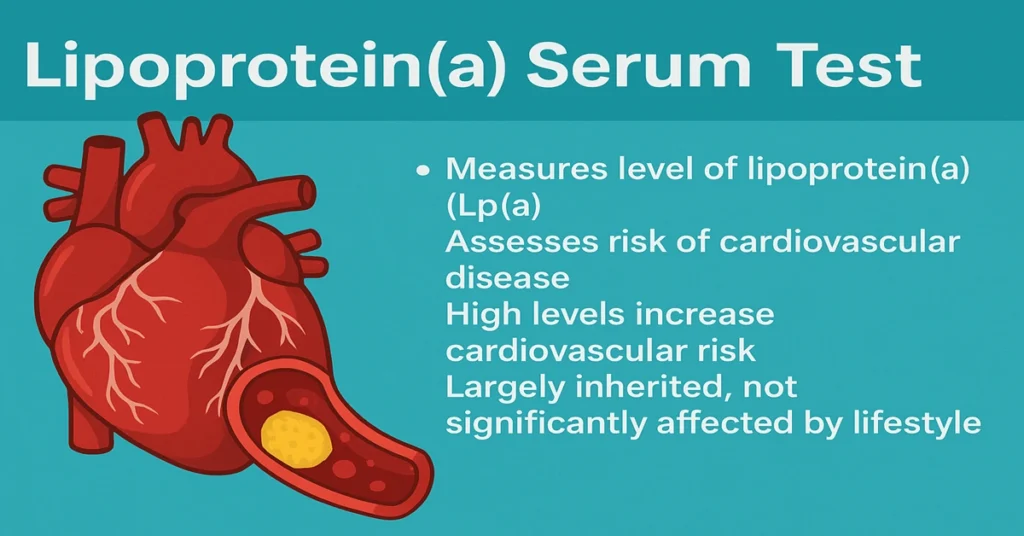
The Lipoprotein(a) Serum Test, often written as the Lp(a) Test, measures the amount of lipoprotein(a) circulating in the blood. Lipoprotein(a) is a specific cholesterol-carrying particle made of two main components: a low-density lipoprotein (LDL) particle and a unique protein called apolipoprotein(a).
What makes Lp(a) clinically important is that it behaves differently from routine cholesterol. Higher levels are strongly linked with cardiovascular conditions such as heart attack, stroke, atherosclerosis, and aortic valve disease. Unlike LDL cholesterol, Lp(a) levels are largely determined by genetics. This means they are inherited and remain relatively stable throughout life. Diet, exercise, and most lifestyle measures have little influence on Lp(a) levels.
Because elevated Lp(a) does not cause symptoms on its own, many people are unaware of the risk until a cardiovascular event occurs. For this reason, Lp(a) testing is increasingly used as part of a more detailed cardiovascular risk assessment, especially in people with unexplained or early heart disease.
Where Is Lipoprotein(a) Produced in the Body?
Lipoprotein(a) is produced in the liver. The liver synthesizes apolipoprotein(a), which then binds to LDL particles to form Lp(a). Once released into the bloodstream, it circulates through blood vessels in a manner similar to other lipoproteins.
Although liver function can influence Lp(a) levels, genetics remains the dominant factor. In most individuals, lifestyle changes do not significantly alter how much Lp(a) the liver produces.
Functions and Importance of Lipoprotein(a)
Lp(a) plays a limited physiological role but has important clinical implications.
It participates in transporting cholesterol and fatty acids in the bloodstream. However, when present in excess, this transport contributes to cholesterol deposition within blood vessel walls.
Lp(a) also shares structural similarities with plasminogen, a protein involved in clot breakdown and tissue repair. Because of this resemblance, Lp(a) may interfere with normal clot dissolution and influence wound-healing pathways.
Clinically, Lp(a) is considered a major inherited risk factor for cardiovascular disease. Elevated levels increase the likelihood of heart attack, stroke, peripheral artery disease, and aortic valve stenosis—even in individuals whose LDL cholesterol and triglyceride levels are otherwise normal and who follow healthy lifestyles.
Higher Lp(a) levels are associated with faster plaque buildup, increased inflammation within blood vessels, and a greater tendency toward clot formation. This combination explains why Lp(a) is often described as a “silent” cardiovascular risk factor.
Causes of Low Lipoprotein(a) Levels
Low Lp(a) levels are usually determined by genetics and reflect reduced production of apolipoprotein(a). In rare situations, advanced liver disease may also be associated with lower levels.
Low Lp(a) does not cause symptoms and is generally not considered harmful.
Symptoms of Low Levels
Low Lp(a) levels do not produce symptoms and are typically regarded as a neutral or favorable finding.
Causes of High Lipoprotein(a) Levels
Most cases of elevated Lp(a) are inherited. The LPA gene strongly influences how much Lp(a) the liver produces, so individuals with affected family members are more likely to have higher levels.
Certain medical conditions may also be associated with increased Lp(a), including chronic kidney disease, hypothyroidism, and long-standing poorly controlled diabetes. However, these factors usually play a secondary role compared with genetic influence.
Lifestyle factors such as diet, exercise, and weight loss do not significantly reduce Lp(a), which distinguishes it from other lipid markers.
Symptoms of High Lp(a)
High Lp(a) levels do not cause direct symptoms. People generally feel well and are unaware of the elevation.
Clinical problems arise only when complications develop, such as heart attack, stroke, chest pain due to reduced blood flow, leg pain from peripheral artery disease, or narrowing of the aortic valve. Because symptoms appear late, testing is the only reliable way to identify elevated Lp(a).
Reference Ranges
Reference ranges may vary slightly between laboratories, but commonly used categories include:
- Below 14 mg/dL (below 30 nmol/L): Desirable
- 14–30 mg/dL (30–75 nmol/L): Borderline
- Above 30 mg/dL (above 75 nmol/L): Higher cardiovascular risk
Rising levels are associated with increasing cardiovascular risk rather than a specific disease threshold.
Who Should Get the Lp(a) Test?
Doctors may recommend Lp(a) testing for individuals with a family history of early heart disease or stroke, those who develop cardiovascular disease at a young age, or patients whose cholesterol levels remain concerning despite treatment.
It may also be advised in people with aortic valve disease, chronic kidney disease, or unexplained cardiovascular findings. Many specialists suggest at least a one-time Lp(a) test in adulthood, as levels remain fairly constant over a lifetime.
Sample Type
The test is performed on a serum blood sample drawn from a vein. Fasting is usually not required unless other lipid tests are ordered at the same time.
How Is This Test Used with Other Tests?
Lp(a) testing complements, rather than replaces, routine lipid testing. Doctors often interpret the result alongside a standard lipid profile, apolipoprotein B levels, inflammatory markers, and, in selected cases, heart imaging or calcium scoring. Together, these results provide a more complete picture of cardiovascular risk.
Can High Lp(a) Be Treated?
Lp(a) itself is not easily modified. Lifestyle changes have minimal effect, and many standard cholesterol-lowering medications do not directly reduce Lp(a), although they may lower overall cardiovascular risk.
Some therapies can influence Lp(a) in selected patients, and new treatments are under development. Decisions about management are always individualized and guided by a doctor, with attention focused on reducing overall cardiovascular risk rather than targeting Lp(a) alone.
Test Preparation
No special preparation is usually needed. Patients should inform their doctor about liver or kidney disease, thyroid disorders, cholesterol-lowering medications, and any strong family history of cardiovascular disease.
When to Consult a Doctor
Medical advice is recommended for individuals with a personal or family history of heart attack or stroke, persistent high cholesterol despite treatment, known kidney or thyroid disease, or symptoms such as chest pain, shortness of breath, or sudden weakness. Early evaluation helps identify risk and guide appropriate monitoring.
Important Word Explanations
- Lipoprotein(a): A cholesterol-carrying particle linked to inherited cardiovascular risk
- Apolipoprotein(a): The protein component that distinguishes Lp(a) from LDL
- Atherosclerosis: Buildup of plaque inside blood vessels
- LDL: Commonly known as “bad” cholesterol
- Peripheral artery disease: Narrowing of arteries supplying the limbs
- Aortic stenosis: Narrowing of the aortic heart valve
- Genetic risk: Inherited tendency passed from parents
~END~
Related Posts
None found