
Leishmania Antibody Test: Purpose, High/Low Levels, Symptoms & Diagnosis Guide
Overview
Leishmaniasis is a parasitic infection transmitted through the bite of infected female sandflies. Depending on the species involved and the individual’s immune response, the disease may affect the skin, internal organs, or, in uncommon situations, broader immune function. Clinically, this infection can be difficult to recognize early because its symptoms often overlap with other common conditions such as malaria, typhoid, tuberculosis, or long-standing febrile illnesses.
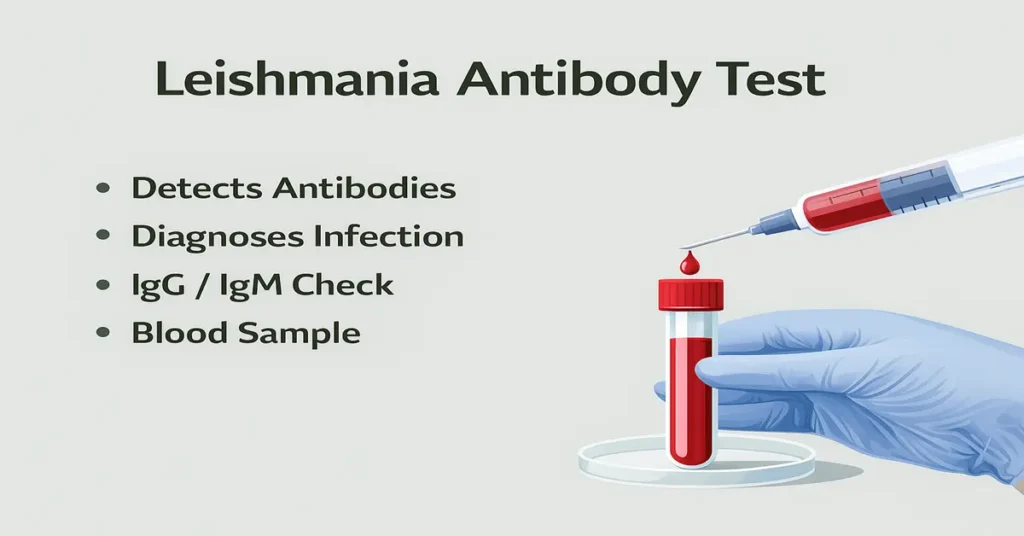
The Leishmania Antibody Test is therefore used as a supportive diagnostic tool. It detects antibodies—mainly IgG and IgM—that the immune system produces after exposure to Leishmania parasites. These antibodies do not appear immediately after infection, but once present, they help clinicians understand whether exposure or infection is likely. The test is used in the evaluation of both visceral leishmaniasis (kala-azar) and cutaneous leishmaniasis.
Early identification is particularly important in visceral disease, as prolonged infection can affect the spleen, liver, bone marrow, and blood cell production if not recognized in time.
What Is the Leishmania Antibody Test?
The Leishmania Antibody Test is a blood test that detects the body’s immune response rather than directly identifying the parasite. After the parasite enters the body, the immune system gradually produces antibodies that can be measured using laboratory techniques.
In practical terms, the presence of antibodies suggests exposure or infection, while their absence may indicate no infection or testing performed very early in the disease course. Clinicians use this test to support diagnosis in patients with suggestive symptoms, confirm infection in suspected cases, and assess exposure in people living in or returning from endemic regions.
Because antibody detection reflects immune response rather than parasite load, results are always interpreted alongside clinical findings and other investigations.
Where Are These Antibodies Produced?
Antibodies are produced by B lymphocytes, which mature into plasma cells when the immune system recognizes a foreign organism. Once activated, these cells generate antibodies specific to Leishmania antigens.
IgM antibodies tend to appear earlier in the course of infection, while IgG antibodies develop later and may remain detectable for months or even years. This persistence explains why a positive IgG result does not always distinguish between current and past infection and must be interpreted carefully.
Why Is This Test Important?
From a clinical perspective, the Leishmania Antibody Test plays an important role in several situations. It helps identify infection early, particularly in visceral leishmaniasis, where delayed recognition can lead to significant organ involvement. It also supports diagnosis when symptoms are non-specific and overlap with other infectious diseases.
In endemic areas, the test assists in understanding disease patterns and spread. A positive antibody result can strengthen the clinical suspicion of leishmaniasis even when parasites are not easily detected in blood or tissue samples, helping clinicians proceed with appropriate evaluation and management.
Causes of Low or Negative Test Results
A low or negative antibody result may have several explanations. In many cases, it simply means there has been no exposure to the parasite. If testing is done very early after infection, antibodies may not yet be present at detectable levels.
Individuals with weakened immune systems—such as those with HIV infection, malnutrition, or chronic illness—may also produce lower antibody levels. Occasionally, technical or timing factors related to sample collection can influence results. For these reasons, a single negative test does not always exclude disease when clinical suspicion remains high.
Symptoms Associated with Low/Negative Antibodies
Low or negative antibody levels do not cause symptoms themselves. If infection is present despite negative results, patients may still experience features such as prolonged fever, weight loss, weakness, enlarged spleen or liver, or anemia. In such situations, clinicians often consider repeat testing or additional diagnostic methods to clarify the diagnosis.
Causes of High or Positive Test Results
A positive antibody result generally indicates exposure to Leishmania parasites. This may reflect an active infection, either visceral or cutaneous, or a past infection that has already resolved. IgG antibodies, in particular, may remain detectable long after recovery.
In some cases, antibody tests can show cross-reactivity with other parasitic infections, leading to false-positive results. Because of this, clinicians interpret positive findings in the context of symptoms, geographic exposure, and supporting laboratory or imaging studies.
Symptoms with High/Positive Antibody Levels
Clinical features depend on the form of leishmaniasis involved. In visceral leishmaniasis, patients may present with long-lasting fever, progressive weight loss, weakness, and enlargement of the spleen or liver, often accompanied by anemia and reduced immunity. Without timely recognition, this form can become life-threatening.
Cutaneous leishmaniasis typically presents with skin lesions such as nodules, ulcers, or non-healing sores on exposed areas of the body. These lesions usually progress slowly and may leave scars even after healing. The presence of antibodies supports the diagnosis but does not define disease severity on its own.
Reference Ranges
Leishmania antibody results are usually reported qualitatively as negative or positive. Interpretation depends on the testing method used, such as ELISA, rK39 rapid tests, or immunofluorescence assays. Because antibodies can persist long after infection, results are always assessed together with clinical symptoms, exposure history, and other investigations rather than in isolation.
Sample Type
The test is performed on a blood sample, using serum or plasma. In complex cases, particularly suspected visceral leishmaniasis with unclear results, additional diagnostic procedures such as bone marrow examination or tissue aspirates may be considered in specialized settings.
Test Preparation
No special preparation is required for the Leishmania Antibody Test. Patients should inform their doctor about recent travel to endemic areas, prolonged fever, skin lesions, immune status, or prior antiparasitic treatment. In suspected visceral disease, testing is often performed urgently as part of a broader diagnostic evaluation.
When to Consult a Doctor
Medical evaluation is recommended for individuals with persistent fever, unexplained weight loss, prolonged weakness, abdominal enlargement suggestive of splenic involvement, or chronic skin ulcers. Prompt assessment is especially important for people living in or returning from endemic regions.
Urgent medical attention is required if there is severe anemia, bleeding tendencies, marked abdominal swelling, breathing difficulty, or extreme fatigue, as these may signal advanced visceral disease requiring immediate care.
Important Word Explanations
- Parasite: An organism that lives in or on another organism and causes disease
- Antibody: A protein produced by the immune system to recognize and fight infections
- IgG / IgM: Different classes of antibodies produced at various stages of infection
- Visceral: Involving internal organs such as the liver and spleen
- Cutaneous: Involving the skin
- Kala-Azar: Another term for visceral leishmaniasis
~END~
Related Posts
None found