
Overview
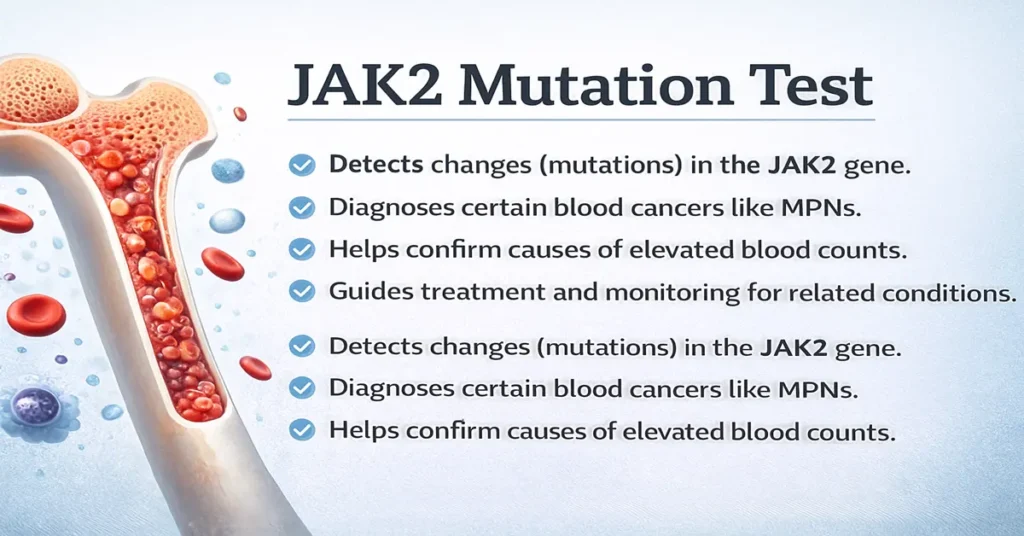
Certain blood cancers and blood disorders develop when the bone marrow begins producing blood cells in excess. To understand why this overproduction is occurring, doctors often rely on a targeted genetic test known as the JAK2 Mutation Test. This test looks for specific changes in the JAK2 (Janus Kinase 2) gene, which plays a key role in regulating how blood cells are formed and released from the bone marrow.
The most frequently identified change is the JAK2 V617F mutation, which is closely associated with a group of conditions called myeloproliferative neoplasms (MPNs). These disorders include polycythemia vera, essential thrombocythemia, and primary myelofibrosis. In these conditions, the bone marrow produces excessive numbers of red blood cells, white blood cells, or platelets, which can increase the risk of clotting, bleeding, and other complications.
What Is the JAK2 Mutation Test?
The JAK2 Mutation Test is a genetic laboratory test designed to detect specific mutations in the JAK2 gene. When present, these mutations alter normal signaling pathways in blood-forming cells, allowing them to grow and divide without the usual regulatory controls.
In practical terms, a normal JAK2 gene supports balanced blood cell production, while a mutated JAK2 gene signals continuous cell growth. Doctors use this test to help confirm suspected myeloproliferative disorders, explain unexplained elevations in blood counts, and better understand disease behavior over time.
Because it is a targeted test, it is not ordered routinely. It is typically requested when blood counts are persistently abnormal or when clinical features raise suspicion for an underlying bone marrow disorder.
Where Is the JAK2 Gene Found in the Body?
The JAK2 gene is located on chromosome 9 and is present in nearly all cells of the body. Its most clinically important activity occurs in the bone marrow, where blood cell formation takes place.
The bone marrow produces red blood cells that carry oxygen, white blood cells that support immune defense, and platelets that help control bleeding. A mutation affecting JAK2 disrupts the signals that normally regulate this process, leading to overproduction of one or more blood cell lines.
Why Is JAK2 Important? (Main Functions)
The JAK2 gene provides instructions for making a protein that functions as a signaling enzyme known as a tyrosine kinase. This enzyme helps transmit growth signals from the surface of blood-forming cells to their nucleus.
Under normal conditions, these signals are carefully regulated to maintain stable blood counts. When a JAK2 mutation is present, signaling becomes continuously active. As a result, blood cells continue to grow and survive even when they should not, which explains the abnormal blood counts seen in myeloproliferative disorders.
Causes of Low/Negative Results
A negative JAK2 test result means that no detectable mutation was found in the JAK2 gene.
Clinically, this suggests that the abnormal blood findings are not driven by a JAK2 mutation. Other genetic changes, such as CALR or MPL mutations, may still be involved, or the condition may have a non-genetic cause. A negative result does not rule out disease; it simply narrows the possible explanations and guides further evaluation.
Symptoms Linked to Low/Negative Results
The JAK2 result itself does not produce symptoms. When the test is negative, any symptoms present are related to the underlying condition rather than the absence of a mutation.
Individuals may still experience fatigue, anemia, bruising, or abnormal blood counts, but these findings arise from causes unrelated to JAK2-driven disease.
Causes of High/Positive Results
A positive JAK2 mutation test indicates that a mutation is present, most commonly JAK2 V617F. Less frequently, exon 12 mutations may be detected.
Positive results are strongly associated with myeloproliferative neoplasms. In polycythemia vera, the mutation is found in the vast majority of cases. It is also present in a significant proportion of people with essential thrombocythemia and primary myelofibrosis. Identifying the mutation supports diagnosis and helps clarify the nature of the bone marrow disorder.
Symptoms Linked to High/Positive Results
Symptoms depend on the specific myeloproliferative condition involved and the type of blood cells affected.
In polycythemia vera, individuals may notice headaches, dizziness, itching after warm showers, or symptoms related to increased blood thickness. In essential thrombocythemia, clotting or bleeding tendencies may occur alongside elevated platelet counts. In primary myelofibrosis, fatigue, anemia, weight loss, night sweats, and spleen enlargement are more common.
Some individuals have few or no symptoms early in the disease, with abnormalities detected only through routine blood testing.
Reference Range
JAK2 mutation testing is typically reported as:
- Negative: No mutation detected
- Positive: Mutation detected
Some laboratories also report the allele burden, which reflects the proportion of cells carrying the mutation. This information can help clinicians understand disease extent and monitor changes over time.
Sample Type
The test is most often performed on a blood sample.
In certain cases, a bone marrow sample may be used to support a more detailed diagnostic assessment.
Test Preparation
No fasting or special preparation is usually required. Doctors may consider current medications, family history of blood disorders, and prior laboratory results when deciding to order the test.
The test is typically requested when blood counts remain elevated without an obvious explanation.
When to Consult a Doctor
Medical review is recommended when blood tests repeatedly show high counts or when symptoms such as unexplained fatigue, frequent clotting or bleeding, night sweats, weight loss, headaches, dizziness, or left-sided abdominal discomfort are present.
Urgent medical attention is required for sudden chest pain, difficulty breathing, or stroke-like symptoms, as these may indicate serious clotting complications.
Important Word Explanations
- Mutation: A change in a gene’s structure
- Myeloproliferative Neoplasm (MPN): A disorder in which the bone marrow produces excess blood cells
- Allele Burden: The percentage of cells carrying a genetic mutation
- Bone Marrow: The tissue responsible for blood cell production
- Tyrosine Kinase: An enzyme involved in cell growth signaling
~END~
Related Posts
None found