
Overview
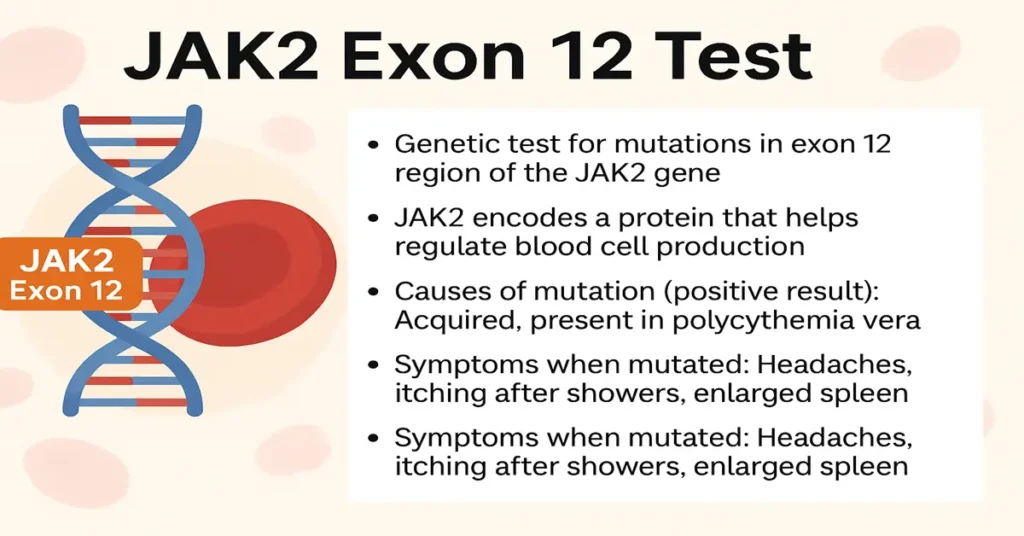
Blood-related disorders sometimes come to attention when routine tests show persistently high red blood cell levels. In such situations, doctors look for underlying causes rather than relying only on numbers. One of the focused tests used in this evaluation is the JAK2 Exon 12 Test. This test looks for specific genetic changes in a small region of the JAK2 gene known as Exon 12.
Although these mutations are uncommon, they are closely associated with Polycythemia Vera (PV), particularly in patients who do not carry the more commonly tested JAK2 V617F mutation. When red blood cell counts are high and standard mutation testing is negative, this test often helps clinicians clarify the diagnosis and move the evaluation forward with confidence.
What Is the JAK2 Exon 12 Test?
The JAK2 Exon 12 Test is a molecular test designed to detect mutations within the Exon 12 region of the JAK2 gene. Changes in this region can interfere with the normal regulation of blood cell production, most noticeably affecting red blood cells.
From a clinical perspective, the concept is straightforward. When Exon 12 functions normally, blood cell production remains well regulated. When a mutation is present, the regulatory signal becomes overly active, and the bone marrow begins producing red blood cells in excess.
Doctors typically rely on this test to confirm Polycythemia Vera in selected cases, understand unexplained elevations in red blood cell counts, and support a diagnosis when other common genetic markers are absent. It also helps narrow down possibilities when multiple blood disorders are being considered. This is not a screening or routine test; it is ordered when there is already a strong clinical suspicion and initial results leave unanswered questions.
Where Is the JAK2 Gene Found in the Body?
The JAK2 gene is located on chromosome 9 and exists in all cells of the body. Its most clinically relevant role, however, is in the bone marrow, where blood cells are continuously produced.
Through the protein it encodes, Janus Kinase 2, this gene helps transmit signals that regulate the production of red blood cells, white blood cells, and platelets. When Exon 12 carries a mutation, these signals may remain switched on even when they should not be, leading to increased blood cell production over time.
Why Is the JAK2 Exon 12 Test Important?
The importance of this test lies in its ability to explain why red blood cell levels are persistently high in certain patients. In individuals who test negative for JAK2 V617F but still show strong features suggestive of Polycythemia Vera, Exon 12 testing often provides the missing piece.
It can support an early diagnosis, sometimes before complications develop, and helps distinguish PV from other conditions that can raise red blood cell counts. Clinically, it allows doctors to approach the case with greater clarity and align further investigations appropriately rather than relying on assumptions.
How Does the Mutation Affect the Body?
Under normal conditions, JAK2-related signaling responds to the body’s actual need for blood cells. When an Exon 12 mutation is present, this signaling pathway may become continuously active.
As a result, red blood cell production increases beyond normal requirements, which can make the blood more concentrated and viscous. Over time, this altered blood flow environment raises concern for circulation-related complications. These effects are not sudden but tend to develop gradually, which is why careful interpretation of laboratory findings is so important.
Causes of a Positive Result (Mutation Detected)
A positive JAK2 Exon 12 result indicates that a mutation has been identified in this specific gene region. Clinically, this mutation is considered acquired, meaning it develops during a person’s lifetime rather than being inherited from birth.
Such mutations are most commonly seen in Polycythemia Vera and only rarely in other myeloproliferative neoplasms. Importantly, a positive result does not imply a family history or genetic transmission to relatives. It reflects a change that occurred in blood-forming cells over time.
Symptoms When JAK2 Exon 12 Mutation Is Present
The mutation itself does not produce symptoms directly. Instead, symptoms arise from the effects of increased red blood cell production associated with Polycythemia Vera.
Patients may report headaches, dizziness, or visual disturbances. Some notice a reddish discoloration of the skin or itching, particularly after exposure to warm water. Fatigue, a feeling of fullness due to an enlarged spleen, and laboratory evidence of elevated red blood cell counts are also commonly observed. In early stages, symptoms can be mild or even absent, which is why laboratory findings often prompt further investigation.
Causes of a Negative Result (No Mutation Detected)
A negative result means that no mutation was detected in the Exon 12 region of the JAK2 gene. This finding suggests that Exon 12–related Polycythemia Vera is unlikely.
However, it does not rule out other causes of elevated red blood cell counts. In some cases, a different genetic mutation—such as JAK2 V617F, CALR, or MPL—may be involved, or the cause may be unrelated to a myeloproliferative disorder altogether. Results are always interpreted in the broader clinical context rather than in isolation.
Reference Result
Results are generally reported in simple terms:
- Negative: No mutation detected (normal finding)
- Positive: Mutation detected, supporting a diagnosis such as Polycythemia Vera or another myeloproliferative neoplasm
Doctors interpret these findings alongside complete blood counts, bone marrow studies when performed, symptoms, and the patient’s medical history. No single test is used alone to make a final diagnosis.
Sample Type
The test is usually performed on a sample of whole blood. In selected cases, particularly when additional evaluation is required, a bone marrow aspirate may be used. Analysis is carried out using molecular techniques such as PCR or DNA sequencing in specialized laboratories.
Test Preparation
No special preparation is needed for this test. Fasting is not required, and there are no dietary restrictions.
Patients are typically advised to inform their doctor about current medications, previous blood test results, and any known history of blood disorders. Based on the clinical picture, doctors may order additional investigations, such as erythropoietin levels or bone marrow examination, alongside this test.
When to Consult a Doctor
Medical review is advised if blood tests repeatedly show high red blood cell counts or if symptoms such as persistent headaches, dizziness, unexplained fatigue, or itching after hot showers occur. Abdominal discomfort related to an enlarged spleen or any history of clotting or bleeding issues should also prompt evaluation.
Urgent medical attention is necessary if symptoms such as chest pain, sudden shortness of breath, or signs suggestive of a stroke appear, as these may indicate serious circulatory complications.
Important Word Explanations
- Exon: A section of a gene that carries instructions for making proteins
- Mutation: A change in the DNA sequence
- Polycythemia Vera (PV): A condition in which the bone marrow produces too many red blood cells
- MPN: Myeloproliferative Neoplasm, a group of blood-related cancers
- Bone Marrow: The tissue inside bones where blood cells are made
- Somatic Mutation: A genetic change acquired during life, not inherited
~END~
Related Posts
None found