
Overview
Modern healthcare relies heavily on precise laboratory testing. Many medical conditions begin with very small changes in hormone or protein levels—changes that can be difficult to detect with routine testing methods. To identify these subtle shifts accurately, highly sensitive laboratory techniques are required. One such method is IRMA, or Immunoradiometric Assay.
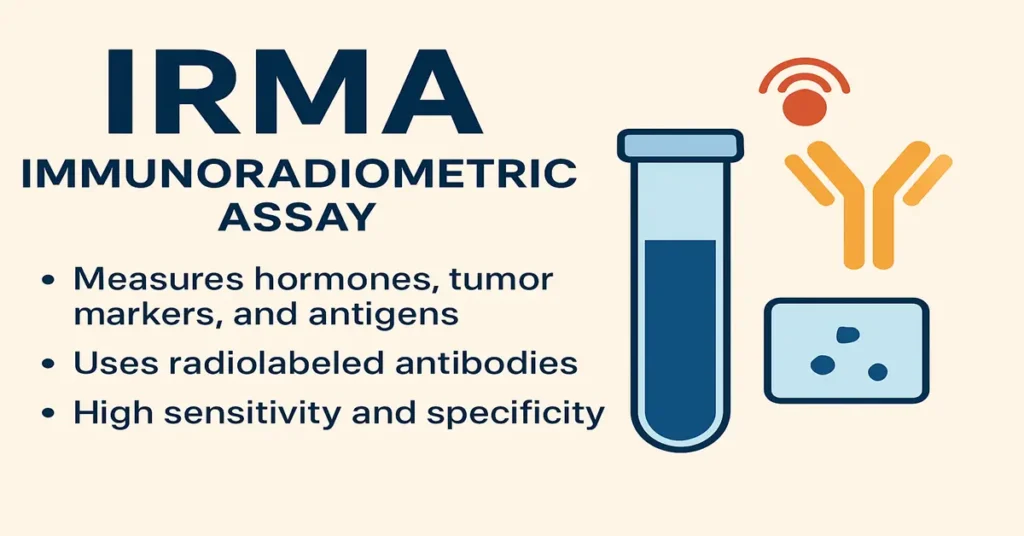
IRMA is widely used in hospital and diagnostic laboratories to measure very small concentrations of hormones, peptides, tumor markers, and related substances in blood samples. It is particularly valuable in endocrine testing, cancer marker evaluation, and fertility-related investigations. The key advantage of IRMA lies in its ability to deliver reliable results even when the substance being measured is present at extremely low levels.
What Is IRMA (Immunoradiometric Assay)?
IRMA is a laboratory immunoassay technique designed to quantify small amounts of specific substances—usually hormones or proteins—in a biological sample, most commonly blood. Like other immunoassays, it works by using antibodies that selectively bind to the target substance.
What distinguishes IRMA from older methods is the use of radiolabeled antibodies rather than radiolabeled antigens. This direct antibody-based approach improves analytical performance and reduces interference.
From a laboratory perspective, IRMA is valued because it offers high sensitivity, strong specificity, and consistent accuracy. These qualities make it especially useful when even minor changes in hormone levels have clinical significance.
How Does IRMA Work? (Simple Explanation)
The working principle of IRMA is often described as a “sandwich” technique.
A blood sample is collected and exposed to a specific antibody that recognizes the target substance. If the substance is present, it binds to this antibody. A second antibody, tagged with a radioactive marker, is then added. This second antibody attaches to another site on the same substance, forming a sandwich-like structure.
The amount of radioactivity measured corresponds directly to the quantity of the substance in the sample. Higher radioactivity indicates higher levels, while lower radioactivity reflects lower levels. This direct relationship allows for precise measurement across a wide range of concentrations.
Is IRMA Produced in the Body?
No. IRMA is not a hormone or chemical produced by the body. It is purely a laboratory testing method.
However, the substances measured using IRMA are naturally produced by different organs and tissues. These include hormones from the pituitary gland, pancreas, placenta, and other endocrine organs, as well as proteins released by normal or abnormal tissues. IRMA’s role is limited to detecting and measuring these substances accurately.
Main Importance and Benefits of IRMA
IRMA is commonly used in diagnostic laboratories because it provides dependable results in situations where precision matters most. It can detect very low concentrations of analytes, often earlier than less sensitive methods. Compared with older techniques, it offers better specificity and reduces the likelihood of misleading results.
Clinically, this helps doctors identify disorders earlier, assess disease severity more accurately, and monitor changes over time. The method also supports consistent laboratory performance when tracking hormone levels in follow-up testing.
What Conditions Is IRMA Used For?
IRMA is used for a wide range of laboratory measurements, particularly in endocrine and oncology testing. Common applications include hormones related to thyroid function, reproductive health, pituitary activity, pregnancy, and certain tumor markers. The specific tests available depend on laboratory capability and clinical demand.
Causes of Low or Negative Results
A low or negative result usually reflects reduced levels of the substance being tested, but interpretation depends on the specific hormone or marker involved.
In clinical contexts, this may be associated with reduced gland activity, underlying endocrine imbalance, chronic illness, or inherited conditions. In some cases, a low result may reflect physiological regulation rather than disease.
Laboratory-related factors can also influence results. Sample handling, reagent performance, or technical issues may occasionally produce unexpectedly low values. For this reason, doctors may request repeat testing if results do not align with the clinical picture.
Symptoms of Low/Negative Results
Symptoms are not related to IRMA itself but to the specific substance being measured. Because different hormones and proteins have different functions, the clinical features vary widely. Some results may be discovered incidentally during routine testing, while others are investigated because symptoms are already present.
Causes of High or Positive Results
A high or positive result indicates increased levels of the measured substance. This may reflect increased production by glands, hormone-secreting tumors, altered regulatory feedback, medication effects, or immune-related influences.
As with low values, the significance of a high result depends entirely on which analyte is being measured and the patient’s overall clinical context.
Symptoms of High/Positive Results
Symptoms associated with elevated results vary according to the hormone or protein involved. In some cases, elevated levels correlate with noticeable clinical features, while in others they are detected during evaluation for unrelated complaints. Doctors interpret these results alongside symptoms, physical findings, and additional laboratory data.
Reference Ranges
IRMA does not have a single reference range, as it is a testing method rather than a specific analyte. Each hormone or protein measured using IRMA has its own established reference interval. Laboratories provide these ranges with the test report, and interpretation always considers age, sex, and clinical context.
Sample Type
Most IRMA tests are performed using serum, obtained from a blood sample. In some cases, plasma or other biological fluids may be used depending on the test. Proper sample handling is important because radiolabeled antibodies are involved in the analytical process.
Test Preparation
In most cases, no special preparation is required. Some hormones may require fasting or timing considerations, and medication history is often relevant. Laboratories or doctors provide specific instructions when needed. Clear communication before testing helps ensure accurate interpretation.
When to Consult a Doctor
Medical consultation is advised whenever test results are abnormal or symptoms suggest hormonal imbalance. Changes in weight, menstrual irregularities, fertility issues, unexplained fatigue, blood sugar fluctuations, or neurological symptoms often prompt further evaluation.
Urgent assessment is needed if severe symptoms such as fainting, seizures, or sudden neurological changes occur.
Important Word Explanations
- Antigen: The substance being measured in the test
- Antibody: A protein that specifically binds to an antigen
- Radiolabeled: Marked with a small amount of radioactive material for detection
- Tumor Marker: A substance that may indicate abnormal tissue activity
- Endocrine: Related to hormone-producing glands
- Adenoma: A non-cancerous glandular tumor
~END~
Related Posts
None found
Cool Post.