
Inhibin B Test: Role, High/Low Levels, Fertility Importance & Reference Guide
What Is Inhibin B?
Inhibin B is a glycoprotein hormone involved in the fine control of reproductive function in both men and women. In everyday clinical practice, it is best understood as a feedback signal to the pituitary gland, helping regulate the release of Follicle-Stimulating Hormone (FSH). Because FSH directly influences egg development in women and sperm production in men, Inhibin B reflects how actively the ovaries or testes are functioning at a given time.
From a laboratory perspective, Inhibin B is not a stand-alone fertility answer. Instead, it serves as a practical indicator that complements clinical findings and other hormone tests. Doctors commonly use it when evaluating fertility concerns, ovarian reserve, testicular function, and certain hormone-related conditions across different age groups.
In routine practice, Inhibin B testing is considered in situations such as infertility work-ups, assessment of ovarian activity, evaluation of male reproductive health, selected tumor monitoring, and specific childhood or pubertal hormone assessments.
Where Is Inhibin B Produced in the Body?
1. In Women
In women, Inhibin B is produced by granulosa cells within developing ovarian follicles. Its levels naturally fluctuate during the menstrual cycle, rising during the early and mid-follicular phases when follicles are actively growing. After ovulation, levels fall as follicular activity decreases. This pattern explains why timing within the cycle matters when interpreting results.
2. In Men
In men, Inhibin B is produced by Sertoli cells in the testes. These cells play a central role in supporting sperm development. As a result, serum Inhibin B provides a useful laboratory signal of ongoing spermatogenic activity rather than a direct sperm count.
3. In Children
During childhood and puberty, Inhibin B participates in regulating FSH as the reproductive system matures. Measuring it can assist clinicians in understanding whether the gonads are responding appropriately for a child’s age and pubertal stage, especially when development appears early or delayed.
Main Functions and Importance of Inhibin B
1. Controls FSH Levels
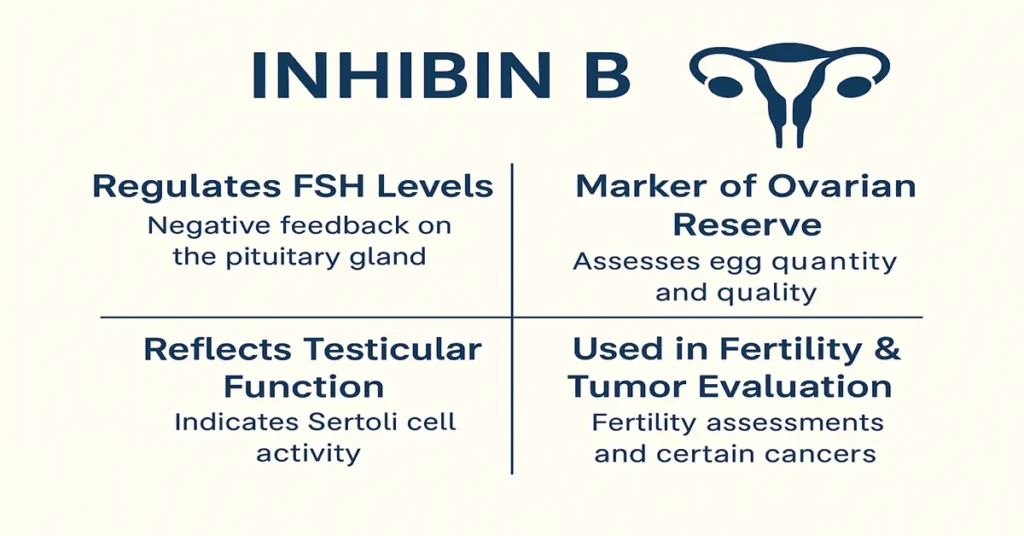
The primary physiological role of Inhibin B is to modulate FSH secretion through negative feedback on the pituitary gland. This balance helps maintain normal ovarian and testicular activity. In laboratory interpretation, changes in Inhibin B are viewed as signals of altered gonadal function rather than isolated abnormalities.
2. Marker of Ovarian Reserve (Women)
In women, Inhibin B offers insight into the functional status of ovarian follicles. Clinicians may use it to better understand ovarian activity during fertility evaluation or assisted reproduction planning. It is particularly helpful when considered alongside other markers and ultrasound findings, rather than on its own.
3. Reflects Testicular Function (Men)
In men, Inhibin B is one of the more reliable biochemical indicators of Sertoli cell activity. Lower values often parallel reduced spermatogenic output, which is why this test is frequently included in male infertility assessments as part of a broader hormonal profile.
4. Useful in Tumor Diagnosis
Certain ovarian and testicular tumors can produce Inhibin B in excess. In such cases, the test may assist doctors not only in diagnosis but also in follow-up and monitoring after treatment. In clinical settings, trends over time are often more informative than a single result.
5. Puberty Assessment in Children
In pediatric endocrinology, Inhibin B can help clarify whether pubertal development is proceeding normally. When combined with physical examination and other hormone tests, it supports decision-making in cases of early or delayed puberty.
Causes of Low Inhibin B Levels
In Women
Lower Inhibin B values generally suggest reduced follicular activity. Clinically, this may be seen in situations where ovarian function is declining or suppressed. Doctors interpret these results carefully, taking age, menstrual status, and treatment history into account.
In Men
In men, low levels often indicate reduced Sertoli cell activity and impaired spermatogenesis. This finding is commonly correlated with abnormal semen parameters, but it is always reviewed alongside other hormonal and clinical data.
In Children
In children, low Inhibin B may signal underactive gonadal function, particularly when pubertal development is delayed. Pediatric specialists use age-appropriate reference standards to avoid over-interpretation.
Symptoms of Low Inhibin B Levels
Low Inhibin B itself does not cause symptoms. Any symptoms that appear are related to the underlying reproductive or hormonal condition rather than the hormone level alone.
Women
Women may present with fertility concerns, menstrual irregularities, or changes suggestive of altered ovarian activity. These clinical features guide further evaluation beyond the laboratory report.
Men
In men, findings such as infertility or changes in sexual or reproductive health may prompt testing. Inhibin B helps provide context rather than a diagnosis by itself.
Children
In children, delayed appearance of secondary sexual characteristics or slower pubertal progression may lead clinicians to include Inhibin B in the assessment.
Causes of High Inhibin B Levels
In Women
Higher levels may be seen during phases of active follicular development. Persistently elevated values can also raise suspicion for specific ovarian conditions, particularly when supported by imaging or clinical findings.
In Men
In men, Inhibin B levels are typically stable. Significant elevation is uncommon and may prompt further investigation if clinically indicated.
In Children
In children, higher levels can reflect early activation of gonadal tissue and may be associated with early pubertal changes.
Symptoms of High Inhibin B Levels
Women
Symptoms, if present, usually relate to the underlying condition rather than the hormone itself. These may include menstrual irregularities or pelvic complaints that require clinical correlation.
Children
In children, early pubertal signs such as rapid growth or early development of secondary sexual characteristics may be observed, prompting hormonal evaluation.
Reference Ranges
Women
In women, reference values vary significantly depending on the phase of the menstrual cycle. Levels are typically higher during early and mid-follicular phases and decline after ovulation. After menopause, Inhibin B is usually very low or undetectable.
Men
In men, values remain relatively stable over time and reflect Sertoli cell function. Lower levels are commonly associated with reduced spermatogenic activity.
Children
Pediatric reference ranges depend on age and pubertal stage. Interpretation is best done by specialists familiar with developmental norms.
Sample Type
A blood sample (serum) is used for measuring Inhibin B.
Test Preparation
No fasting is required for this test. Women are usually advised to inform their doctor about the day of their menstrual cycle, as timing can influence interpretation. Men undergoing parallel fertility testing may be advised to follow standard semen test preparation guidance. It is also important to share information about ongoing hormone therapy, recent chemotherapy, radiation exposure, or reproductive treatments, as these can affect results.
When to Consult a Doctor
Medical advice should be sought when reproductive or developmental concerns arise.
Women
Consult a doctor for difficulty conceiving, irregular or absent menstrual cycles, early menopausal-type symptoms, features suggestive of hormonal imbalance, or unexplained pelvic discomfort.
Men
Men should seek evaluation for infertility, reduced sexual drive, testicular discomfort, or a history of treatments or conditions that may affect testicular function.
Children
Early or delayed puberty, unusual growth patterns, or concerns about gonadal development should be assessed by a healthcare professional.
Important Word Explanations
- FSH: A hormone that stimulates egg development in women and sperm production in men.
- Granulosa Cells: Ovarian cells that support egg maturation and hormone production.
- Sertoli Cells: Testicular cells that nourish and support developing sperm.
- Ovarian Reserve: An estimate of the remaining quantity and functional quality of eggs in the ovaries.
- Precocious Puberty: Puberty that starts earlier than the typical age range.
- Hypogonadism: Reduced functional activity of the ovaries or testes.
~END~
Related Posts
None found