
Inhibin A Test: Functions, High/Low Levels, Pregnancy Role & Clinical Importance
What Is Inhibin A?
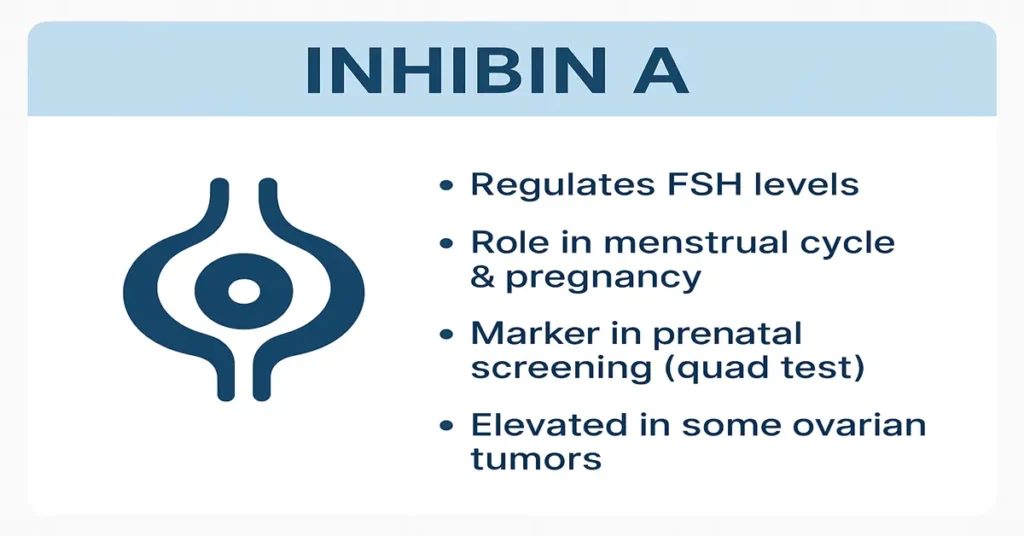
Inhibin A is a glycoprotein hormone involved in the fine control of reproductive hormones. Its main function is to regulate the release of Follicle-Stimulating Hormone (FSH) from the pituitary gland through a negative feedback mechanism. By moderating FSH levels, Inhibin A helps maintain balanced ovarian function in women and supports normal testicular activity in men.
In women, Inhibin A levels fluctuate with the menstrual cycle and increase markedly during pregnancy. Because of this predictable rise, Inhibin A is included as one of the four markers in second-trimester prenatal screening, commonly called the Quadruple Test. In this setting, it contributes to risk estimation for chromosomal conditions such as Down syndrome (Trisomy 21) and Edwards syndrome (Trisomy 18).
Outside pregnancy, Inhibin A testing is mainly used to assess certain aspects of reproductive health and to support the diagnosis and follow-up of specific ovarian tumors. The test is best understood as a supportive marker rather than a standalone diagnostic tool.
Where Is Inhibin A Produced in the Body?
In women who are not pregnant, Inhibin A is produced primarily by granulosa cells in the ovaries. These cells are closely involved in follicle development and hormone regulation during the menstrual cycle.
During pregnancy, the placenta becomes the major source of Inhibin A. Production increases as pregnancy progresses, particularly in the second trimester, which explains its role in prenatal screening programs.
In men, small amounts of Inhibin A are produced by Sertoli cells in the testes. Although circulating levels are much lower than in women, the hormone still participates in feedback control of FSH and supports normal spermatogenic function.
Main Functions and Importance of Inhibin A
Regulation of FSH
Inhibin A acts as a feedback signal to the pituitary gland, reducing FSH secretion. This balance is essential for orderly follicle development in women and efficient sperm production in men.
Role in the menstrual cycle
By influencing FSH activity, Inhibin A contributes to normal follicular maturation and hormonal balance across the cycle. Disturbances in its production can be associated with cycle irregularities, although it is rarely assessed alone.
Role during pregnancy
Placental Inhibin A supports hormonal stability during pregnancy. Its predictable pattern of rise makes it useful for screening rather than diagnosis.
Prenatal screening (Quad Screen)
In the second trimester, Inhibin A is measured alongside AFP, hCG, and unconjugated estriol. When interpreted together, these markers help estimate the statistical risk of chromosomal abnormalities. An Inhibin A value higher than expected for gestational age, particularly above about 2.0 MoM, is one of several factors associated with increased Down syndrome risk.
Tumor marker use
Inhibin A is a recognized marker for certain ovarian tumors, especially granulosa cell tumors. In this context, it may help with diagnosis, treatment monitoring, and long-term follow-up.
Causes of Low Inhibin A Levels
Outside pregnancy, low or undetectable Inhibin A levels are usually normal in both women and men.
During pregnancy, lower-than-expected values may be seen in association with conditions such as Edwards syndrome or reduced placental function. Interpretation is always done in combination with other screening markers and ultrasound findings.
In non-pregnant women, Inhibin A levels fall with declining ovarian function. This occurs in menopause, premature ovarian insufficiency, or after treatments that impair ovarian activity. Some hormonal disorders affecting follicular development may also be associated with reduced levels.
Symptoms of Low Inhibin A Levels
Low Inhibin A itself does not cause symptoms. Any clinical features arise from the underlying condition.
When related to ovarian insufficiency, symptoms may resemble those of reduced estrogen activity, such as irregular or absent periods, fertility issues, or menopausal-type complaints. During pregnancy, low values do not cause symptoms in the mother and are usually identified only through screening reports.
Causes of High Inhibin A Levels
In pregnancy, higher Inhibin A levels—particularly when expressed as elevated MoM values—are associated with an increased statistical risk of Down syndrome. This does not confirm a diagnosis and must be interpreted alongside other screening markers and gestational details.
Multiple pregnancies naturally produce higher hormone levels, including Inhibin A, and this is taken into account during result interpretation.
Outside pregnancy, elevated Inhibin A levels are most clinically relevant in ovarian tumors, especially granulosa cell tumors and some mucinous epithelial tumors. In rare cases, other gynecological malignancies may also show increased levels.
Symptoms of High Inhibin A Levels
Elevated Inhibin A does not itself produce symptoms.
During pregnancy, higher values do not cause physical complaints in the mother and are meaningful only in the context of screening.
When associated with ovarian tumors, symptoms depend on tumor size and location and may include pelvic discomfort, abdominal bloating, early fullness after meals, or changes in menstrual bleeding. These features are related to the underlying condition rather than the hormone level alone.
Reference Ranges
In non-pregnant women and in men, Inhibin A levels are typically very low or undetectable.
During pregnancy, results are reported as MoM (Multiples of the Median), which adjusts for gestational age and other factors. A value around 1.0 MoM is considered typical. Values above approximately 2.0 MoM are regarded as higher risk for Down syndrome within screening protocols.
Exact reference ranges vary by laboratory, gestational age, and maternal factors, so results are always interpreted within the full prenatal screening context.
Sample Type
The test requires a blood sample, usually serum. No special collection tubes are needed.
Test Preparation
No fasting is required. Accurate gestational age is essential during pregnancy, as MoM calculations depend on it.
Patients should inform their doctor about multiple pregnancies, assisted reproduction techniques, or use of hormonal medications, as these may influence interpretation. When used for tumor monitoring, timing of repeat tests should follow clinical guidance.
When to Consult a Doctor
Medical advice is appropriate if prenatal screening results are reported as abnormal, if there are persistent menstrual irregularities, or if symptoms suggestive of ovarian pathology are present. Individuals with known ovarian tumors should follow recommended monitoring schedules.
Pregnant patients with concerns about screening results should discuss them with their obstetrician or genetic counselor for appropriate interpretation and next steps.
Important Word Explanations
- FSH – A hormone that stimulates ovarian follicle development and sperm production.
- MoM (Multiples of the Median) – A standardized way of comparing a test value to the expected median for a specific gestational age.
- Granulosa cells – Ovarian cells involved in estrogen and Inhibin A production.
- Quadruple Test – A second-trimester screening test combining four biochemical markers.
- Chromosomal abnormalities – Conditions caused by changes in chromosome number, such as Down syndrome or Edwards syndrome.
~END~
Related Posts
None found
Great info.