
What is the Indirect Coombs Test (IAT)?
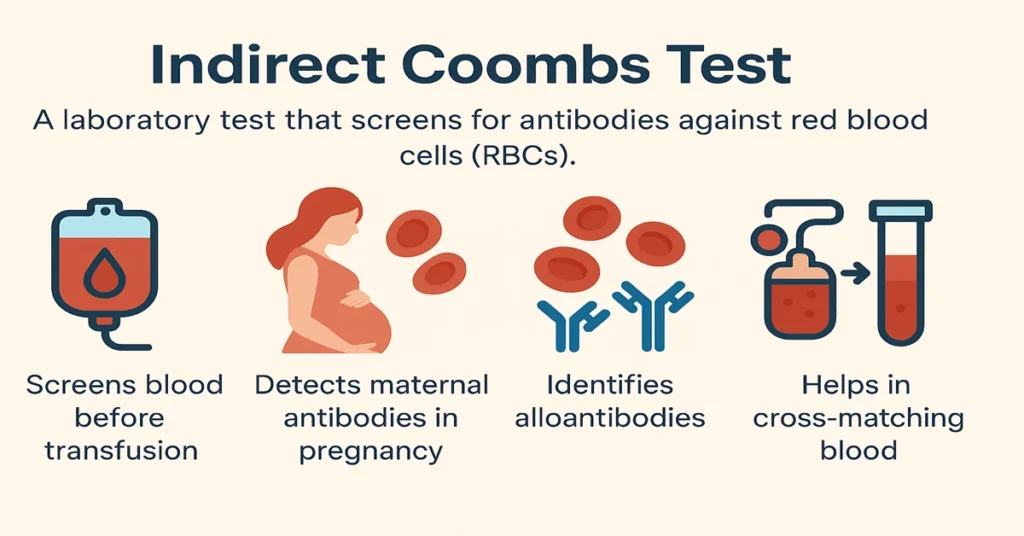
The Indirect Coombs Test, also known as the Indirect Antiglobulin Test (IAT), is a blood test used to detect antibodies that are freely circulating in the blood and have the potential to react with red blood cells.
In routine clinical settings, this test helps doctors assess whether a person has developed antibodies that could react against red blood cells if exposure occurs. This situation commonly arises during blood transfusions or pregnancy. Unlike the Direct Coombs Test, which looks for antibodies already attached to red blood cells, the Indirect Coombs Test focuses on antibodies that are still unbound but may cause problems under the right conditions.
Because of this, the test is widely used in blood compatibility testing and in monitoring pregnancies where blood group incompatibility is a concern.
Where It Is Synthesized or Produced in the Body
The Indirect Coombs Test itself is a laboratory procedure and is not produced by the body.
The antibodies detected by this test are made by the immune system. They are usually produced by B lymphocytes and plasma cells and circulate freely in the blood plasma. From a laboratory viewpoint, these antibodies often develop after exposure to foreign red blood cell antigens, such as during a previous blood transfusion or pregnancy. In some cases, they may also appear as part of broader immune responses.
The test simply identifies their presence; it does not determine when or exactly why they were formed.
Main Functions and Importance of the Indirect Coombs Test
The Indirect Coombs Test has a preventive role in clinical medicine. Its primary value lies in identifying potential immune risks before red blood cell destruction occurs.
In transfusion medicine, it is routinely used to screen patients for unexpected antibodies that could react with donor blood. In obstetric care, it helps detect maternal antibodies that may cross the placenta and affect a newborn’s red blood cells. The test is also part of cross-matching procedures, ensuring compatibility between donor and recipient blood.
From a clinical perspective, the IAT allows doctors and laboratory professionals to anticipate immune reactions and plan care more safely, especially in high-risk situations such as repeated transfusions or pregnancy with known blood group differences.
Causes of Low or Negative Levels
A negative Indirect Coombs Test means that no red blood cell–reactive antibodies are detected in the blood at the time of testing.
This is considered a normal and reassuring finding. It usually indicates that the immune system has not been sensitized against foreign red blood cell antigens. Such results are commonly seen in individuals with no prior incompatible transfusions and in pregnancies where no maternal sensitization has occurred.
Clinically, a negative result supports safe transfusion practices and low risk of immune-related complications.
Symptoms of Low or Negative Levels
There are no symptoms associated with a negative Indirect Coombs Test result. The finding simply reflects the absence of circulating antibodies that could target red blood cells.
When this result is seen, doctors generally focus on other clinical factors rather than immune-related red blood cell reactions.
Causes of High or Positive Levels
A positive Indirect Coombs Test indicates that antibodies capable of reacting with red blood cells are present in the bloodstream.
In practice, this is most often related to previous exposure to foreign red blood cell antigens, such as through earlier blood transfusions or pregnancy. In some patients, immune or autoimmune conditions may also be associated with antibody formation. Less commonly, sensitization may occur following organ transplantation or other immune-altering events.
A positive result does not by itself confirm active red blood cell destruction. Instead, it signals the need for careful interpretation and further laboratory evaluation, especially before transfusion or during pregnancy.
Symptoms of High or Positive Levels
The Indirect Coombs Test does not cause symptoms. Any symptoms arise only if the detected antibodies later react with red blood cells.
In newborns, this reaction may present as anemia or jaundice. During blood transfusion, immune reactions may lead to signs such as fever, chills, or dark-colored urine. In other settings, general features related to anemia may be observed if red blood cell destruction occurs.
Clinicians often use the IAT proactively to reduce the risk of these situations rather than waiting for symptoms to develop.
Reference Ranges
The Indirect Coombs Test is reported as negative or positive.
A negative result indicates that no free red blood cell antibodies are detected.
A positive result confirms the presence of antibodies and highlights potential risk, prompting additional testing or precautions.
Importantly, a positive result reflects immune sensitization rather than an active disease state on its own.
Sample Type and Test Procedure
The test is performed on a blood sample, usually serum or plasma collected from a vein in the arm.
In the laboratory, the patient’s serum is mixed with red blood cells that carry known antigens. If antibodies are present, they bind to these cells. When the Coombs reagent is added, visible clumping occurs, confirming a positive reaction. This controlled laboratory process allows accurate detection of antibodies that may not yet be causing symptoms.
Test Preparation
No fasting or special dietary preparation is required for this test.
Patients are usually advised to inform their doctor about any previous blood transfusions, pregnancies, or transplant history, as these details help with result interpretation. In pregnancy, the test is commonly performed at specific stages to monitor immune sensitization, depending on clinical protocols.
When to Consult a Doctor
Medical consultation is important if the test is performed during pregnancy, before blood transfusion, or when there is a known history of immune-related blood reactions. A doctor should also be consulted if unexpected symptoms develop after transfusion or if anemia is present without a clear explanation.
The Indirect Coombs Test supports early identification of immune risks and helps clinicians plan care safely and appropriately.
Important Word Explanations
- Antibody: A protein produced by the immune system that reacts with specific targets.
- Alloantibody: An antibody formed against red blood cell antigens from another person.
- Hemolytic Disease of the Newborn (HDN): A condition where maternal antibodies damage fetal red blood cells.
- Rh Factor: A protein on red blood cells that determines whether blood is Rh-positive or Rh-negative.
- Agglutination: The visible clumping of red blood cells caused by antibody binding.
~END~
Related Posts
None found