
India Ink Preparation Test: Purpose, Results, Cryptococcus Detection & Complete Medical Guide
Overview
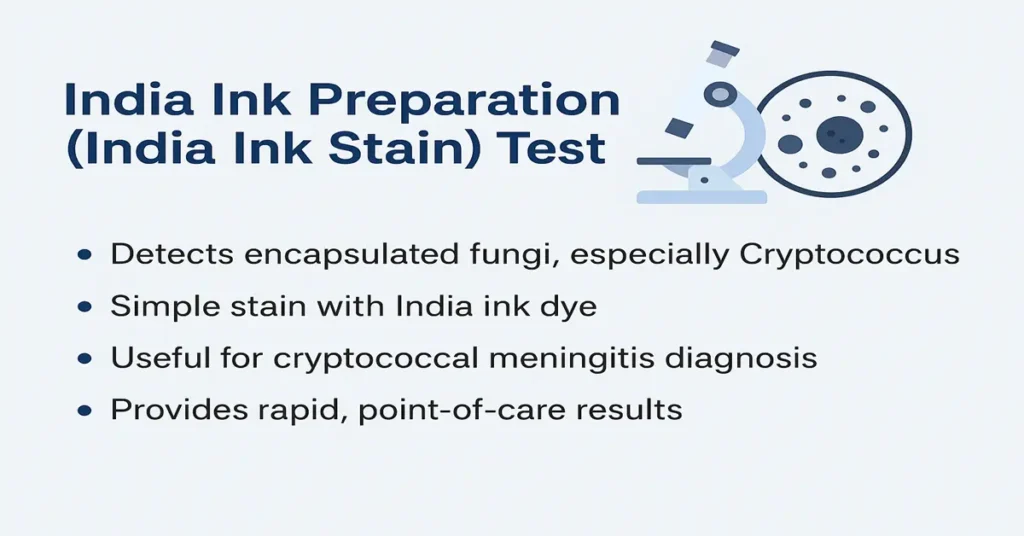
India Ink Preparation, also called the India Ink Stain, is a rapid microscopic test used to look for encapsulated fungi, most notably Cryptococcus neoformans and Cryptococcus gattii. These organisms are known to cause serious infections, especially cryptococcal meningitis, a condition that most often affects people with weakened immune systems.
The test uses India ink, a dark, carbon-based stain. When a clinical sample is mixed with this ink and viewed under a microscope, the background appears dark. The thick capsule surrounding Cryptococcus does not absorb the stain, so the organism appears as a clear, round halo around the yeast cell. This visual pattern is considered a classic and easily recognizable finding.
From a laboratory perspective, India Ink Preparation is valued for its speed. Results are available within minutes, which makes it useful when quick decisions are needed in emergency or critical care settings.
Where the Fungal Capsule Is Produced in the Body
India ink itself is purely a laboratory reagent and has no role in the human body.
The test highlights the capsule produced by the Cryptococcus fungus once it infects the body. This capsule forms as the organism grows, most commonly in:
- The lungs, where infection often begins after inhalation
- The brain and spinal cord during meningitis
- The bloodstream in advanced or disseminated disease
The capsule acts as a protective layer for the fungus, helping it evade immune defenses. This same feature makes it clearly visible with India ink staining.
Main Functions and Importance of India Ink Preparation
India Ink Preparation remains one of the fastest methods for identifying Cryptococcus in clinical samples.
It is particularly useful because it can directly demonstrate encapsulated yeast cells, a feature that strongly points toward Cryptococcus infection. In suspected meningitis, this rapid visualization can support early diagnosis while more advanced tests are being arranged.
The test is especially important in people with compromised immunity, such as those living with HIV, transplant recipients, cancer patients on chemotherapy, or individuals using long-term steroids. In these groups, cryptococcal infection can progress quickly and be life-threatening.
Another advantage is practicality. India ink staining is inexpensive, technically simple, and does not require advanced equipment. For this reason, it remains valuable in low-resource settings, smaller hospitals, and rural laboratories.
Although cerebrospinal fluid (CSF) is the most common sample, the stain can also be applied to other body fluids when disseminated infection is suspected.
Causes of Low / Negative India Ink Results
A negative India ink result means no encapsulated yeast cells were seen under the microscope. In many cases, this simply indicates that Cryptococcus infection is not present.
However, there are situations where the test may appear negative despite infection. Early disease may involve very few organisms, making them difficult to detect. Prior antifungal treatment can reduce the fungal load, and poor sample quality or technical limitations can also affect visibility.
From a laboratory standpoint, a negative result does not always fully exclude cryptococcal disease, especially if clinical suspicion remains high.
Symptoms When the Result Is Negative
If the result is truly negative, there is no cryptococcal infection to explain symptoms.
If the result is falsely negative, patients may still have features such as headache, fever, neck stiffness, nausea, confusion, or sensitivity to light. In these situations, doctors usually rely on more sensitive methods, such as cryptococcal antigen testing, to clarify the diagnosis.
Causes of High / Positive India Ink Results
A positive India ink preparation means encapsulated yeast cells are present, most commonly indicating Cryptococcus infection.
This finding is strongly associated with cryptococcal meningitis when CSF is examined. In some patients, especially those with advanced immune suppression, the infection may spread beyond the central nervous system into the blood, lungs, skin, or other organs.
Although rare, a few other organisms may occasionally resemble this appearance, but in routine practice a positive India ink stain is considered highly suggestive of Cryptococcus.
Symptoms When the Test Is Positive
Symptoms depend on the site and severity of infection.
In cryptococcal meningitis, patients often develop persistent or severe headache, fever, neck stiffness, nausea, vomiting, sensitivity to light, confusion, or altered behavior. In advanced cases, seizures, excessive drowsiness, or coma may occur.
When the lungs are involved, symptoms may include cough, fever, chest discomfort, or shortness of breath. In immunocompromised individuals, disease progression can be rapid and multisystem involvement may occur.
Reference Ranges
India Ink Preparation does not produce numerical values. Results are based on direct microscopic observation.
A normal (negative) result shows no encapsulated yeast cells. An abnormal (positive) result shows round yeast cells surrounded by a clear halo against the dark background. This halo represents the fungal capsule that repels the ink.
Sample Type
The most common and important sample for India ink staining is cerebrospinal fluid, especially when meningitis is suspected.
Depending on the clinical situation, other samples such as blood, urine, sputum, pleural fluid, or synovial fluid may also be examined, particularly in disseminated disease.
Test Preparation
India ink testing itself does not require special preparation.
Patients do not need to fast. Doctors should be informed about current or recent antifungal therapy, as this can influence results.
If CSF collection is planned, it is done through lumbar puncture. Patients may be advised about temporary medication adjustments, staying still during the procedure, and post-procedure care.
When to Consult a Doctor
Immediate medical attention is needed for symptoms such as severe or worsening headache, high fever, neck stiffness, confusion, seizures, or marked sensitivity to light.
People with weakened immunity should seek medical evaluation even for mild or early symptoms, as cryptococcal infections can progress quickly and become life-threatening without timely care.
Important Word Explanations
- Cryptococcus – A fungus that commonly affects the lungs and brain, especially in immunocompromised individuals.
- Encapsulated – Covered by a thick protective layer that helps the organism evade immune defenses.
- Halo – The clear ring seen around yeast cells in India ink staining.
- CSF (Cerebrospinal Fluid) – Fluid surrounding the brain and spinal cord.
- CNS (Central Nervous System) – The brain and spinal cord.
- Disseminated – Infection that has spread to multiple organs.
- False negative – A test result that appears negative even though infection is present.
~END~
Related Posts
None found