
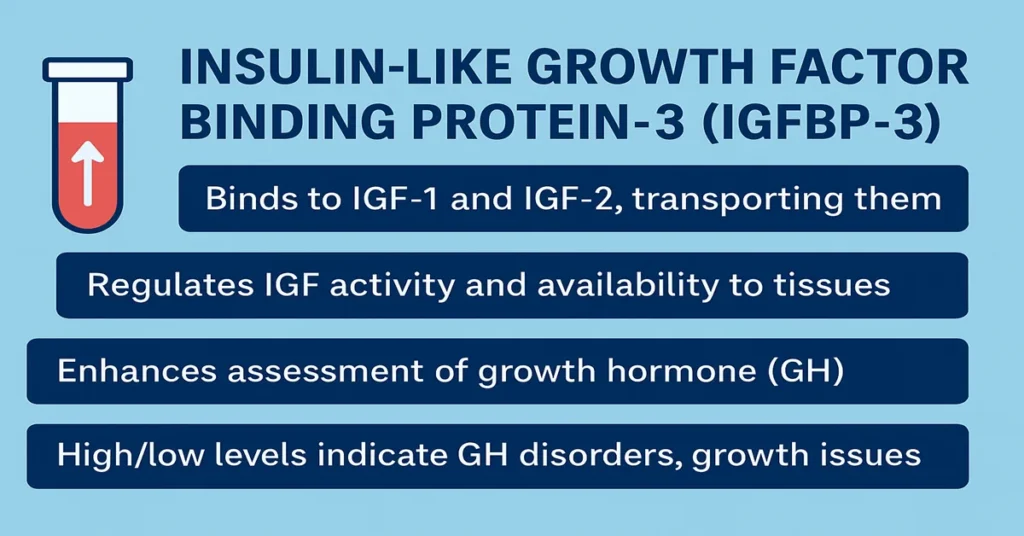
What is Insulin-Like Growth Factor Binding Protein-3 (IGFBP-3)?
Insulin-Like Growth Factor Binding Protein-3 (IGFBP-3) is the principal transport protein for Insulin-Like Growth Factors, mainly IGF-1 and IGF-2. In circulation, nearly 80% of IGFs are bound to IGFBP-3, which allows these growth factors to remain stable and available for controlled release to body tissues.
In the bloodstream, IGFBP-3 forms a well-regulated three-component complex consisting of IGF-1 or IGF-2, IGFBP-3 itself, and the Acid-Labile Subunit (ALS). This complex protects IGFs from rapid breakdown and ensures that their biological effects occur in a balanced and regulated manner.
From a clinical perspective, IGFBP-3 provides valuable information about long-term growth hormone activity, particularly when interpreted together with IGF-1. Because growth hormone is released in pulses, IGFBP-3 helps give a more stable reflection of hormonal status.
Doctors commonly evaluate IGFBP-3 alongside IGF-1 when assessing:
- Suspected growth hormone deficiency
- Growth hormone excess such as acromegaly or gigantism
- Abnormal timing of puberty
- Certain metabolic or endocrine conditions
- Chronic illnesses affecting nutrition or liver function
Rather than being interpreted alone, IGFBP-3 is used as part of an integrated hormonal assessment.
Where is IGFBP-3 Produced in the Body?
IGFBP-3 is produced in several tissues, with the liver serving as the main source of circulating IGFBP-3.
1. Liver – Main production site
The liver produces most IGFBP-3 in response to signals from growth hormone. This liver-derived IGFBP-3 accounts for the majority of what is measured in blood tests.
2. Other tissues
Smaller amounts of IGFBP-3 are produced in tissues such as the kidneys, immune cells, bones, and muscles. These locally produced amounts support tissue-specific functions, but they contribute less to circulating levels seen in laboratory testing.
Main Functions and Importance of IGFBP-3
1. Transports IGF-1 and IGF-2
IGFBP-3 binds IGF-1 and IGF-2 in the bloodstream, protecting them from rapid degradation. This binding significantly increases the stability and lifespan of these growth factors in circulation.
2. Controls IGF Release to Tissues
Clinically, IGFBP-3 acts as a regulator rather than a simple carrier. By controlling how much IGF is released to tissues, it helps prevent excessive or insufficient growth factor activity.
3. Supports Growth and Development
Through its stabilizing effect on IGFs, IGFBP-3 indirectly supports normal bone growth, muscle development, tissue repair, and cellular maturation. These effects are gradual and tightly regulated rather than sudden or excessive.
4. Improves Growth Hormone (GH) Evaluation
When doctors measure IGF-1 together with IGFBP-3, diagnostic accuracy improves. This combined approach is particularly helpful when evaluating suspected growth hormone deficiency or excess, especially in children where growth patterns are closely monitored.
5. IGF-Independent Functions
Beyond its role as a carrier protein, IGFBP-3 also has direct biological effects. These include participation in regulated cell turnover, immune system modulation, and maintenance of normal cell growth. These additional roles explain why IGFBP-3 is relevant in a broader range of endocrine and metabolic evaluations.
Causes of Low IGFBP-3 Levels
Low IGFBP-3 levels generally reflect reduced growth hormone activity or underlying systemic conditions rather than a primary disorder of the protein itself.
1. Growth Hormone Deficiency
Because growth hormone directly stimulates IGFBP-3 production, reduced GH activity commonly leads to lower IGFBP-3 levels.
2. Malnutrition or Chronic Illness
Long-term illness, inadequate nutrition, or catabolic states can lower IGFBP-3 production, as the body shifts focus from growth to essential survival processes.
3. Liver Disorders
Since the liver produces most circulating IGFBP-3, chronic liver disease can significantly affect measured levels.
4. Hypothyroidism
Reduced thyroid hormone activity may indirectly lower IGFBP-3 by slowing metabolic and growth-related processes.
5. Natural Aging
IGFBP-3 levels decline gradually with age. This change is expected and interpreted differently from disease-related reductions.
Symptoms of Low IGFBP-3 Levels
Symptoms associated with low IGFBP-3 usually arise from the underlying hormonal or systemic condition, not from the protein level itself.
In children, doctors may observe slower growth rates, delayed puberty, or reduced energy over time.
In adults, low levels may accompany features of growth hormone deficiency, such as reduced muscle mass or increased fatigue.
When low IGFBP-3 is linked to chronic illness or liver disease, symptoms reflect the primary condition rather than the laboratory value alone.
Causes of High IGFBP-3 Levels
Elevated IGFBP-3 levels typically indicate increased growth hormone activity.
1. Growth Hormone Excess
Conditions involving prolonged GH overproduction commonly show increased IGFBP-3 levels.
2. High IGF-1 Levels
IGFBP-3 and IGF-1 often rise together, particularly in states of GH excess.
3. Puberty
During puberty, natural increases in growth hormone lead to higher IGFBP-3 levels as part of normal development.
4. Pregnancy
Hormonal changes during pregnancy may cause mild, temporary increases.
5. Rare Tumors
In uncommon cases, tumors affecting GH or IGF pathways may influence IGFBP-3 levels.
Symptoms of High IGFBP-3 Levels
Symptoms associated with high IGFBP-3 generally reflect excess growth hormone activity.
In children, this may present as unusually rapid height gain and overall skeletal growth.
In adults, long-standing elevation can be associated with gradual enlargement of bones and soft tissues, often developing over years rather than suddenly.
When pituitary tumors are involved, symptoms such as headaches or vision disturbances are usually related to pressure effects rather than hormone levels alone.
Reference Ranges
IGFBP-3 reference ranges vary by age and sex.
Approximate examples include:
- Children (8–12 years): 2.5 – 6.0 mg/L
- Adults (20–40 years): 3.0 – 7.0 mg/L
- Older adults (>60 years): 2.0 – 4.0 mg/L
Final interpretation should always use the reference ranges provided by the testing laboratory.
Sample Type
The test is performed using a blood (serum) sample.
Fasting is generally not required.
Test Preparation
In most cases, no special preparation is needed. Doctors may still consider thyroid status, liver function, nutritional health, and any ongoing hormone therapy when interpreting results. In children, growth patterns and pubertal stage are important contextual factors.
When to Consult a Doctor
Medical evaluation is recommended when growth patterns or physical changes appear inconsistent with age expectations.
In children, this includes slow or excessively rapid growth, delayed or early puberty, or deviation from expected growth charts.
In adults, symptoms such as unexplained fatigue, changes in hand or facial features, joint stiffness, or difficulty fitting rings or shoes may prompt evaluation.
Anyone with known liver disease, thyroid disorders, or symptoms suggesting pituitary involvement should seek specialist assessment for proper interpretation of results.
Important Word Explanations
- IGF-1 / IGF-2: Growth-related hormones regulated by growth hormone
- ALS: Acid-labile subunit that stabilizes the IGF–IGFBP-3 complex
- Acromegaly: Growth hormone excess occurring in adults
- Gigantism: Growth hormone excess before growth plate closure in children
- GH Deficiency: Reduced growth hormone activity affecting growth and metabolism
- Carrier Protein: A protein that transports hormones in the bloodstream
~END~
Related Posts
None found