
Overview
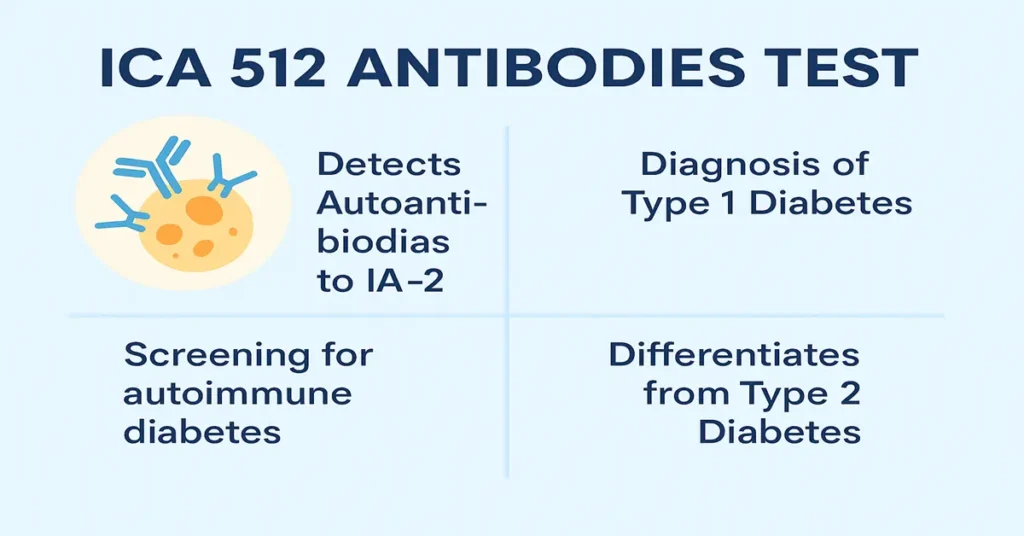
Diabetes is a common condition, but its underlying causes can vary significantly from person to person. Type 1 Diabetes is an autoimmune disorder, meaning the immune system mistakenly attacks the insulin-producing cells of the pancreas. Identifying this autoimmune activity is an important part of diagnosis and long-term management. One laboratory test used for this purpose is the ICA 512 Antibodies Test, also known as the IA-2 Antibodies Test or Islet Cell Antigen 512 Antibodies Test.
This test helps doctors determine whether immune-mediated damage to the pancreas is occurring. It is particularly useful when the type of diabetes is unclear or when distinguishing between Type 1 Diabetes, Type 2 Diabetes, and other autoimmune-related forms of diabetes. Rather than measuring blood sugar directly, the test provides insight into the immune process behind the disease.
What Is the ICA 512 Antibodies Test?
The ICA 512 Antibodies Test detects autoantibodies directed against a protein known as IA-2, which is present in the insulin-producing beta cells of the pancreas. Under normal conditions, these antibodies are not found in the bloodstream. Their presence indicates that the immune system is targeting pancreatic tissue.
Clinically, this test is used to support the diagnosis of autoimmune diabetes and to assess immune involvement in people with abnormal blood sugar levels. It is commonly included in broader antibody panels when doctors are evaluating suspected Type 1 Diabetes or related conditions.
In simple terms, the test looks for immune markers that suggest the pancreas is being attacked, rather than measuring insulin or glucose levels themselves.
Where Are ICA 512 Antibodies Produced?
In a healthy immune system, ICA 512 antibodies are not produced. They appear only when immune regulation is disrupted and the body begins to misidentify its own pancreatic cells as harmful.
In this setting, immune cells produce these antibodies as part of an autoimmune response. The antibodies themselves do not serve a protective role; instead, they act as indicators that immune-mediated damage is occurring within the pancreas.
Why Is This Test Important? (Main Uses)
Although ICA 512 antibodies do not have a biological function, detecting them is clinically valuable. The test helps doctors understand the mechanism behind diabetes rather than focusing only on blood sugar levels.
It supports the diagnosis of Type 1 Diabetes by confirming autoimmune involvement. It can also identify individuals who may be at higher risk before significant insulin deficiency develops. In adults, the test is particularly helpful when diabetes does not fit the typical pattern of Type 2 Diabetes and autoimmune causes are suspected.
In addition, the presence of these antibodies may prompt clinicians to consider screening for other autoimmune conditions, as autoimmune disorders often occur together.
Causes of Low or Negative Levels
A negative ICA 512 antibody result is common and usually indicates the absence of autoimmune activity against pancreatic beta cells.
This finding is typical in healthy individuals and in people with Type 2 Diabetes, where insulin resistance—not immune destruction—is the primary problem. In some individuals with long-standing Type 1 Diabetes, antibody levels may decline over time, leading to a negative result despite established disease.
Symptoms of Low/Negative Levels
There are no symptoms directly related to low or absent ICA 512 antibodies. The antibodies themselves do not cause symptoms.
When diabetes is present with a negative antibody test, the clinical picture often aligns more closely with non-autoimmune diabetes. Symptoms, if present, reflect blood sugar imbalance rather than immune activity.
Causes of High or Positive Levels
A positive ICA 512 antibody result indicates autoimmune activity directed at pancreatic beta cells. This finding is most commonly associated with Type 1 Diabetes, particularly in its early stages.
Positive results may also be seen in Latent Autoimmune Diabetes in Adults (LADA), a form of autoimmune diabetes that develops more gradually. In some cases, ICA 512 antibodies coexist with other autoimmune disorders, reflecting broader immune system involvement.
Symptoms Linked to High/Positive Levels
The antibodies themselves do not produce symptoms. Instead, they are associated with the gradual loss of insulin-producing cells.
As insulin levels decline, individuals may develop symptoms related to rising blood glucose, such as increased thirst, frequent urination, unexplained weight loss, fatigue, or blurred vision. These symptoms reflect insulin deficiency rather than the antibody presence itself.
Reference Ranges
Results are typically reported qualitatively:
- Negative: ICA 512 antibodies not detected
- Positive: ICA 512 antibodies detected, indicating autoimmune activity
Some laboratories may report numerical values, but interpretation depends on the laboratory method used. Results are always assessed alongside clinical findings and other diabetes-related tests.
Sample Type
The test requires a blood (serum) sample.
It is usually performed in specialized laboratories with expertise in autoimmune antibody testing.
Test Preparation
No fasting or special preparation is usually required for this test.
Doctors may consider medication history, existing autoimmune conditions, and family history when interpreting results. If additional diabetes-related tests are ordered at the same time, specific instructions may be provided by the laboratory.
When to Consult a Doctor
Medical consultation is recommended if symptoms suggest diabetes or if blood sugar levels are abnormal without a clear explanation. The test is particularly useful when diabetes develops at a young age, appears unexpectedly, or behaves differently from typical Type 2 Diabetes.
Individuals with a family history of autoimmune disease or known autoimmune conditions should seek evaluation if symptoms related to blood sugar imbalance appear.
Urgent medical attention is necessary if symptoms such as severe dehydration, vomiting, confusion, rapid breathing, or fainting occur, as these may indicate serious metabolic complications.
Important Word Explanations
- Autoantibodies: Antibodies that mistakenly attack the body’s own tissues
- Beta Cells: Pancreatic cells responsible for insulin production
- Autoimmune: A condition in which the immune system targets the body’s own cells
- LADA: A slowly progressive form of autoimmune diabetes in adults
- Pancreas: The organ that produces insulin and digestive enzymes
- Antigen: A substance recognized and targeted by antibodies
~END~
Related Posts
None found