
Overview
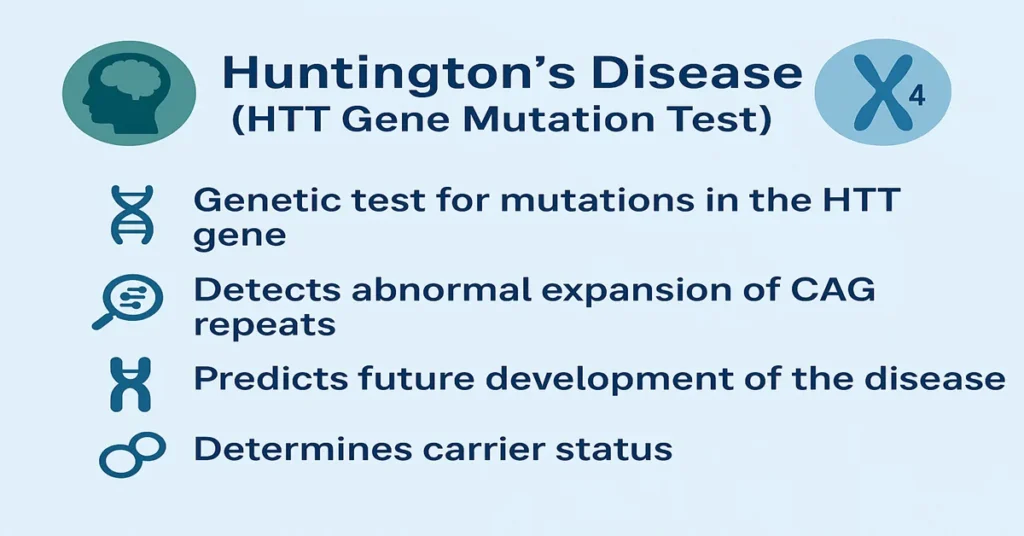
The Huntington’s Disease (HTT Gene Mutation Test) is a specialized genetic test used to identify abnormal changes in the HTT gene, located on chromosome 4. This gene contains a repeating DNA sequence known as CAG repeats. In the general population, this sequence appears within a stable and limited range. In Huntington’s disease, however, the number of repeats becomes abnormally expanded.
When the CAG repeat count exceeds the normal range, it leads to the production of an altered huntingtin protein that gradually damages brain cells. Over time, this results in characteristic movement disturbances, changes in behavior and mood, and progressive cognitive decline. Huntington’s disease follows an autosomal dominant inheritance pattern, meaning that a single altered copy of the gene is sufficient to cause the condition.
The HTT Gene Mutation Test is used for confirming a diagnosis in symptomatic individuals, identifying people who may develop the disease later in life, and assessing genetic risk within affected families. It is also used in prenatal and preimplantation settings when families wish to understand the risk of transmission to future generations.
Understanding the HTT Gene
The HTT gene provides instructions for producing the huntingtin protein, a protein that is widely expressed throughout the body. Its role is especially critical in the brain, where it supports the function and survival of nerve cells.
Where huntingtin protein is produced
Huntingtin protein is produced inside neurons across multiple brain regions. It is particularly important in areas such as the basal ganglia and cerebral cortex, which are involved in movement control, emotional regulation, and higher cognitive processes. Although the protein is also present in other tissues, its impact is most evident in the nervous system.
When the HTT gene contains an expanded CAG repeat, the resulting huntingtin protein becomes structurally abnormal. This altered protein gradually accumulates within neurons, interfering with normal cellular processes and leading to slow, irreversible neuronal damage.
Main Functions and Importance of Huntingtin Protein
While research continues to refine our understanding, several core roles of the huntingtin protein are well recognized.
It supports normal brain development, particularly during early life. It also plays a protective role in neuron survival, helping nerve cells cope with metabolic and environmental stress. Within neurons, huntingtin is involved in intracellular transport, assisting with the movement of essential molecules and signals along nerve pathways. In addition, it influences the regulation of multiple genes that are necessary for maintaining normal brain function.
Disruption of these processes by the abnormal protein explains the gradual and progressive nature of Huntington’s disease.
Why the Test is Important
The HTT gene mutation test plays a central role in clinical and family care. It is used to confirm the diagnosis when clinical features suggest Huntington’s disease and to provide predictive information for adults with a known family history. It is also relevant for individuals planning a family who wish to understand inherited risk.
Beyond diagnosis, the test allows for accurate genetic counseling. It helps individuals and families plan medical follow-up, personal decisions, and long-term care with clearer expectations and fewer uncertainties.
Causes of Low / Negative Levels (Normal Result)
A negative or normal result indicates that the CAG repeat count in the HTT gene is 26 or fewer repeats. This finding means there is no disease-causing expansion present.
Individuals with repeat counts in this range are not at risk of developing Huntington’s disease and will not pass a pathogenic expansion to their children. The HTT gene functions normally in this range.
Symptoms or Effects of Low / Normal Levels
When the test result is normal, there are no Huntington’s-related effects to expect. Individuals do not develop the movement, cognitive, or behavioral features associated with the disease, and there is no increased genetic risk to offspring from this person.
For many families, a normal result provides reassurance and brings clarity after years of uncertainty.
Causes of High / Positive Levels (Abnormal Result)
A positive result indicates that the CAG repeat count is expanded beyond the normal range. Interpretation depends on the number of repeats identified.
Repeat counts between 27 and 35 are considered intermediate. Individuals in this range do not develop Huntington’s disease themselves, but the repeat size may expand when passed to the next generation.
Counts between 36 and 39 fall into the reduced-penetrance range. Some individuals develop symptoms later in life, while others may remain asymptomatic.
A count of 40 or more repeats represents a full mutation. Individuals in this range will develop Huntington’s disease at some point in their lifetime. In general, higher repeat numbers are associated with earlier onset, although the test cannot predict exact timing or severity with certainty.
Symptoms of High / Positive Levels
Symptoms typically appear in adulthood, most often between 30 and 50 years of age, though onset can be earlier or later.
Movement-related changes are often the first signs, including involuntary jerking movements, muscle stiffness, coordination problems, and difficulties with speech or swallowing. Cognitive changes may follow, such as slowed thinking, memory difficulties, reduced organizational ability, and impaired judgment. Over time, these changes can progress to significant cognitive impairment.
Behavioral and psychiatric features are also common. These may include mood changes, depression, anxiety, irritability, impulsivity, or loss of motivation. In advanced stages, more severe behavioral disturbances may occur. Symptoms progress gradually over many years and eventually require increasing levels of support.
Reference Ranges
CAG repeat counts are interpreted using internationally accepted standards:
- ≤ 26: Normal / Negative
- 27–35: Intermediate (no disease, possible transmission risk)
- 36–39: Reduced penetrance (variable expression)
- ≥ 40: Positive (disease-causing mutation present)
These ranges are consistent across accredited genetic laboratories worldwide.
Sample Type and Testing Method
The test is performed on a blood sample. DNA is extracted from white blood cells and analyzed using techniques such as polymerase chain reaction (PCR) and fragment analysis. These methods allow precise counting of CAG repeats within the HTT gene.
Test Preparation
No fasting or special physical preparation is required. Because of the genetic and psychological implications of the test, genetic counseling is strongly recommended both before and after testing. Providing a detailed family history can be helpful during interpretation.
When to Consult a Doctor
Consultation with a neurologist or genetic counselor is recommended if there is a known family history of Huntington’s disease, if early neurological or behavioral symptoms are noticed, or if genetic risk assessment is needed before pregnancy planning. Support from healthcare professionals is especially important after receiving test results, as the information can have significant emotional and practical implications.
Important Word Explanations
- CAG Repeats – A repeating DNA sequence in the HTT gene; excessive repetition causes disease
- Autosomal Dominant – A single altered gene copy is enough to cause disease
- Chorea – Involuntary, irregular, dance-like movements
- Basal Ganglia – Brain structures involved in movement control
- Penetrance – The likelihood that a genetic change will produce symptoms
- Prenatal Testing – Genetic testing performed during pregnancy
~END~
Related Posts
None found